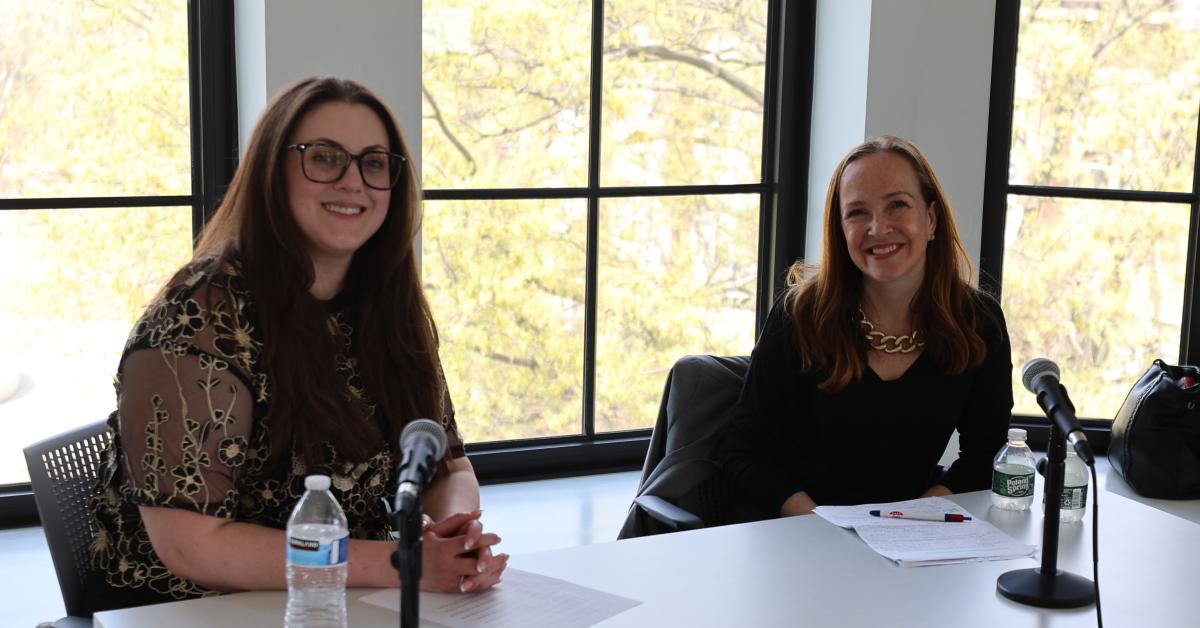

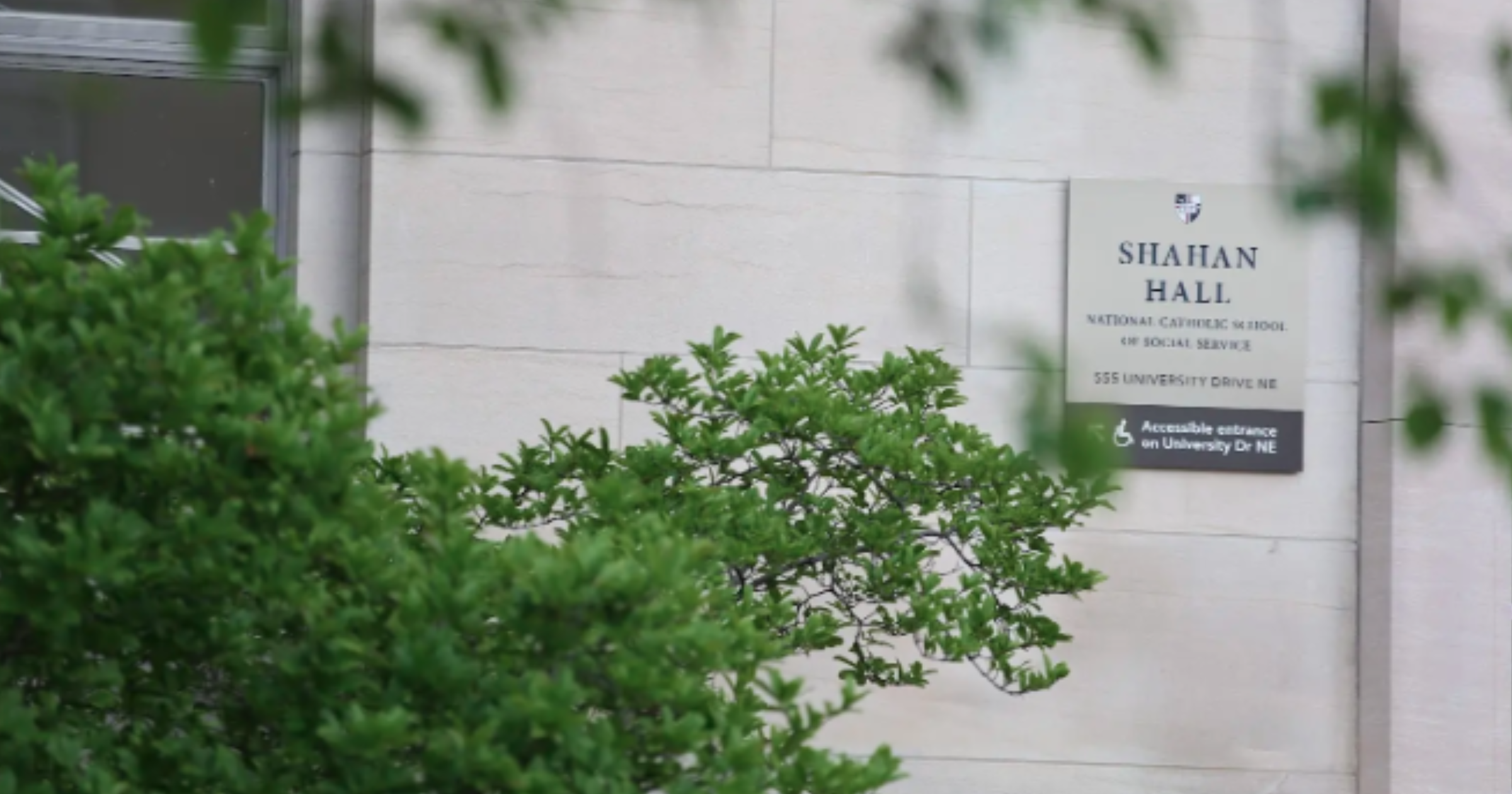
At the National Catholic School of Social Service (NCSSS), a leadership change is underway with Eileen A. Dombo, M.S.W. 1996, Ph.D. 2005, outgoing chair of the Ph.D. program, passing the baton to Melissa D. Grady, Ph.D. NCSSS focuses on the study and science of helping — working to discover and put into practice the most impactful ways to serve the world’s greatest needs. Rooted in the Church, the school’s mission is to meet people where they are, as they are, preserving human dignity, serving those in need, and seeking justice for all. U.S. News & World Report ranks The Catholic University of America #60 among social work programs.
Dombo began her teaching with NCSSS in 2000 and is now an assistant dean and associate professor in the school. A clinical practitioner with extensive experience working with survivors of sexual trauma, she began chairing the Ph.D. program in 2020. Ordinary Professor Grady’s clinical experience spans the public and private mental health sectors, and includes helping clients with issues ranging from depression to co-parenting challenges. She teaches in the areas of mental health, clinical practice, clinical theory and research methods.
As we enter Mental Health Awareness Month in May, explore the Q&A with NCSSS leadership.
Questions for Eileen Dombo, Ph.D.
- What first drew you to social work and, eventually, to serving as chair of the Ph.D. program here at NCSSS?
From a young age, I was drawn to helping people and was particularly interested in mental health. I studied psychology in my undergraduate work, but was quickly drawn to social work. I found a field that was focused on social justice and understanding the whole person and the environment. It allowed me to express my Catholic faith in my professional work, with a focus on the dignity and worth of every person.
Social work is a calling, and I felt that when I worked in an internship where I was supervised by a social worker. I was in awe of all she was able to do in her role; she did policy advocacy, education in schools, group therapy, and individual counseling. I wanted to be just like her! When I moved to Washington, D.C., after college, I pursued a master of social work degree here at Catholic University, and then my Ph.D., all while working in the field. I decided to lead our Ph.D. program because the school had a need and I felt I could provide support and guidance to our students. It has been a wonderful experience.
- What are some key achievements the Ph.D. program had under your leadership?
I took over the Ph.D. program in January 2020 after chairing our bachelor and master of social work programs. At that time, we had a large number of candidates who were preparing to defend their dissertation research and then the COVID-19 pandemic shut down business as usual.
We had to pivot to working in a virtual environment, and this meant figuring out how to hold a dissertation defense online. As it turned out, in March 2020, NCSSS was the first school at the University to hold a fully virtual defense. We held six more that semester. It kicked off a process of integrating technology into our program, streamlining processes, and updating courses. I am proud of the changes to the program, made with help from my NCSSS colleagues, our Ph.D. students, and support from our Dean.
- How does the University’s R1 designation impact the Ph.D. program in Social Work?
The R1 designation signals the University’s commitment to research and support of our program. NCSSS is proud to produce doctoral graduates who contribute to the understanding of the human condition and to programs and services to alleviate the barriers to wellbeing that many in our society encounter.
Research in social work is essential to advancing the science and philosophy of helping, which grounds students in theory and practice beyond volunteerism, and provides the education and skills to do social work as a professional.
- How have external resources, whether grants, donors, or institutional support, played a role in advancing the mission of the Ph.D. program?
For a doctoral program to thrive, external resources are essential. We have secured grants and donors who have enabled us to support students in their coursework and dissertation research. Many of our students are working professionals who are balancing school and life demands. Providing scholarships allows us to draw the best and brightest applicants–attracting those who will go on to be leaders in the profession, hanging their Catholic University diploma proudly on their wall. Institutional support and external funding is everything! As our dean is a champion of the Ph.D. program, securing funding and support for our doctoral students is a top priority.
- As you “pass the reins,” what are the biggest lessons about academic leadership you have learned as chair?
Passing the torch of leadership for this program to Dr. Grady gives me great comfort. She is an established researcher and leader in the field of social work and I know she will serve as a great mentor to our students. One of the biggest lessons I have learnedabout academic leadership is that our students must guide everything we do and involving them in decisions and processes makes every part of our program stronger. As a leader, my focus is empowering students and colleagues to have a voice. I’m not in charge, I’m the shepherd.
- Is there anything else you would like to share about the program or the transition?
Our Ph.D. program is nearing 100 years old and is the third oldest in the country. I am proud to have earned my Ph.D. here and helped steward the program. I am one of a long line of chairs, including Drs. Betty Timberlake, Elizabeth Smith, Barbara Early, Joseph Shields, Lynn Mayer, and many others. I can not think of a group of scholars who are more impressive and I am honored to be in their company. I am confident that Melissa Grady will continue this legacy.
Questions for Dr. Melissa Grady
- As you step into this leadership role, what new ideas or priorities do you have for the Ph.D. program?
One of the key priorities for the program is strategic recruitment. This involves understanding what prospective students are looking for in a Ph.D. program and then having a curriculum that meets those needs. As we look at what potential students need, we need to balance their needs with the strength of our existing program, which is designed to help develop excellent scholars and leaders within social work.
- What should prospective Ph.D. students know about what it’s like to study, research, and grow here at NCSSS?
Students in our program engage in a curriculum that addresses the scope of social work practice and scholarship. For example, they take courses on sociological and clinical theories, as well as courses on qualitative and quantitative research methods. In addition, we are committed to working with students on their individual interests and provide a great deal of mentoring and guidance to support them in their own scholarly pursuits. Because of our commitment to the range of social work practice, theory, and research, our students graduate with the capacity to work, research, and lead in all levels of social work.
- Can you share a bit about one of the social work school’s key research projects?
Our faculty are engaged in a number of research projects. These range from understanding the impact of mental health stigma on individuals, immigration, adoption, trauma, homelessness, sexual violence, and spirituality, among others.
- How does NCSSS collaborate with not only community programs, but other schools and colleges at Catholic University?
Social work is inherently interdisciplinary. Our school is continuously seeking opportunities to engage with other schools and colleges on campus, as well as within the community. We work with a range of agencies and organizations, such as Catholic Charities, which include services providers and scholars from a variety of disciplines, including nursing, psychology, and professionals from the criminal justice system.
- As you prepare to step into this role, what gives you the greatest confidence in the future of the Ph.D. program?
We are the third oldest Ph.D. program in the country with our graduates working in academia, practice, and key leadership roles. We have an incredibly dedicated faculty and administration who are committed to our program and continuing to provide the most current and relevant content to our students.
- Is there anything else you would like to share about the program or the transition?
I want to acknowledge the incredible work that the previous chairs of the program– Eileen Dombo, Joe Shields, and Lynn Mayer most recently–have done to create such a strong program.. Their leadership of the program and the countless students that they have supported over the years have enhanced the quality and reputation of the program.
Published on: Wednesday, April 29, 2026
Tags: NCSSS