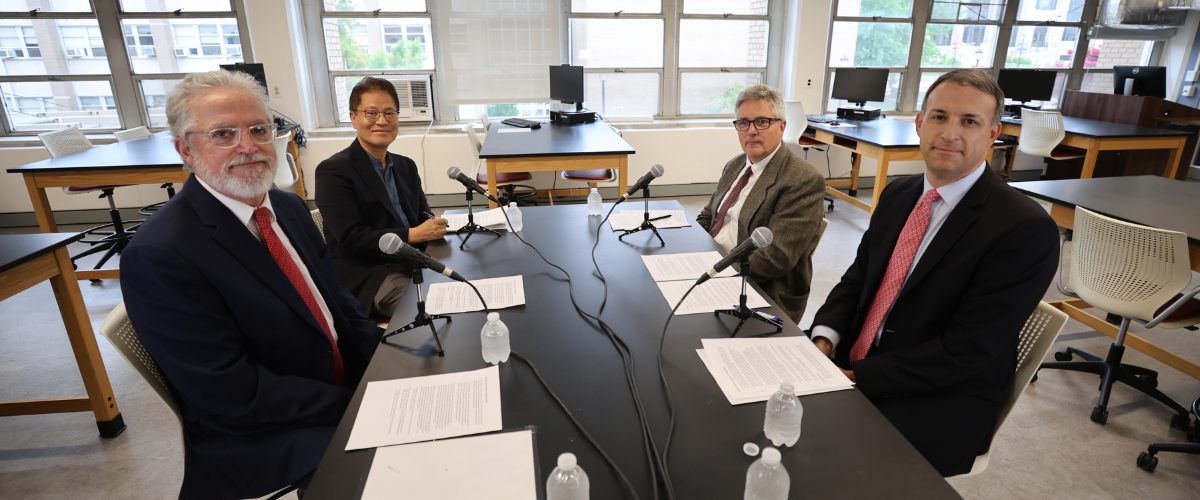

Welcome to Cardinal Perspectives, a series featuring in-depth conversations with alumni, students, faculty, staff and the extended family and community of The Catholic University of America.
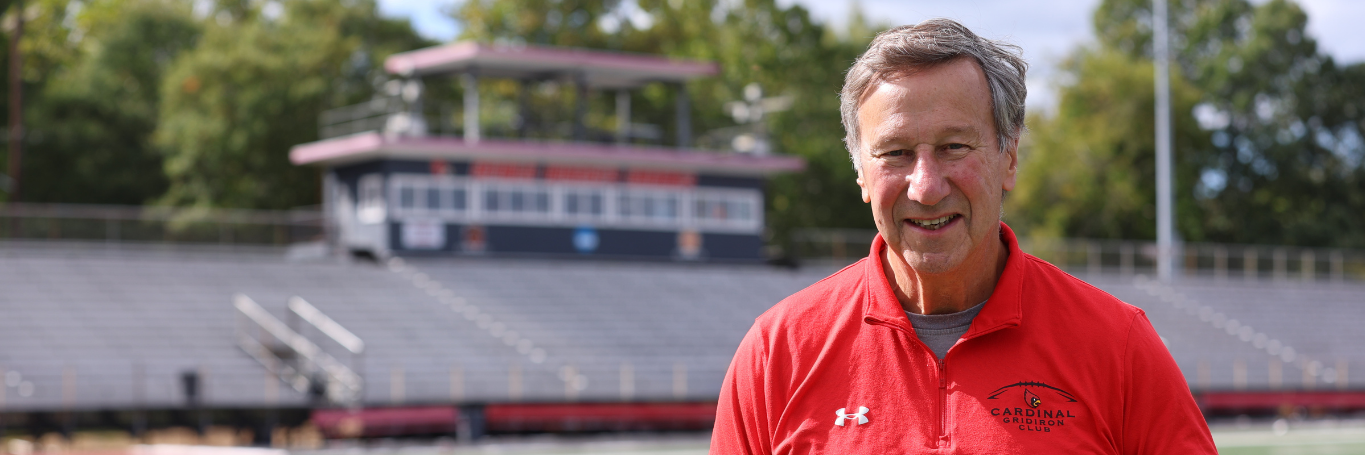
We are pleased to introduce this episode featuring Scott Amey, Class of 1969, and Kevin Robinson, vice president for Athletics and Recreation.
Scott Amey is a proud Catholic University alumnus and former Cardinal football player. After a distinguished career building and leading successful federal contracting companies, Scott reconnected with his alma mater in a meaningful way.
He and his wife, Deborah, have stepped forward with a generous $100,000 match in support of the Mulholland Locker Room Project, helping to strengthen the student-athlete experience for the next generation of Cardinal football players.
Scott sits down with us to reflect on his time at Catholic University, his career journey, and what inspired him to reinvest in the program that helped shape him.
*This transcript is based on an audio recording and has been lightly edited for readability. It reflects the substance of the conversation but may not be a verbatim record.
Kevin
Catholic University community, what’s going on? We’re so blessed today to have Scott Amey, Class of 1969 and former Catholic University football player, with us.
Scott, thank you so much for joining us today.
Scott
I'm looking forward to it. Thank you.
Kevin
Let's just dive right in and get started. How did you get to Catholic University in 1965?
Scott
Let me take you back. It was the summer of ‘65.
I had just graduated from high school and I had been fortunate enough to win a Maryland State scholarship. So I could go to any of the state schools in Maryland. And so I had selected College Park.
About that time I learned that I had also been offered a scholarship called the War Memorial Scholarship to Catholic University. This was given to a descendant of a soldier who had lost their life while serving. My granddad, as it turns out, had lost his life in World War I at the age of 23. And so that made me a candidate for the scholarship. When it was offered to me, I jumped at it.
I said, “This is good,” and I'm so glad that I did, and so thankful to the donors who made this scholarship possible.
Kevin
That's awesome. Now, football didn't play into that. It was simply your grandfather who gave his life for our country and it resulted in a scholarship to college.
That's an incredible story. But football was never in play here.
Scott
I didn't even know that the Catholic University had a football program. It wasn't until after the first few weeks of being there that I found out that football was coming back at the University for the first time in 16 or 17 years.
I decided to try out for the team and I was able to make it.
Kevin
At that time the stadium was in the middle of campus, a big dirt bowl. I think they played baseball, track, everything on that field.
Talk to me through that football experience. What were the coaches like? What were your teammates like? What was that overall experience, playing Catholic University football?
Scott
You mentioned something there that's important to me. Let me say 1965, we only had one game. It was the homecoming game. It was at the bowl that was behind McMahon Hall. I think it's now where the Pryzbyla is.
And it was a wonderful setting for football and the campus. The alumni were excited about the fact that football was returning, that they had football at homecoming, not soccer. And so we had about 3,000 attendees at that particular game. It was a lot of fun.
Kevin
I don't mean to interrupt, but how incredible was that to have 3,000 people for the only game that year?
Scott
It was exciting!
I'll share a quick story. I was the starting safety on the team, even as a freshman. About a week before the game started the coach asked if I could kick off. I had never done that in my life. I was so nervous about being the guy to kick off. And fortunately, I got the ball down to about the five yard lines. I was pleased with that and breathed a sigh of relief.
Kevin
That's awesome. How were the coaches? How were those teammates? What were some of those core memories beyond that first game as you got into your sophomore, junior, senior year?
Scott
Yeah, it was good stuff. I'll try three out on you.
The first memory was that first game.
The second memory is from my sophomore year. Now, I am playing both ways. The guy who was the quarterback the previous year – who, by the way, had quarterbacked at Harvard before that – he had graduated and they're looking for a quarterback, and the coach tapped me.
Kevin
So from kicker to safety to quarterback, you're playing all the positions?
Scott
I still played safety, so I didn't come off the field that often that year.
The first snap from the line of scrimmage of that game, I threw a pass that went for 70 yards to a gentleman by the name of Vic Capece, who's in the Catholic University Athletics Hall of Fame. Unfortunately, it was called back because of a penalty. But later in the game, I was able to throw a touchdown pass to a gentleman named Mike Stefanic, and it was the first touchdown the Catholic University had scored since the 1940s. So that was cool.
Kevin
What an experience. And you always have that in your bag! Saying, “I threw the first touchdown when football came back.” That's awesome.
Scott
It was a lot of fun.
The third one is a funny memory. In my junior year another Catholic University Athletics Hall of Famer, David Murphy, came out for the team. David was an exceptional athlete. He was the quarterback, I'm now back at safety.
What the coach would like to do was, every once in a while, and he did this once or twice a game, he would insert me as a halfback and Dave Murphy would take the snap lateral to me, I would make like I’m going to do a run around the right side but I would stop, and usually we would get a first down on the play.
After a few times we had done that, the coach comes up to me just before one of the games and says, “Scott, I want you to wear a different jersey with a different name, so that if they've scouted us, they won't know that as soon as you come in, we're gonna be throwing a halfback pass.”
So here I am with my different name, different number. Dave laterals me the ball but this time it goes for a touchdown. And in fact, if I remember right, it was the winning touchdown.
The funny part about all this is that my father had come to the game with one of his buddies and they spent almost the entire game trying to figure out where I was. He had no idea that it was me that threw that halfback pass for a touchdown.
Kevin
That is an awesome story.
From throwing the first touchdown back to throwing the halfback pass with a different jersey on, what incredible memories. Now to go along with those incredible memories, what were some memories that you have off the field? I think there's one in there about a certain bar on campus that you might have had some influence on?
Scott
This could be the only thing people remember about me at Catholic University.
The summer before my senior year, I led a group of students. With the permission of the Catholic University President, we established a Rathskeller on campus. I think there'll be a lot of alumni out there that might possibly have a link to that.
I got some architectural students to design a German-style Rathskeller. They did a beautiful job with that. We talked to Marriott, who was the food service provider at Catholic University at the time, into building the Rathskeller for free.
With our alumni president's help, Mr. Ed McMahon, alumnus and Tonight Show announcer, we got Budweiser to put in a six-tap, 30-keg bar there. We became the number two Budweiser account in the city that year, by the way.
The first day that the Rathskeller opened was October 10, 1968.
Kevin
We just celebrated 57 years.
Scott
Is it October 10 today? It is!
So, 57 years ago, Ed McMahon purchased the first round of drinks for almost 500 of us in the Rathskeller, and I still have a picture of that today. It was a great time.
Kevin
Can we educate who Ed McMahon is for some of our younger listeners or younger Catholic University alums?
Scott
Hopefully people will know who Johnny Carson is. Johnny Carson was one of the first or second people on the Tonight Show.
And Ed McMahon was Johnny's sidekick. And one of the things that Ed did was, as Johnny finished up his monologue, Ed McMahon would come along with a Budweiser commercial. So he had a lot of pull with the Budweiser folks, and that's how he helped us get that.
Kevin
I still can't get over that the Rathskeller was the second biggest account for Budweiser in the city. But what an entrepreneurial spirit that you had! I think that speaks to the Catholic University alumni and the type of students we've had and throughout our history to to have this foresight, to have this thinking and to go out and get creative on how we were going to get it paid for and then make it happen.
And the Rathskeller existed until the late eighties, early nineties?
Scott
Yeah, I think it was into the eighties, when they finally changed the drinking age back to 21. But it's neat that even today, Murphy's is on campus at the Pryzbyla Center. And that's a kind of a tribute to the original Rathskeller. So it kind lives on, in its own way.
Kevin
Here we are 60 years later, and what you and Ed McMahon started all that long ago is still alive, and our students are taking advantage of it.
That's incredible. Now, you had a very memorable experience at Catholic University, it seems. And you did a lot of different things, a lot of great memories. What was life like after the University? How did you take that Catholic education and turn that into the successful business person that you are today?
Scott
Let me start with my first job. I was a math major, and during my senior year, I wanted to get exposed to computer science. Catholic University didn't have a computer science major at the time, but they did offer a class in computer science; so I took it. And I like to say that my combination of math and a little bit of computer science got me my first job at Vitro Laboratories.
I was able to work on a project for the U.S. Navy, the Polaris Submarine Project that was led by a brilliant engineer. I got elbow-to-elbow training on how to design, code, and test software.
It was terrific. It was a good exposure.
Kevin
Just as computer science is starting to grow, you're at the cutting edge of that. How cool of an experience was that like?
Scott
Oh, it was great. And I will jump ahead for the next one.
I moved to another company called Singer Link, and we developed one of the very first nuclear power plant simulators. What that's used for is to train nuclear power plant operators. Again, I worked for a brilliant nuclear engineer this time, and he would tell me all the mathematical equations that we had to do to simulate what would happen with this or that. I would do the programming and it was another exciting experience.
My lesson to others is, if you have the opportunities to have mentors like those two guys, really learn and try to get everything out of them that you possibly can.
Kevin
Incredible. On the cutting edge of computers, on the cutting edge of nuclear power. How did you take those lessons and take those experiences and turn them into the business that you created?
I’m sure that there were some risks, some leaps of faith that you took to create your technology business.
Scott
After those first two jobs, I was able to move into management a little more. I started off as a project manager and then became a division director and then became a vice president. And then I finally, with a partner, decided to go out and do our own thing.
So we were developing our business plan, which consists of things like what services are we gonna offer? Who's going to be our customers? Who's our competition? What's going to make us different from the competition? How much money is this going to cost?
We were getting that all wrapped up when our current employers found out about it. The president of our then-employer came to me and said, “All right, we've learned about this, Scott. We're going to offer you an opportunity to be a vice president here, but there's a catch. You have to abandon this idea of starting a new company.”
That night, I spoke it over with my partner, we mulled over a little bit, and we took a deep breath. We declined the offers that they gave us, and we started out on our own.
Kevin
What a risk. But what confidence you had in yourself, in the belief that you had in the product that you developed. How was that feeling walking in the next day knowing you were going to decline the offer?
Scott
It was tough. And my wife did say to me, “Are you sure?” But we did it.
That was the first hard thing I had to do. And then the second hard thing, for anybody who's an entrepreneur, is getting those first few contracts. What we did was we first got ourselves some consulting gigs so that during the daytime we were just working as consultants to pay the bills.
And during the nighttime, we were developing proposals to get new work. After a while, we started to win some of those opportunities, and it snowballed. We then made a point that every time we got a contract, we would make sure that we exceeded the expectations of our client. We also made sure that when we got employees, that we gave them great benefits, great salaries, and recognized what they did.
We kept those two tenets and we began to grow. And 11 years later we had 1,700 employees and we were doing about $340 million a year in business with the federal government, with agencies like the U.S. Air Force, NASA, Department of Transportation, Department of Energy, the National Weather Service. I really loved doing that.
Kevin
I love what you said there about taking care of your employees and giving great customer satisfaction, in taking care of your customer. How did you maintain that through rapid growth over 11 years? Going from two highly intelligent people with great ideas to a company of 1,700 and keeping your core tenants – that's really hard. Some companies, they grow, they start putting the dollar above emotions and behaviors and those types of things. How did you maintain that care?
Scott
I guess maybe I could go back to the athletic side of the fence. You make sure that when you're bringing on people, you bring on people who you think can really grow. And then you coach 'em up. You take the time to make sure that they understand where the priorities are.
They're bright people. They're going to pick it up and in many cases they were better than me at what they did. You focus on that, and it works.
I'm very proud of the people that we brought on board that have gone on to run their own companies after they left us.
Kevin
That's the key part there, Scott. Most people are going to have the technical skills when you hire them, but it's the behavior skills. It's those hard-to-quantify skills of empathy, compassion, care, work ethic, resilience… if you can recognize that and potential employees and bring them on board and build on those on those core beliefs, I think that's really important.
Are those some of the things that you look for out of your employees?
Scott
Absolutely. And when we set up our goals, we always talked about customer satisfaction, employee satisfaction, employee growth. The third one was giving back to the communities we were working for.
You never heard the word and make a lot of money. We figured that if we did those first two or three things, the money's gonna come.
Kevin
And it did. And the success came. But you did it the right way, so that's awesome.
How did you take those things that you learned through your journey in the business world and in life? What advice would you give to our Catholic University students or our young alumni professionals who are just getting started in the workplace?
Scott
I have a bunch of them. I recently gave a speech to the School of Engineering at George Washington University, so I'm gonna steal from a few things I said there.
Number one is while you're a student, look for opportunities to get internships in your field. I'm sure Catholic University has a great career center and they will help you get exposed to internships. Do it. And don't worry about how much money you're making on it, what's important is the experience you're getting. The experience doing something that's in your field, the experience of working on a team, usually the experience of working for a supervisor, all those things are important.
In my career, I've been a hiring manager a number of times, so here's my little point I'm going to make. If I'm looking at two students and one of them had a 3.5 GPA but they don't have any experience, and the other student has a 3.0 GPA, but they've got experience working in internships, and they're doing the type of stuff that I'm looking for, I'm gonna pick the student with the experience. So that's why you want to do that.
Number two is try to get yourself involved in more than just the classroom. That's probably not too hard. Get involved in other things, whether it's student government or athletics or community groups, get involved in those things. Make yourself well-rounded. And you find out that's probably the thing you're gonna remember the most about what you did when you went to school.
Thirdly, when you're about ready to go get that first job, or even when you're trying to get the internship, and you're applying for it, don't just take your standard resume and send it in. Take the time to read the job description that you're applying for, and then take the time to tailor your resume so that you are addressing the things that they're looking for.
Now, don't lie if you don't have the experience. Don't lie, just move on to the next opportunity. But if you've got that experience, make sure it jumps off the page so that the person reading your resume says, “I have to bring that person in for an interview.”
I'll leave it at that for some ideas.
Kevin
That is fantastic. I think those are some key aspects in the hiring process.
What advice would you give to people when they get a job? What are some of those key things that they can do to stand out in those first six to nine months?
Scott
I think number one, learn what it is that your company's objectives are. And don't be afraid to ask. The number one person that you interface with is your manager. Don't be afraid to ask them. Say, “What can I do to improve my performance? What can I do to try to be a team player?” Find out what else can be done. That's one way to do it.
Also, volunteer. If you have a chance to maybe help out with writing proposals or reviewing proposals while you're still doing your day job, then do that as well.
Kevin
How do you advise someone on handling setbacks? How do you show that resilience in hard times?
Scott
There was a time back when I was working all those great jobs and I wanted to get into management. They were letting me be the one who ran the company softball team. They let me run the ski trip. But they didn't let me run a project. So I went out and I found another opportunity. And it was to run something that was about an eight person job. And the only problem was I only got like a $1,000 raise over what I was making.
So I went back to the senior executive of the company and said, “I'm sorry, but I'm gonna have to leave because I was looking for an opportunity to become a project manager.” And it just so happened that particular day they had won a brand new project. He told me about a project that was again for the Navy, and asked if I would like to run it. He asked about compensation, what the other guys offered me. I shared that, and so he says, “How about an $8,000 raise?” And I said, “That'll do it. Yes.”
Sometimes you have to advocate a little bit for yourself, but if you ever do, make sure it's one-on-one with the senior person, not in front of a group. That's my advice.
Kevin
Great advice. Pivoting a little bit, you and I have worked together with our colleague, Neil Donahue, on a big project for our football program, something that's near and dear to your heart.
I wanted to just ask what motivated you and Deb to get involved in the philanthropic giving towards our new locker room project? What was that motivation about?
Scott
I wanted to do something for Catholic University for many years, and finally, a couple of years ago, I decided to give a general gift to the football team.
It was actually you and Neil that brought me in. And you brought my wife Debbie and I both in, and you guys told us about this locker room project. And I think it was you that gave me a tour of the locker room and suggested that we really need to improve this thing in order to get both more and better recruits to come in.
And we said, “Let's do it.” Debbie and I totally embraced that. We have had an experience with philanthropy before, and I noticed that when you do a match, it's very effective. So I suggested that we would donate $100,000 dollars, $25,000 for four years straight, as a match.
Hopefully – Mike Stefanic, I hope you hear this – some others will join us in the matching part. Because donors are more likely to dig a little deeper into their pocket if they think that every dollar that they give is going to be matched to go to the benefit of the locker room. And that's what we have pledged to do.
Kevin
And we can't thank you enough for that pledge. I appreciate you calling out a couple of your teammates about the match. And you're right, knowing that we have someone like yourself and Deb who are putting that generous gift out there and saying, “Look, like we're willing to take that step and help the football program get a locker room.”
The DuFour Center is celebrating its 40th year. And that locker room is the same locker room that was in place in 1985. And so you recognize the need for those 110 student-athletes, and we really appreciate that you have that spirit of generosity to do that and to challenge your teammates, challenge some of our other alumni to step up and help get this project off the ground.
Scott, as you know, our football locker room project is going to be named after Brigadier General Sean Mulholland, Class of 1982. He was 7th Special Forces, Green Beret, the whole nine. He was really respected in the armed forces and did a lot in his career.
Now, how does it feel to be the lead donor on this project after also being the lead of Catholic Football coming back in 1965?
Scott
First of all, Kevin, let me say that I think that naming the locker room after the brigadier general is just great.
As far as how it feels? I've been wanting to do something like this for a long time, and I would like to challenge not only my teammates back there in the late sixties, but other generations of alumni and football players and people who went to the football games to chip in and help out this worthwhile effort.
Kevin
And there's a lot of different ways they can chip in to help meet the match that you and Deb have set forth. You can name a locker through this project. With a $5,000 donation, you can put your name on the locker, and every student-athlete that comes through is going to be able to see your name on that locker and feel a connection to our alumni.
It’s going to be something special.
How do you envision this project, changing the football program, how do you see it elevating to that next level?
Scott
The student-athletes are going to spend a lot of time in that locker room. And if you're coming into something that's attractive, clean, and fun; it's gonna lift the morale of the team.
It also helps you recruit. The quality of the football program is going to get better, and then the students are going to enjoy coming to the football game. The alumni hopefully will come back on many occasions. Alumni like to come to football games, especially ones where our team wins.
I'm hoping that this is step one in making that happen.
Kevin
I appreciate you recognizing how this can galvanize a program. That's a big piece because for everything you just said about the team comradery, about the recruitment, about the snowball effect that a facility can have in the success of a program, is huge.
We see this at a lot of places. When the alumni show support and they show generosity, it creates pride within the student-athletes who are utilizing that facility. That's going to emanate out from that and grow to other alumni and so on and so forth.
We really appreciate you and Deb stepping up in that way. Now, what would you like to see from the Catholic University football program over the next five to 10 years as a result of this project?
Scott
Let me say first, I'll follow your leadership as to what you guys want. But if you ask me personally… I recently moved to the Richmond area and had an opportunity to visit the University of Richmond's football stadium, and I really was impressed by it. It was just a nice experience to walk in there.
They've got a nice entrance to it. It has places where you can have food and all that kind of stuff. Maybe that's a bridge too far, but I think that we can go towards that. I can see maybe getting some 2025 architectural students to design an improved football stadium and, who knows, maybe we can get the alumni and other donors and friends of the University to pitch in and make that happen. And then the whole experience is better.
Kevin
100%. And I think the football locker room, which you again have so generously given to, is the first step to that. Because if we could look out this window right here, and we could see – and I envision this every day – looking forward to having a new set of stands, nice brick environment, and an additional 3,000 seats. And then behind that, we have locker rooms, concessions, restrooms, and a true entranceway to our football stadium that can put us on par with not only any Division III program, but some of the Division I programs such as Richmond.
We have to dream like that, and I appreciate you dreaming with me, to try to make that happen. We have to set the standard for Catholic University athletics and the football locker room, which we see right here, is a great starting point, right? And it's going be a huge advantage for us in the recruiting process and in building team camaraderie.
Then the next step is to put more beautiful stands, a building that shows our commitment to not only the football program, but to Catholic Athletics. That's going to come from alumni, parents, and some of our key donors out there. So I appreciate you saying that.
Scott
You're welcome. I will say one more thing, Kevin. I want to first state that I don't know the whole coaching staff. I've only really met Coach Gut. I am so impressed by him. He is a great coach and his battle, he had a challenge with cancer and he battled it and succeeded.
I think he's fantastic, but there is another place where we can help. We can make sure that the coach and his staff are adequately compensated so that he can get top staff. These are the guys that can “coach up” the players.
Kevin
I appreciate your vision for the Catholic University football program because that is very much in line for how we see it.
Going back to what you were talking about, with how you were so successful in your career path and starting your business. You have to take care of your people. They have to feel valued. They have to feel that the organization is looking after their best interests.
And sometimes it's through the compensation piece. And also, can we get the appropriate number of people in the program? Football is 110 to 120 student-athletes right now. We have one full-time head coach and four full-time assistants, as well as a graduate assistant.
How do we add another person into there? Move up their compensation levels so that we can continue to attract the high level football coaches? So again, you're spot on because you're thinking the same way as I am in terms of how we can continue to make Catholic University Football the program that we're all proud of, how we can keep increasing that pride and getting more and more people back into the fold.
I really appreciate everything you and Deb have done to help elevate our football program, especially with this locker room project, but also the foresight to see that this is just the start. And now we can continue to do this, but we need help from others. You and I, we can go out there on our grassroots campaign and keep bringing more and more people into the fold. Does that work with you?
Scott
That works for me.
Kevin
Your $100,000 match to the football locker room project is a great start, and then we'll keep building on that.
So for all you Catholic University football alumni, parents, and donors out there, let's follow in Scott Amey and his wife Deb's footsteps and help us meet that match and help us get this football project off the ground.
Scott, thank you for your time today. It's been a pleasure talking with you. Any last words for our Catholic faithful?
Scott
Go Cards. How about that?
Kevin
Go Cards! Let's go!
Published on: Wednesday, December 17, 2025
Division:
Tags: Athletics, Football, computer science