

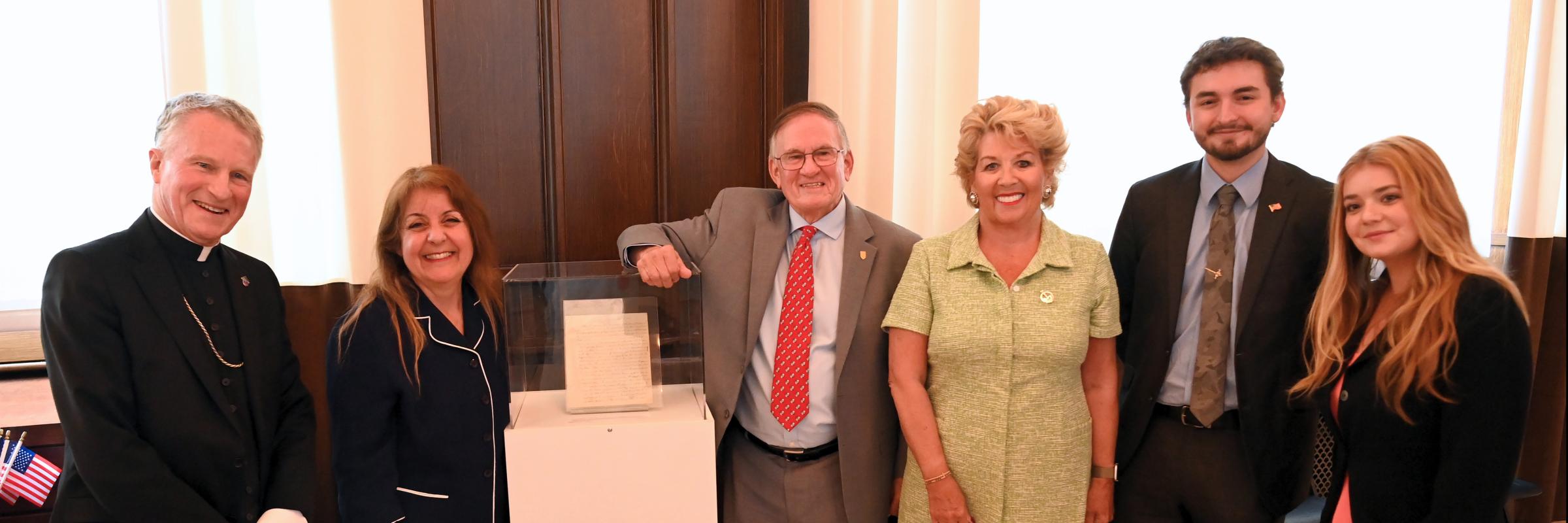
Banner image features Archbishop Timothy Broglio, Maryann Cusimano Love, Robert P. Duckworth, and student speakers at the Politics for Good event.
By Audrey Hill
In 2026, the United States' 250th anniversary presents an opportunity to celebrate a letter written by Thomas Jefferson and gifted to The Catholic University of America by Robert P. Duckworth, B.A. 1965, M.C.R.P. 1967. As the Clerk of the Circuit Court in Anne Arundel County, Maryland for more than 25 years, Duckworth served in an important elected civil servant position. His long-held interest in the Founding Father and dedication to public service and his alma mater, converged in the donation of a historical document on the early days of our nation.
Duckworth unveiled the Jefferson letter this spring at a campus event celebrating the 250th anniversary of the United States, called "Politics for Good." As part of the inaugural commissioning ceremony, the politics students received a blessing from Archbishop Timothy Broglio and a copy of the Declaration of Independence.
Active in the civil rights movement while at Catholic University, Duckworth experienced seminal moments on campus. The letter by Jefferson, as well as his account of the Catholic University community's role during a fraught, hopeful, and violent time in the nation, provide student learning opportunities. Maryann Cusimano Love, associate professor of international relations and chair of the College of Arts & Sciences' politics department, explored these topics with Duckworth, who received his bachelor's degree in politics, in a recent Cardinal Perspectives episode.
The Thomas Jefferson Letter
A primary author of the Declaration of Independence, Thomas Jefferson played a major role in establishing democracy and religious freedom in the U.S. Written on December 31, 1783, the letter by Jefferson to Virginia Governor Benjamin Harrison V addresses the ongoing process to ratify the Treaty of Paris that ends the War of the American Revolution.
In 1783, Jefferson had already drafted the Declaration of Independence. He was representing Virginia in the Second Continental Congress, which was meeting in Annapolis, the temporary capital of the nation. Centuries later, Duckworth would discover not only the existence of the letter when it went up for auction, but also that it was written in the same city where he was serving as Clerk of Court and giving tours on the U.S. system of government.
"I've always been fascinated with Thomas Jefferson. He's a very complex person and very important as a Founding Father," said Duckworth. "He had more positions than all the other Founding Fathers together from the time he was in the House of Burgess in Virginia to when he was president in his second term."
Jefferson was the third U.S. president and the first Secretary of State. He enlarged the nation through the Louisiana Purchase. He also owned more than 600 enslaved people, more than any other American President.
Duckworth traces his interest back to childhood visits to Philadelphia's Independence Hall, where the Declaration of Independence is housed. He was inspired to purchase and donate the letter to Catholic University as a legacy gift for his 60th reunion. Fittingly, he learned about the previously unknown document on July 4, 2025.
In the letter, Jefferson is focused on gathering support from the states to ratify the Treaty of Paris and thereby secure democracy in the U.S., while encouraging the spread of democracy in the Netherlands and elsewhere in Europe. He also applauds the people of the Netherlands for demanding the right to bear arms from their king, or stadholder.
"When Jefferson and the founders were in the process of founding our country as a democracy, there were no other democratic governments. It was a very lonely place to be," said Cusimano Love. "And they were trying to spread these ideas, not only in the 13 colonies and then, what became the larger United States, but also more globally."
Thomas Jefferson, Catholics, and the Catholic University Connection
As a Founding Father, one of Jefferson's most significant achievements was enshrining religious liberty in the Declaration of Independence, at a time when Catholics did not have full rights. Catholics were not allowed to vote nor own land in most of the 13 colonies, and only Protestants were able to hold office in eight of the colonies.
"Jefferson didn't like Catholics, but he was a deist. He believed in God and the natural law. I'm inspired by what he did, as well as wondering about what he didn't do," Duckworth said.
Jefferson's connections to the University extended beyond his pivotal role in religious freedom. In 1803, at the behest of Jefferson, a prominent newspaperman came to Washington, D.C., to chronicle his presidency. He built a farmhouse on land near Mullen Library, which hosted Jefferson and many other distinguished Washingtonians. Eventually, the property became part of Catholic University and the site of St. Thomas Hall, in which Duckworth took classes before its demolition in 1970.
Catholic University and the Civil Rights Era
The height of the civil rights movement occurred during Duckworth's time at the University, and he and the Catholic University community played a role in historic events. Due to segregation, many African Americans were unable to find housing in the city when they arrived for the March on Washington in 1963.
"Catholic University opened up their gymnasium, their campus, to house those who came for the March, and the Knights of Columbus helped organize and fund it," Cusimano Love said.
The Most Reverend Patrick O'Boyle, who was the Archbishop of the Diocese of Washington, D.C., and University chancellor, provided the opening blessing at the March on Washington. Duckworth joined a group of students attending the march and even carried the University banner in the historic event.
"We got off the buses and walked into a tidal wave of people, and we splashed up onto the steps of the Lincoln Memorial. And there stood Dr. Martin Luther King Jr., with his "I Have a Dream" speech. Everyone – I think there were 300,000 people that day – we were frozen in silence listening to his words, as they echoed across the Mall and into each of our ears," Duckworth said.
"In my life, I've never had a more memorable moment than the moment of civil rights and the moment to actually carry out what Thomas Jefferson said, 'All men are created equal.'"
Learning Opportunities for Students in the Modern Era
Duckworth's higher education experience encompassed victories for civil rights and desegregation, but also the Cuban Missile Crisis, the assassination of John F. Kennedy, Jr., and the advent of the Vietnam War.
"Politics is a rocky road today. It's been a rocky road throughout our history," Duckworth said. "I would say to Catholic University students that they are the next generation of leaders. If our country is to remain a democracy in its 250th year, they have to carry the torch forth."
From the donated letter, Duckworth would like students to learn that Thomas Jefferson was more than just the drafter of the Declaration of Independence – he worked in the trenches for our republican democracy for years.
"Democracy is a building project. It's not one and done," said Cusimano Love.
Duckworth concurred.
"Republican democracy – government by the people – is very fragile," Duckworth said. "We have to work to keep it. Will we live up to what the Declaration of Independence said, that all men are created equal, today?"
More resources to explore: The Thomas Jefferson letter, the Cardinal Perspectives episode, and The Archivist's Nook: Unlikely Connections - Thomas Jefferson and Catholic University
Published on: Monday, June 29, 2026