

Welcome to Cardinal Perspectives, a series featuring in-depth conversations with alumni, students, faculty, staff and the extended family and community of The Catholic University of America.
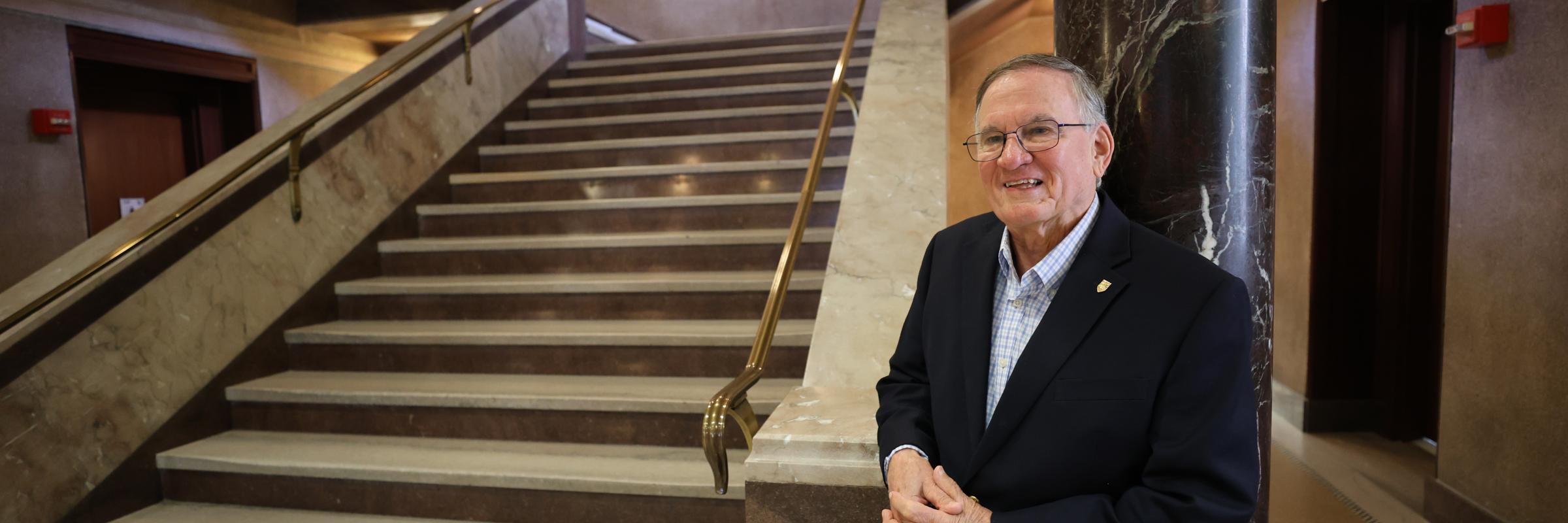
Robert “Bob” Duckworth is an alumnus of the politics department at The Catholic University of America. He served as an elected official in Maryland as the Clerk of the Circuit Court for more than 25 years. In that position, he worked to help people through the court system as he processed adoptions, married over 8,000 couples, issued business licenses, recorded deeds, and managed court cases.
Born in Philadelphia, Bob served in the U.S. Army in the 82nd Airborne Division, before coming to Catholic University, where he earned his bachelor’s degree in politics in 1965 and a master’s degree in regional and urban planning in 1967.
During his time at Catholic University, Bob was active in the civil rights movement, attending the March on Washington where Dr. Martin Luther King gave his famous “I Have a Dream” speech and the President of Catholic University gave the opening blessing.
Bob’s lifetime of public service has included serving on the policy staff of the U.S. Department of Housing and Urban Development, as a Board member of the Bowie Health Center, as well as serving on numerous national and regional bodies to improve the court system and advance court management.
Bob is married with two children and five grandchildren.
This conversation is facilitated by Maryann Cusimano Love, associate professor of international relations and chair of the politics department at Catholic University.
*This transcript is based on an audio recording and has been lightly edited for readability. It reflects the substance of the conversation but may not be a verbatim record.
Maryann Cusimano Love
I'm excited to be here today with an illustrious alumni, Robert P. Duckworth, of the politics department at The Catholic University of America. As we approach our celebration of the 250th anniversary of our country and of the Declaration of Independence written by Thomas Jefferson, Bob has given us a most generous gift to The Catholic University of America, a handwritten letter from Thomas Jefferson.
It might seem a little unusual to be having a letter from Jefferson, he was not a Catholic but he does have many connections to this University. Many people don't realize that he actually visited here on the land that is Catholic University. He encouraged a journalist, Mr. Smith, to come to document his administration and that land of the Smith home later became part of the Catholic University near Mullen Library.
Bob Duckworth
Thomas Hall.
Maryann Cusimano Love
Exactly. It was wonderful to have that part of the connection. And of course the other more serious connection is that at the time the Declaration [of Independence] was written, Catholics were not really having full rights in this country. They were not allowed to vote, to hold office, to own land in most of the 13 colonies, and in eight of those colonies there was a restriction that only Protestants could be office holders.
So, Jefferson is known most for his work on religious liberty. And on his tombstone he asked that only three things be on that tombstone: founder of the University of Virginia, his work on the Declaration of Independence and on religious freedom. He didn't even put the presidency in his top three.
So there are some connections between the work of Jefferson and his physical presence here and this University. But I wonder if you can tell us a bit more about this letter and what inspired you to acquire this very special piece of our country's history?
Bob Duckworth
Thank you Dr. Love.
Just a footnote on your presentation. I actually was in Thomas Hall, which is where Jefferson met at the mansion. The mansion was torn down, and Thomas Hall was built later. There was a religious community there, and then it was acquired in 1887. But I actually had a political science class in that hall.
Maryann Cusimano Love
On my goodness - where Jefferson was!
Bob Duckworth
Where Jeffson was. I had no idea.
But I've always been fascinated with Thomas Jefferson. He's a very complex person, very important as a Founding Father. In fact, I find him to be the most interesting Founding Father. He had more positions than all the other Founding Fathers together from the time he was in the House of Burgess in Virginia to the time he was president in his second term.
I've always had a fascination. When I was a kid–I'm a Philly boy–my mom took me to Independence Hall, where I could see the Declaration of Independence. And she was an Irish immigrant. She wanted to make sure, because she had to do the citizenship route to become a citizen.
She had to study history, and she learned about Jefferson, and she was very proud of Independence Hall. And as a kid, she would take me to Independence Hall with my brother, where we would see the Declaration of Independence. We'd also go to the site where Thomas Jefferson actually wrote the Declaration of Independence.
Maryann Cusimano Love
Amazing.
Bob Duckworth
And what is amazing about that is he wrote it on a portable desk. I surmise it was the same portable desk where he wrote the letter that we're talking about, this historic document. So I had that attachment and fascination with Thomas Jefferson as a Founding Father.
He didn't like Catholics but he was a deist, as we know. He believed in God and the natural law. Some would attack him in his campaigns as being an atheist, the Federalist Party, but he really wasn't. In any case, I'm inspired by what he did as well as wondering about what he didn't do.
But in the letter I had an ‘aha’ moment. I was a clerk of the court for 20-some years in Anne Arundel County in the Annapolis Courthouse. And during that time, one of the things I would do would be giving presentations of the courthouse. Our courthouse in Annapolis was historic, 1824. It was built after Thomas Jefferson was on that site writing that letter.
I did not know when I was presenting at the courthouse, [on] the rule of law and the way the government works, especially the judiciary branch, I didn't realize at that time. I didn't have any knowledge about that letter. But I did know that Thomas Jefferson resided on that site where the courthouse was built.
Maryann Cusimano Love
Bob, just to let our listeners know, Annapolis was, for a brief time, the capital of the country before Washington. Isn't that correct?
Bob Duckworth
That's correct, which is why Thomas Jefferson was there. Thomas Jefferson was attending the Confederation Congress, and they were meeting in Annapolis.
They kinda had to scramble out of Philadelphia because the continental soldiers wanted their back pay, and they weren't getting it, so they were about to march on Philadelphia. The Congress went from Philadelphia down to Annapolis. The reason they were in Annapolis, their main order of business, was the ratification of the Treaty of Paris of 1783. This letter was written in December 1783.
Maryann Cusimano Love
Now, the Treaty of Paris was important because that was what ended the Revolutionary War and established officially the independence from Britain.
Bob Duckworth
It was literally the birth of our nation, and we were signing sort of the birth certificate.
You could look at the Treaty of Paris as the birth certificate of our final separation and independence. But Jefferson was there. He was a delegate from Virginia, and in fact, he was the chair of the committee of the Confederation Congress for ratification. So, he was concerned in December when the letter was written. He was concerned about getting the treaty signed and ratified by Congress.
Maryann Cusimano Love
So then and now, trouble to get Congress moving.
Bob Duckworth
Things never change. Although I must say, Congress back then was more civil. They understood Washington's rules of civility in their debates.
Very distinguished debates, I might add as opposed to today, where we're shouting and throwing things at each other. He was there at that time. When I was clerk of the court and doing my presentations in the courthouse, I would remark, “where Thomas Jefferson lived.” I only wish at that time that I knew about the letter.
But that letter became known last July 4th for the first time. And when I saw the article, it was in "The Capital Newspaper," when I saw the article on the letter. The letter was put up for auction by the Raab Collection. And the Raab Collection is a private company that deals in historic documents, the selling and buying and researching of historic documents, and they put this letter up for sale. It had just been sold, and they put it up for sale and were advertising, of all places, in the Annapolis Capital.
So there I was on July 4th morning when I read about it, and I said, "That is what I want to get." And I wanted to do it for several reasons, because my 60th reunion was coming up–
Maryann Cusimano Love
Beautiful.
Bob Duckworth
–And the 250th birthday of our nation. So I thought, "Boy, this would be a nice legacy gift to give to Catholic University, where I studied political science." And if it weren't for Catholic University, I wouldn't be the clerk of the court in Anne Arundel County for 26 years or whatever.
I thought, "I'm going to purchase that letter." I'm inspired by Thomas Jefferson, as complex a man as he was, and I'm going to give it to Catholic University and as a legacy gift celebrating my 60th reunion, our 60th reunion, and hoping that Catholic University can use it in their celebration of our nation's 250th birthday.
Maryann Cusimano Love
So we had the unveiling of the letter this spring at a ceremony to commission our politics students in Politics for the Good and commemorating politics as a vocation, and the students seemed very excited. They gathered around the letter and were asking a lot of questions. Tell us what you hope the letter will be used for, as it's now part of the collections here at Catholic University.
Bob Duckworth
In your wonderful presentation about Thomas Jefferson and some of my comments alluding to Thomas Jefferson, I thought that letter would, for students and for Catholic University's community, would enlighten them more about Thomas Jefferson. He was a complicated man.
But that letter came way after signing the Declaration of Independence or drafting the Declaration of Independence. So what I would like to see the students understand and learn from it is that Thomas Jefferson was more than just the drafter of the Declaration of Independence. This founding father worked in the trenches for our democracy, our republican democracy, in all possible ways.
You talked about the resolution on religious freedom. He did so much more. At this time, when he wrote this letter, he had already been governor. He had been a delegate to the Second Continental Congress, writing-- drafting the Declaration of Independence. He had done so much up to that time, and then this letter was kind of between stations where he was going.
This was 1783, and he was about to go off to be the minister of France in France. First, actually, the first U.S. minister. Ben Franklin was over there for a while, but he was the first minister to France representing us as the United States of America. So he was in the middle of things. And so he was involved in the ratification process, and he really wanted to get that, to make sure that the ratification occurred.
Back then, it was difficult, the timing, with the coming across the North, the Atlantic and into the colonies to get the treaty ratified. So there were a lot of issues going on with that.
But let me get back to what else I would like the students to learn: that Thomas Jefferson, in different capacities, was truly an enlightened founding father. I think there were, in my estimation, only three really enlightened founding fathers: Ben Franklin, perhaps. Hamilton, John Adams, and Thomas Jefferson. So what I would like is for this letter to be used as a learning instrument, [for] research, looking at it and thinking about what Thomas Jefferson went through up to the revolution, after the revolution as Minister of France, and all the way to his presidency.
So enlightenment and insight more than they have now.
Maryann Cusimano Love
It's a really interesting point that you bring up, Bob, because democracy is a building project. It's not one and done. And so when you have a marking of a 250th anniversary, it almost makes it seem like, there, they signed the declaration. Mic drop, it was done.
And of course, that's not at all what happened, and he was trying to urge them to get across the finish line this important treaty to make sure that they'd finished that process. But of course, in the letter, he's also talking about the spread of democracy in other places, and he's commenting on the implications that there may be some democratization occurring in the Netherlands and other European countries.
And to us, there's often a reading of history backwards. We're living in a time when there's more democracies on planet Earth than ever before. But when Jefferson and the founders were doing the founding of our country, that was it. There were no other democracies out there. It was a very lonely place to be. And they were hoping and heralding and trying to spread these ideas, not only in the 13 colonies and then, of course, what became the larger United States, but to spread these ideas more globally.
And that's certainly a great thing to be discussing and teaching in our classes. I've talked to several professors who are interested in bringing the letter into the classroom because the discussion about the spread of democracy, democratization, and of course today, democracy under challenge around the world, it's a very good time to be looking at the original and thinking about what the original concerns and challenges and opportunities for democracy were.
Bob Duckworth
That is a major part of that letter, and there's another part of that letter that is also fascinating, and that is the right to bear arms. In that letter, he applauds the people in the Netherlands with their demands of their royal king, “stadholder,” I think the title was, demanding the right to bear arms.
Eighty thousand men in the Netherlands were demanding of the king their rights to bear arms. And Thomas Jefferson recognizes that. And I think, in studying that letter, what else did Thomas Jefferson say about the right to bear arms? He actually, when he was a Virginia congressman or Virginia councilman, when he was working with the design of a constitution for Virginia, he actually had a section in there about the right to bear arms.
Now, mind you, the Constitution of the United States was further down the road after this letter. So if you look at the Constitution of the United States and the Second Amendment, you see the right to bear arms. Where did that come from?
Maryann Cusimano Love
And petitioning your government, which of course was in the Declaration and also in the Constitution, the rights to freedom of speech, freedom of assembly, petitioning your government. So he was very happy that they were having no kings protests in the Netherlands, just as they had protested the monarchy here in the United States.
Bob Duckworth
Absolutely.
Maryann Cusimano Love
I wonder if you could tell us a little bit about studying politics at Catholic University. So you had a very interesting time to be here.
You had served in the 82nd Airborne in the military before coming to Catholic University. And then, I understand during your time here at Catholic University, you participated in the historic March on Washington in 1963, best known for Martin Luther King delivering his "I Have a Dream" speech at the Lincoln Memorial.
Many people don't realize that the Archbishop of Washington, Archbishop O'Boyle, who was Archbishop of Washington [and] would be the chancellor of the Catholic University, said the blessing at the beginning of that day, and that students were organized here from Catholic University. And because it was that time of segregation, when you have this many people come for this march, there was no housing for African Americans to stay.
They were not allowed to stay in hotels where whites were-- had segregation. So Catholic University opened up their gymnasium, their campus, to housing those who came for the march, and the Knights of Columbus helped organize and fund it. But can you tell us what that was like as a student to be part of that day of history?
Bob Duckworth
It was a remarkable day for freedom in the United States. The civil rights movement was flourishing at that time. And at that time, I lived that summer at St. Joseph's Boys Home. And one of the counselors that lived with us that summer happened to be African American. And so I was right in the middle of all the debate because he would remind me every day of what was going on.
We decided, he and I and another counselor, to carry the banner for The Catholic University of America. We were so proud that with the gathering and what the bishop did, the blessing and the housing, and just the organization that CUA put together for that.
We got on buses, just excited. And we got off the buses and walked into a tidal wave of people. And we joined the tidal wave, and we splashed up onto the steps of the Lincoln Memorial.
And there stood, at that time, Dr. Martin Luther King Jr., with his "I Have a Dream" speech. Everyone–I think there were 300,000 people that day–we were frozen in silence listening to his words, as his words echoed across the Mall and into each of our ears. And the message that we knew we would bring back for the rest of our lives and live, hopefully. It was just a remarkable day. At the end of the day, when we came back to the orphanage, the sisters were cheering us for being there and we just replayed the whole day. And in my life, I've never had a more memorable moment than the moment of civil rights and the moment to actually carry out what Thomas Jefferson said, "All men are created equal."
Maryann Cusimano Love
And continuing that into the present moment, continuing to build and perfect the democracy from its origins with slavery to that very important movement to make sure that those rights were available for all.
Bob Duckworth
Yes. And we have to work at it. And some of us are not doing it. Many of us are. Democracy, republican democracy, government by the people–very fragile. Very fragile, and we have to work to keep it. And, I hope to God that does happen in these times, because what we need to be concerned about is, will we live up to what the Declaration of Independence said, that all men are created equal, today?
Will we live up to us being a government of the people or something else? So these are times to reflect on that, and I think the 250th birthday of the nation and the Declaration of Independence give us pause to think of who we are as a free people, who we are as a free nation, and who we will be tomorrow.
Maryann Cusimano Love
And how we strengthen and carry forward these principles for future generations.
Bob Duckworth
Yes. So it's a very important moment in our history, this 250th birthday.
Maryann Cusimano Love
In your time here, you had both intellectual formation, learning about political science and your classes on politics, but obviously, moral formation, as you were discussing this pivotal point of being part of the civil rights movement.
How do you think that connection of both the “Catholic” and the “of America” in our title impacted your career going into public service and serving others? I know you worked in the Anne Arundel County Court system for many decades, you were a public official in Maryland and worked very hard to reform and professionalize the administration of justice, particularly in family courts.
Can you tell us how some of your experiences at Catholic U carried over into your life of public service?
Bob Duckworth
My desire to get into public service, I believe, began when I was in the 82nd Airborne Division. It was January, Inauguration Day, 1961.
And John Kennedy had been elected president, and he challenged everyone, "Ask not what your country can do for you; ask what you can do for your country."
When I heard those words, it was the end of my time in the service, military service, and I was about to, in a few months, embark to Catholic University, so I carried that message with me. And I knew that at that time, that political science is what I wanted to do. I wanted to get involved politically somehow.
Didn't know where the journey would take me. Didn't know that I'd be 26 years as clerk of the court in Anne Arundel County serving people, which is what I wanted to do, a dream come true. But that's what got me down that path. And in terms of moral formation, you can't be a good leader if you don't know intellectually who we are as human beings and morally who we are as human beings, to treat each other with dignity. And I learned a lot about the common good here at Catholic University. I took theology, philosophy, political science courses. I could have been a priest, I took so many courses. And I don't mind that either, because at one time that was in the back of my head.
But in any case, Catholic University helped me really think about the moral code we carry within us, the values we carry within us. And the intellectual side, reading Aristotle and Socrates and Thomas Aquinas, my favorite, Thomas Aquinas, you learn that a functional society begins with the morality of each and every one of us.
We have to have a strong moral anchor if we're going to serve people. And if we're gonna be leaders, we sure should have a strong moral code. And I learned that, the formation of the importance of that to good governance, the common good, what makes communities work for the people, and I honed my own moral approach to things.
And the fact that political life needs to be a life of civility if you're going to serve the people. We have to have comity and civility in our dialogue if we want to achieve things that will make life better for our people. And all that was, I think, placed into my head with my education here at Catholic University, both on the moral side and on the intellectual side.
It was a great gift that this Catholic University gave me. I wouldn't be here today in front of this microphone if it hadn't been for my four years in political science at Catholic University and all the courses that I took to help me develop a strong moral code [so] that I could be a leader who would carry out the common good for people and not be a selfish leader.
Know that I am the servant of the people, and that's sort of my moral code and how I conducted myself for 26 years as clerk of the court.
Maryann Cusimano Love
As a citizen of Anne Arundel County, Maryland, I voted for you many times, and only met you this year after voting for you all these years.
And I noted in your explanations of why people should vote for you that you always said that the government should be in service to the people. And doing things like reform of different judicial processes or professionalizing services was not a matter of technical bureaucratese, but that was about making the government better able to serve real people.
I wonder if you could tell us about what some of the moments were that you feel especially proud of in this long career of public service you had.
Bob Duckworth
I wanted the courthouse in Annapolis, the circuit courthouse, to really be the people's courthouse. Not Anne Arundel County's courthouse, not the courthouse of Maryland, but the people's courthouse.
And everything we did was aimed at that, serving the people, making sure that when they came to the courthouse, we attended them with the most professional care we could. So that was generally my philosophic approach to government. And everyone–I had about 100 people on staff, clerks on staff under me–and that message went to everyone that: When they meet the public, you are their servant, they are your bosses. And when we deliver justice in the courthouse, it's for them. So there were many things when I was a clerk that I remember that gave me great satisfaction in performing my role as clerk for the good.
Looking at our clerks, our staff, I developed with other clerks of the court across the state of Maryland, an institute for court management certification. It was just one of the things we did, and we did it with all these clerks across the 24 counties.
And we initiated a program whereby clerks that were in the trenches, the docket clerks, could learn about their jobs and who they served and what it was that they were serving: justice. This was a courthouse. And so it was a two-year program that we developed to enlighten our staff and also to help them move up in the ranks, makes them more valuable as employees in terms of more responsible positions.
I was very happy and proud and that program is still in effect today. I, in my lifetime as clerk of the court, I swore in almost 70 judges.
...
Bob Duckworth
Our courthouse is where jury trials are held. It's the circuit court. And, during my time, approximately 60 to 70 judges passed through, and I had the honor to represent the people to swear each and every one of them in.
And I just felt like that I'm making some contribution in the business of justice. I also swore in elected officials, which was interesting as well. The Anne Arundel County Council, the mayor of Annapolis, people like that. I would always, in my swearing-in ceremonies, remind the audience what we were doing that day, that the people standing before you that are about to be sworn in are swearing into an oath to serve you.
And you are to hold them accountable for their service. And that was very rewarding. What was really rewarding for me, another thing that I was able to do, I'm an adopted person, very proud of it. I talked about my mom who was an immigrant from Ireland. She was my adopted mom. And for us, every day, every year rather, we would have Adoption Day and it was a national holiday.
We would have an Adoption Day ceremony that we organized, and when the adoptees came to the bench and they would get adopted, we would sign the papers and at the end, we would have a little party for everybody.
Maryann Cusimano Love
How beautiful.
Bob Duckworth
Once a year just to recognize the importance of adoption and family formation.
And I would get up and just give a talk to the parents and to the kids, they were all ages, and about my being adopted and how you can do whatever you want to do if you just strive at it. And I'd try to be somewhat inspirational for them. That was the purpose of it. I don't know if I was.
But it was, for me, it was like a catharsis. I could stand up there and say, "I'm one of you."
Maryann Cusimano Love
Of course.
Bob Duckworth
“And you're you're one of me, and we serve each other. We're adopted. We have our own unique family." So the Adoption Days were really important.
One of the functions that I had, there were marriages at the courthouse. We at the courthouse, while I was there in those 26 years, we probably married over 50,000 couples, maybe 60,000. About 4,000 a year. And that was very special for me. Every one of them. I married about, I guess, I performed 8,000 marriage ceremonies in the courthouse. And that was another way of serving in my role, serving people.
And I made sure at the time that I was clerk that every person that came to the courthouse, and I hope this happened with you, because we had a small group of people that did the marriages, that when the couples would come before us, we wanted them to know that this was a special event. This is not just a bureaucratic occasion that's going on here. And I think that was important that people when they walked out, away from the courthouse said, "Gee whiz, that was a real nice ceremony." That wasn't a bureaucratic process where my papers were stamped and we walk out of the courthouse.
Maryann Cusimano Love
And I can attest that is true because my husband and I have been married 25 years. We have three children in Anne Arundel County, and we got married in Rome at our Catholic Mass the Year of the Jubilee, and we were blessed by St. John Paul II. But by Roman custom, you have to get a separate civil ceremony before they allow you to have your church Catholic wedding, and then there was no way we were going to try Roman bureaucracy, Italian bureaucracy.
So we went to the courthouse, and Robert Duckworth married us 25 years ago, and it was very special. There was a beautiful arch with flowers and you felt very much like this was a special day, not just, as you said, signing papers on a desk.
Bob Duckworth
We set aside a special room in the courthouse for the wedding ceremonies, and we had on the wall what I wrote were the 10 Commandments of a Good Marriage.
I don't know if you got to see that. But I enjoyed doing that, and I just wanted to make sure that the couples knew what they were doing and that it was really a real marriage, not just a bureaucratic process.
Maryann Cusimano Love
It was very encouraging, and it happened to be on July 3rd.
Robert Duckworth
Oh, wow.
Maryann Cusimano Love
So there were fireworks in some of the communities that evening, and it also gives us an extra anniversary, so my husband always says we celebrate the July 3rd anniversary-
Bob Duckworth
How wonderful ...
Maryann Cusimano Love
And then of course, our actual anniversary from our wedding Mass. But he always says "Oh, I got you fireworks for our anniversary this year, honey." But it was wonderful what you did to help family formation and adoption and with the support of the marriages in the courthouse.
I wonder what you would tell to students today who are following your footsteps in studying politics at Catholic University who may want to engage. They've come to Washington for a reason, to study politics, but may be discouraged about the political climate right now of polarization or just the kind of bad rap politics has right now, not the idea of politics that we were discussing as a way of building something together for the common good.
What advice would you have for students who are looking to enter politics at this time or public service at this time?
Bob Duckworth
I think it has to be a mindset. Entering into politics or a political career, it's not just a career. It's a vocation, and it's a calling. Politics can be a rocky road.
That is a rocky road today. It's been a rocky road throughout our history. I would say to them that they are the next generation of leaders, and they can change things if they want to. It's best to look on the positive side and understand that in our history, we're always going to have patches where our democracy will be threatened or some serious problem will negatively impact our country.
They have to be there. They are the next leaders. And I would just say that if our country is to remain a democracy at its 250th year, they have to carry the torch forth. Ask not what your country can do for you, ask what you can do for your country. And at this time, it's so important for the young people to stand up.
I was delighted actually to see the No Kings March. I thought, "Wow, it's 250 years ago." And so I wish they would just have that mindset. Serving the public in a political role, as I said, is a calling. It's not just a career. It begins in your heart and your mind, and with you as a good citizen.
Are you a good citizen? Do you vote? Are you up on the issues? Do you understand the foundation of our country? All these things. Be a torchbearer for democracy. And when the light of democracy dims, make sure we can turn that back on. And you're our next generation, and our country depends on you, the future depends on you. This is a critical moment. Go forth. And I would just like to quote Edmund Burke, who said, "The only thing necessary for the triumph of evil," and to me, what happens to our democracy if it gets diminished is evil, "is for good men to do nothing." So you got a challenge.
We had a challenge. When I was, my goodness, when I was a student at Catholic University, it was four years of challenge. The first year, my freshman year, we had the Cuban Missile Crisis. We all thought we were gonna perish off the face of the Earth. And then came in 1963, the assassination of JFK. We all marched down to his funeral where his body was in the Capitol Rotunda.
We had the civil rights marches, and we had all kinds of civil disobedience going on, and rightfully so, some of the things that happened. So we had rough times. And then at the end of our four years, lo and behold, we have a war in front of us called Vietnam.
Again, maybe artificially, an artificial war that wasn't necessary. And many of us didn't know where we would be after our graduation. Some of us, some of my fellow students, died in that war and are on the wall down on the Mall in Washington, DC. So I say to the kids today, students today at Catholic University in politics, "Go forth. You can make a change. Carry the torch of democracy for us, please."
Maryann Cusimano Love
That's part of our motto, "God is our light."
Bob Duckworth
God is our light.
Maryann Cusimano Love
And to be that light to the Church, to the nation, and to the world, and you certainly have been a good model of that motto of our university in your own life and your own experiences.
And I think the message that you bring of hope is really important because there's nothing automatic about democratic decline. Democracies can and do bounce back, and it's all about what the citizens do to hold those values strong and the institution strong and to continue to work to build a stronger or better democracy, as you and your fellow students did during your time here and ever since then.
Are there any particular skills you would encourage students to have to do this type of work of public service?
Bob Duckworth
It really depends on what you want to be, a senator, a president, a councilman, a clerk of court, or if you want to teach political science. It depends on where you're coming from. But in all those cases, you need to listen. Listen to people. That's a skill that today is sort of absent.
You need to get rid of all the distraction and beware of the social media influencers that may be saying things that aren't correct. You need to be aware that you need to have civility in your political discourse. Know the issues, know the candidates, know who you are. And most importantly, that moral compass that you have inside you has to be working all the time. That's your North Star. That's what I would say. I think some things that I would say to the students, political science students at Catholic University. Have heart.
Maryann Cusimano Love
It's good to have that message of hope because it's easy to hear the negative messages and certainly negative messages about politics, that it's all about power or money or greed. But that's not the type of politics you're describing.
Bob Duckworth
No.
Maryann Cusimano Love
You're describing a politics of service to the common good. That's really a vocation, part of our religious vocation and our faith to serve others and to serve our God.
It's beautiful.
Bob Duckworth
Yeah. Sometimes I think of myself as a political priest.
Maryann Cusimano Love
Nothing wrong with that. We're all baptized priests, prophets, and kings, right? Is there anything I haven't asked you that you wished I would have?
Bob Duckworth
No, I think we've covered it pretty well. I hope my comments describe who I am and how I feel about things.
Maryann Cusimano Love
Just a little footnote, I would have loved to hear more about your day for President Kennedy's funeral after somebody who so influenced you into wanting to enter politics and public service. Do not, do think of what you can do for your country.
What was that day like?
Bob Duckworth
It was one of the saddest days on campus. I was in the social studies room in Mullen Library. I was writing a paper on why John Kennedy could possibly lose the 1964 election, and I was doing a district-by-district statistical tabulation of Pennsylvania voting districts.
I was in the middle of writing that paper when, in the social studies seminar room in Mullen Library, in runs one of the librarians saying, "Oh my God, Kennedy's been shot." And we all sat there stunned and just in disbelief, and everybody got up, and we walked to the shrine, now the Basilica, to pray that he would live, only to learn that he passed away.
But his message lives on in me, and I hope that the message will live on in your political science students' hearts as well.
Maryann Cusimano Love
Thank you so much, Bob, for your gift of this Jefferson letter, for the gift of your life to the people of Maryland and to our community at Catholic University, and for sharing your wisdom and experiences with us today.
Thank you.
Bob Duckworth
You're welcome.
Published on: Friday, June 12, 2026