
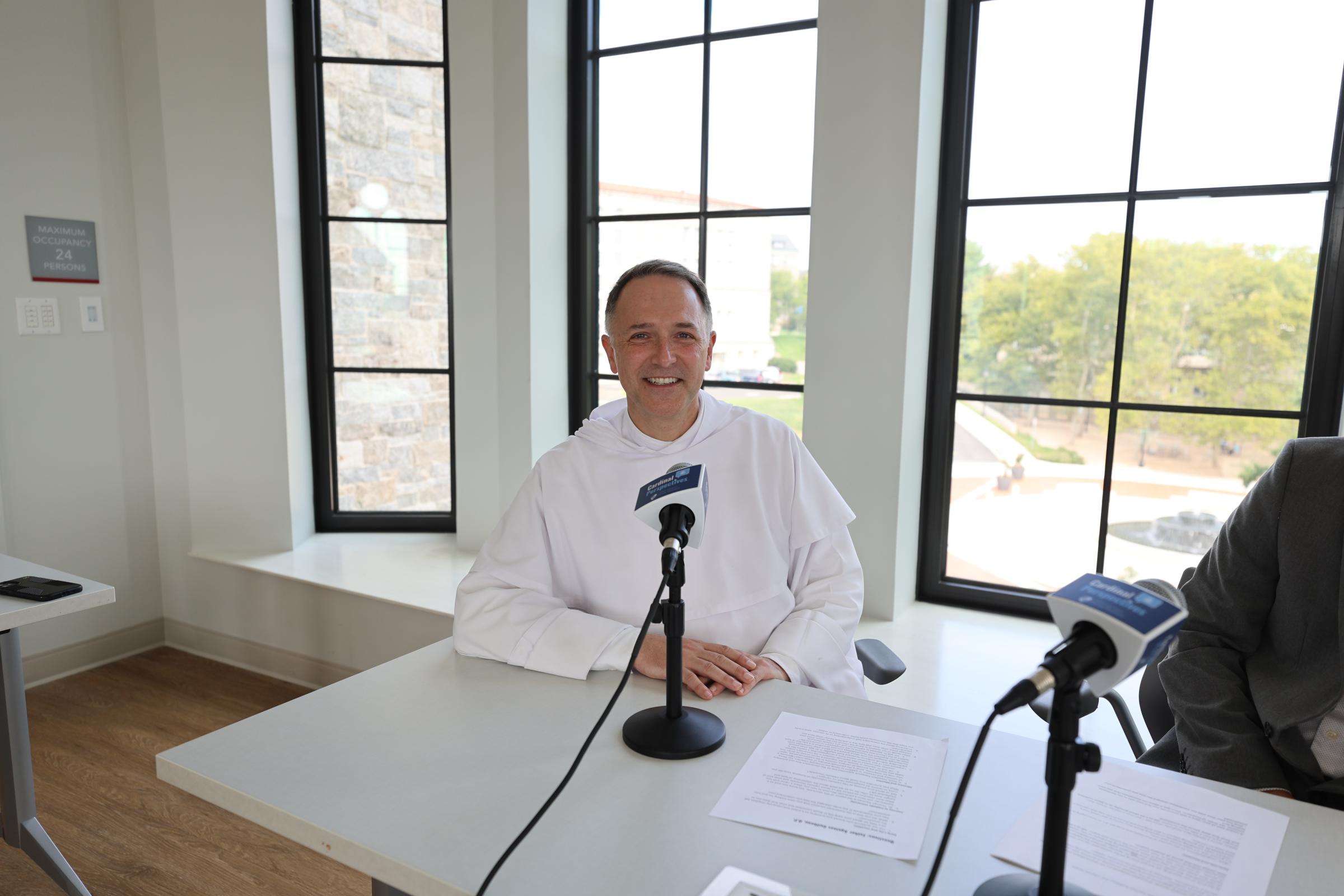
Welcome to Cardinal Perspectives, a series featuring in-depth conversations with alumni, students, faculty, staff and the extended family and community of The Catholic University of America.
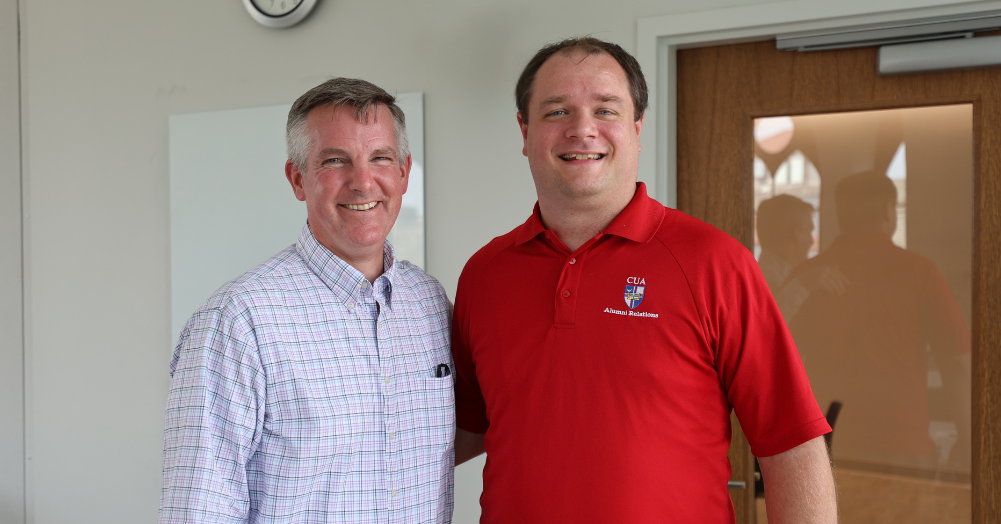
We are excited to feature Father Aquinas Guilbeau, O.P., University chaplain and vice president of ministry and mission at Catholic University.
A native of Louisiana, Father Aquinas entered the Dominican Province of St. Joseph in 2005. After several years of pastoral work in New York City, he began doctoral studies in theology at the University of Fribourg (Switzerland), where he completed a dissertation on St. Thomas Aquinas’s doctrine of the common good. Before arriving at Catholic University, Father Aquinas taught moral theology at the nearby Dominican House of Studies, where he also served for a time as prior of the community.
In October of 2023, Father Aquinas was appointed by President Peter K. Kilpatrick as the University's first vice president of Ministry and Mission, a position that places him in the president’s cabinet alongside other University vice presidents, where he assists in animating the Catholic character of the University.
This conversation is facilitated by Dennis Strach, director of Diosean Engagement.
*This transcript is based on an audio recording and has been lightly edited for readability. It reflects the substance of the conversation but may not be a verbatim record.
Dennis Strach
Welcome to another episode of Cardinal Perspectives. I'm Dennis Strach, the director of the Office of Diocesan Engagement at The Catholic University of America. Today I'm joined by Father Aquinas Guilbeau, a Dominican priest, university chaplain, and vice president of ministry and mission.
Welcome to Cardinal Perspectives, Father.
Father Aquinas Guilbeau
Thank you, Dennis. It's great to be with you.
Dennis Strach
So just for our audience, at the time of our recording, we're just kicking off the school year. We just had our first day of class yesterday. But unlike many on campus, Father Aquinas, you start the academic year a little earlier than most. Just this past week, over 150 student ministry leaders came off of retreat. So your team's been hard at work preparing to accompany that group so that they could be sent out across campus to minister to their peers once the school year began.
Tell us a little bit about that retreat and that group of student leaders.
Father Aquinas Guilbeau
Yeah, that's one of the great things that we've been able to accomplish here at Catholic University. The Dominican chaplains, since we arrived about four summers ago, have worked to expand student leadership and student participation in the real work of Campus Ministry. We went from 25 student leaders in Campus Ministry to 150, and they're a delight. It's just great to be with them. They arrived on campus a week earlier than everyone else, and they got here on a Friday morning.
Friday afternoon, they were on buses to a retreat house. That was the first thing we did with them for an overnight retreat, just to decompress from the summer, but also to enter into a period of quiet and fraternity with each other before getting back to campus, beginning training, and then welcoming the first-year students to campus last Thursday and returning students three days ago, last Saturday. Then, as you said, classes began yesterday. And so, here we are. We've launched the academic year 2026-2027.
Dennis Strach
It's just so encouraging to see the growth of that leadership program, and there's always something uniquely compelling about a peer ministry. We can get into that a little later, but it's definitely exemplified by the growing interest in that program and particular flavor that we have in terms of the way ministry is done here on campus. Father, you're a familiar face across the University. You wear a number of hats, but I thought we'd start a little closer to home.
Just tell us a little bit about growing up in South Louisiana and what first drew you to the priesthood.
Father Aquinas Guilbeau
I've been to many icebreakers with student leaders, and they all ask for a fun fact, right?
So, my fun fact, or one of them, is that I was a diocesan priest before I entered the Dominicans. My trajectory, my path to priesthood, was very tied up in my home parish, in my home diocese, the Diocese of Lafayette, one of the best in the country, I must say. I grew up in a Catholic family in a very Catholic part of the country, and I was just always intrigued by who the priest is, what he does, and how he lives.
I grew up outside of a small town in South Louisiana, but it just so happened that our parish priest retired out in the countryside, literally across the street from where we live. So, even growing up, I just always had the presence of a priest, a good priest, around. When I got to high school and started thinking about what I am going to do next, seminary was just a real possibility, a real choice, and a real interest.
I applied to different colleges. I got into the big school nearby with a scholarship, but decided to apply to the diocese. I was accepted and began studies in the seminary just out of high school. Eight years later, I was ordained a priest for the Diocese of Lafayette, and then three years after that, entered the Dominicans. Why? Well, grace being one of them. That was the grace for priesthood, the call to the priesthood, that was evident earlier on.
I would say the grace of religious life and religious consecration came a little bit later and took a little bit longer to develop and to blossom, so to speak. I grew up in a rural part of the country with very little presence of male religious. There was a vibrant Church and many priests, but there were no religious priests. It just took time to gain that experience, to learn about religious consecration within the priesthood, and to meet communities that lived this out, such as the Benedictines, the Franciscans, the Dominicans, and the Jesuits.
I had real contact with all of those throughout my seminary years and in the first few years of priesthood. Then, with the help of my bishop, I made the apparently right decision, much to his chagrin, of leaving the diocese and entering the Dominicans. I did that in 2005.
Dennis Strach
Like you said, that experience is unique. How has your time with the Dominicans changed the way that you perceive your priesthood?
Father Aquinas Guilbeau
I would say the biggest difference, and probably the one I had the most difficulty adjusting to, is the fraternity of religious life. I grossly underestimated how intensely fraternal Dominican life is. When I was thinking about religious life, that really wasn't what I was focused on. I wanted to be consecrated to the counsels, pick up the intellectual and preaching charism of the Dominicans, and really be a part of that great 800-year intellectual tradition of Thomism.
Those are the things that excited me and drew me. I had great fraternity in the seminary. I had great fraternity among friends, priest friends in the diocese. That wasn't a felt need or felt lack. I just figured, I'm already a priest, and I'll just do priestly things as a Dominican now. By day two of the novitiate, I realized that is not it. These people are always here, and I'm always here with them. They never go away. I have to say, after years now of growing in that grace, I can't imagine not sharing the fraternal life that we have in the Dominican Order.
I say that's probably the biggest change that I experienced: taking up projects as a priest, as a pastor, and as a preacher is always linked to or tied up in the work of others. Diocesan priests live somewhat differently, and by necessity, right?
There's a freedom and independence that the diocesan priest necessarily enjoys, and has to enjoy, as the pastor and a father of a community. He can exercise his prudence somewhat independently in order to take care of the people that he's been given by the bishop to minister to, to lead, to preach to, and to sanctify. There is an independent spirit that's necessary to the diocesan priesthood, which can be, in fact, poisonous in religious life, right?
It can destroy the fraternity that's at the heart of how it is that religious communities live. There's a premium there on the exercise of charity within the community. We need to take initiative. We need to be somewhat independent, but not outside of the common good of the community. That took me a long time to figure out, but I'm glad I did. They haven't thrown me out, so I guess I'm not too disruptive in the community.
Dennis Strach
Well, of course, there's a really unique connection to the University, too, and it's somewhat providential. The Dominican tradition and, as you mentioned, its intellectual tradition intersect with the intellectual life of this University in a pretty profound way. You pursued doctoral studies in moral theology at the University of Fribourg after joining the Dominicans. You wrote your dissertation on St. Thomas Aquinas and the common good, another concept that has profound relevance for University life and the discourse that takes place here.
Thomas Aquinas is our University patron as well. You know him well as a Dominican, you have a particular devotion to him, and you share his name. Let's talk about that connection for a moment in light of your study of him. What might the selection of St. Thomas Aquinas as a patron tell us about Catholic University, especially in the realms of faith and intellectual life?
Father Aquinas Guilbeau
Yes, it makes absolute sense when you consider the history of Catholic University that St. Thomas Aquinas is our patron. Our founder, Pope Leo XIII, received the request of the U.S. bishops at that time to found a national Catholic university, which turned out to be only the second research university in the country at that point. Pope Leo saw the new university as a national university to be located in Washington, in this growing Church of the United States.
It was part of a project that he had already launched earlier in his pontificate: the renewal of Catholic studies, especially Catholic philosophical and theological studies, after the devastations of political revolutions in 18th- and 19th-century Europe. This was also after inroads made by philosophies that were agnostic at best and atheist at worst, taking over the schools and really closing the minds of the young to the full range and scope of reality that we can come to know.
Pope Leo launched an initiative for the renewal of Thomist studies: the study of St. Thomas Aquinas in Catholic schools, beginning early on in grammar school, but going all the way to universities. He just wanted to open up the fullness of the Christian and Catholic tradition, making that available again to the young. He references that project specifically in his letter to the U.S. bishops in 1887, giving them permission to open this new University. With that background, it's wonderful that St. Thomas is our patron, not just because of the conclusions that he reached in his own philosophical and theological studies, which are themselves great and which we should study, but also because of how he arrived at those conclusions, which is especially interesting. It wasn’t just his humility of mind, the breadth of his curiosity, and the tenacity of his study, but also the great confidence that he had in reason to know natural truth and our utter dependence upon the light of faith to know and believe supernatural truth.
We are the knowing animal. We are the questioning animal. We are the talking animal. He understood all of those things and the profundity of their reality. We are a weird creature on this planet. In this whole material creation, look at us. We're strange. He wanted to understand that as much as he could. In taking Aristotle as a guide for the perfection of our natural reason, but also the Gospels as the perfection of our faith or the source of our faith, he had utter confidence that what we know is true. We can base our entire lives, every choice that we have to make, on that, the truth that we come to know. And not just individually: he had a real sense, too, of how we come to know and to live the truth in relation to others, in the family, in the city, and in the Church, as we will continue in the communion of saints in heaven. He had a real sense, too, of the social, political, and economic nature of the human creature, which is something our modern minds cannot overlook at first glance.
Dennis Strach
That brings us nicely to kind of your own relationship with the University. Like we mentioned, you didn't grow up near here, but Catholic University doesn't seem to be the obvious next step in the journey that you've shared so far. So how did you eventually come to be here? How did you receive the assignment at Catholic University?
Father Aquinas Guilbeau
My presence here actually falls into a context of a very long relationship that Dominicans have had with Catholic University. As many of your listeners will know, Catholic University was established here in Washington in 1887, when Washington was part of the Archdiocese of Baltimore. Cardinal Gibbons, the archbishop of Baltimore, as the bishop overseeing the University, wrote to all of the religious communities in the United States present at the time, inviting them to move their houses of study to Washington around Catholic University so that they could receive not only a top-notch formation within the traditions of their own communities, but also a world-class education in theology and philosophy here at Catholic University. So around 1903, the Dominicans took Cardinal Gibbons up on his offer and laid the cornerstone of the Dominican House of Studies across Michigan Avenue, which I think at the time was Bunker Hill Road. So we've been neighbors now with Catholic University since 1905 or so. From the beginning, we Dominicans have been involved in the life of the University, supplying professors in philosophy and professors in theology. A Dominican founded the drama department here at Catholic University. We were also the unofficial chaplains for a long time, from the 30s until the 50s. Then once the University established the office of the undergraduate chaplain, the first three of them were Dominicans from the House of Studies. So when I got here in 2022, I thought, great, that's my place in Catholic University's history, right? I'm the first Dominican chaplain. Nope, not quite.
So we've returned to campus and been invited back to take up the chaplaincy of the University, and we're thrilled to be here.
Dennis Strach
As you alluded to here, your role has grown in many beautiful ways within that year of your arriving. So let's transition a little bit to talk about a Catholic mission. In 2023, President Peter Kilpatrick appointed you as the University's first vice president of ministry and mission, in addition to your role as University chaplain. For people who might not be entirely sure what that title means, what falls within your purview? It really does take you beyond what someone might conceive of as Campus Ministry. It goes beyond that.
Father Aquinas Guilbeau
Right. The portfolio of the position is still developing, as you said. I think the inspiration for President Kilpatrick was a discussion about what the place of the chaplain should be, if at all, in the administration of the University. My understanding is that this discussion began even before I arrived and before President Kilpatrick arrived. That was a conversation that was probably begun by Bishop O'Connell when he was President here, or certainly President Garvey in his latter years.
I think that's basically the first instinct: to have the chaplain of the University at The Catholic University of America be part of the administration.
I sit on the cabinet, and I participate in the discussions that take place there that touch on the common good of the University at the highest administrative level. That's a real blessing. That's something I've enjoyed. Every Monday, when we get together, it's just impressive. The care and solicitude that the President, the vice presidents, and others at the University have for the well-being of the students and the flourishing of this community are really moving.
It's a blessing to be part of that. Of course, the mission officer at any university is the president. It has to be, and so that's the case here. President Kilpatrick is the mission officer of Catholic University. He, as President, articulates the mission, sets the vision, and I think does a marvelous job at that. My role is to help and support him in that, and so we'll have discussions periodically about mission-oriented issues.
I think, together with the rest of the cabinet, the University's been on a trajectory now, probably on its third President, at least, where mission, identity, and the Catholic DNA of Catholic University have been attended to, and real administrative decisions have been made to put an emphasis on that. I think we're seeing the benefits of that. I think around the country, Catholic University is being recognized as a school that lives up to its mission. A lot of schools can talk about whatever their religious or their historical mission is, and sometimes a lot of flowery lip service is given to that. But when you check under the hood, it's, well, how does this, that, or the other thing really fit the mission?
I think that when prospective students and prospective parents come to Catholic University, that mission is not just a couple of sentences on the website, but something palpable as you walk around and see the campus, but even more so when you talk to the students. We're just really impressed by the caliber, the character, and in the Catholic life that our students bring to campus.
So as a priest, as a chaplain, and as an administrator, it's really the students coming in that make our job easy because we're really just responding to what it is that they come here looking for. I think we've seen, over the last several years, classes arrive where the desire to be formed in the fullness of the Catholic tradition, and all that that means, is top of mind for families and students.
Dennis Strach
Can you speak to us a little bit about the challenges of that, too? We have students coming in from all over the place who have been formed in different ways. We have a very diverse staff and faculty population as well. So we conceive of the University as a place where we pursue truth together, but we're living in a moment in time when people might disagree not just about the answers but even about what truth is.
As a Catholic university, we have many different students and staff who are at different places in their relationship with the Church, similar to a parish, but unlike a parish, we have many on campus who aren't Catholic or don't have a particular faith tradition. How do you approach your responsibilities in a way that is deeply faithful to the Church while also taking seriously the complexity and sometimes the disagreement that can come with campus life?
Father Aquinas Guilbeau
That's not just an ecumenical or interreligious question; that's among Catholics themselves, too. We have a lot of people coming from all 50 states who have various experiences of the Church, of prayer, and of worship. We just had the Welcome Back Mass on Sunday night, and I had one or two first-year students come up to me and say, “Wow, that was not like anything my high school ever put on in terms of the liturgy.” But they liked it, and they were open to it.
That's part of our work here, to be as unifying as possible within the tradition of the Church. It's the one and the many. We are one Church made of many persons, and many different experiences and expressions of the faith come together in the life of the one Church. Part of our work, at least within the Catholic community of Catholic University, is to offer a breadth of experience of different aspects of the Church's life, tradition, and practice as a way of uniting people. Regardless of their background and regardless of their preference, they can come together in the oneness of worship, prayer, and service here on campus. We're seeing that increasingly, and that's been a big blessing for us. But as you said, we also have a sizable non-Catholic Christian community: Protestants and evangelicals of various stripes. We also have non-Christians: Jewish, Muslim, and Hindu members of the community, as well as people with no religion at all. That's another benefit, actually, of being a Catholic university. The Church has been in the human being business for 2,000 years.
The Church considers herself a master not only of the Christian soul but of the human soul in general. She has something to say and has something to offer to every human being that's going to resonate as true, good, and welcoming. The Church has great confidence in that. There's a sense in which the more Catholic the Church is and the more explicit she is about her identity and mission as the guardian of the truth of Jesus Christ, the channel of his grace, and the source of salvation for all peoples, the more she is a unifier.
That doesn't mean the Church has to hide her identity and mission in order to fit into the world. In fact, no, the world needs her to be as bold and as Catholic as she can be in a way that is open, is inviting, and genuinely seeks the well-being of all peoples and the salvation of all. The more we can do that here at Catholic University, the more welcoming we are to non-Catholics and non-Christians. I hear that articulated by those members of our community. On the one hand, we have certain Protestants or evangelicals who come to Catholic University because that's what they want. They want four years of engaging the Church. So if we shy back from our mission in any way, that robs them of that experience they're seeking. But also, especially among the non-Christians—the Jewish, Muslim, and Hindu members of the community—they want us to be as Christian as possible because they're curious and they're looking. Or they want to engage as full members of the Muslim or Hindu community with kind of a full Christian community to see whatever that religious or interreligious experience or exchange is going to be.
That excites me too. Just within the last couple of years, we've established a Muslim-Catholic association for bringing our Muslim and Catholic students together in real engagement and dialogue with each other. Within Campus Ministry, we're setting up one of our student ministry teams, an ecumenical team, for evangelical students who have come to us and said, “You know, we love being here. We're part of this community, but don't overlook us. We have a part to play in a way that's appropriate on a Catholic campus.” We're going to help them to do that too.
Those are just two examples of real fruits of being, as fully as possible, The Catholic University of America. If what we believe about the Church is true, it's going to naturally bring people together. That might be counterintuitive, especially to the American experience where we celebrate diversity, and there's a real truth to that. The unity of the Church is not running over and flattening the differences among peoples, traditions, histories, or ethnicities. It's not that. It's being the place where all of that real distinction and real diversity can come together and establish a unity whose foundation is deeper than all of those things.
Dennis Strach
You get there not by watering it down, but by living into the fullness of what it is.
Thanks for that. That's a beautiful response. I'm mindful that our conversation will be shared with our campus community and with our alumni, and mindful that you've given more thought to this than most others. When it comes to our own self-understanding at Catholic University or as a Catholic University graduate, thinking about our unique mission, our self-articulation, is there something you wish the University community better understood or perhaps something we could see more clearly about ourselves?
Father Aquinas Guilbeau
Yes, several things. But we say it in the cabinet all the time. The school really does undersell itself. Traditionally, and even still, we're just bad at telling our own story. Catholic University is a remarkably incredible place. It's got a great history. It plays an integral part in the life of the Church in this country. It forms an integral part of the city of Washington in ways that we don't always appreciate or are reluctant to celebrate, even.
Part of that is the real difficulty that there is in pinpointing what Catholic University is. What's its mission? What's its identity? We like to say we're the bishops' University. We're the national Catholic University. Well, what does that mean? We're defining ourselves against what most people understand a Catholic university to be or a Catholic school. Catholic schools are run by your parish. We've got Catholic universities run by dioceses or religious orders. Especially at those universities run by religious orders—the Jesuits, the Dominicans, the Augustinians, and the Vincentians—the charism of that community pervades the identity, the mission, and the life of those universities. You see that at Villanova with the Augustinians. You see it with the Holy Cross Fathers at Notre Dame. At every Jesuit university—and there are over 30 of them in the country—they all know that to be at a Jesuit university is to be in a community where it is “men and women for others.”
From the president to the contracted landscaper, they can all repeat that phrase. That's how they're brought into the life and the mission of the university. Catholic University lacks that because we are a project of the bishops of the country, still overseen by the bishops of the country. We can't point to that one diocese or that one religious order that really gives the identity and mission of the school. It’s something that every generation that comes to Catholic University has to not only pick up the history and the mission and study, as I said earlier, the DNA of the place, but then also articulate that anew and make it living and relevant for our own day.
Those are two things I would like to see just in terms of mission and identity. On the one hand, I would like to see a revived, renewed understanding of what it means to be the national Catholic University in the United States, established by the Pope, governed by the bishops, but at the service of the entire Church and the entire nation in a unique way with our ecclesiastical schools, but also our professional schools. We sit in the Church differently from all the others, and I think that should inform the way we understand Catholic University.
Also, in all humility, let's toot our horn a little bit more and get excited about the real achievements that take place here, not only in history but also in the great things that we're doing now through our partnerships with NASA, all of the great partnerships we have here in Washington and around the country, what we're doing with AI, the innovations of our nursing school, and the great success that our law school has enjoyed in recent years. There's also the way we've been able to hold arts and sciences together within the Catholic tradition in a way that a lot of schools, frankly, have kind of lost their way on. They haven't let the humanities be taken over by ideologies that ruin those studies. There's a lot of good here, and there's something good here for everyone. I think we need to be, in all humility again, a little prouder of what Catholic University is and has achieved and make sure others know about it. That's what I say there.
Dennis Strach
Let's make sure everyone knows about the good things that are happening in Campus Ministry, too. You've done a lot of great work, fantastic work, and again, I'm cognizant that many of our listeners haven't been to campus or don't see sort of the day in the life of a student here. Just give us a sense of that growth you mentioned before, like the ecumenical dialogue taking place or how we talked about our student leaders and the success of that program.
What are some other highlights that you'd like to let our audience know about?
Father Aquinas Guilbeau
The thing that struck me first in engaging the students when I got to campus four summers ago was that they want the Lord. That's it. We have a real critical mass of students who come to us already having met Jesus, whether it's their home parishes, their families, or their high schools. They're well on their way and well down the path and road to conversion. That's what they're looking for, not a lot of frills, not a lot of entertainment. They just want this: “Give me access to the Lord, teach me the truth, give me the sacraments, and make the tradition and life of the Church available.” That's basically what we've tried to do. It's the old evangelization. Before we even get to the new one, let's perfect the old one. That's what we've really tried to work on. The image I use for our Campus Ministry staff is that we are just the furniture around campus. We are the spiritual furniture that's immovable and that students have to walk around because they can't avoid it.
Sometimes they sit on the couch when it's necessary. But even if they don't always choose to sit, they know it's there when that time in their life comes, when they're exhausted by the world and ready to do something new. What we've set up is a regular, consistent, and predictable liturgical schedule, as well as a schedule of service. We've got five Masses a day at the same place and same time every day. We've got two scheduled sessions for confession every day. Again, same time, same place. We have four or five weekend Masses and three Holy Hours per week, on Tuesday, Wednesday, and Thursday evenings, so the students know to come there. We also hear confessions during those times. We have two Eucharistic processions a year, one each semester.
We've just opened a 24/7 adoration chapel. There are many chapels around campus, many of them with the Blessed Sacrament, but none of them were accessible to everyone all day long. Some are in residence halls, and some are in academic buildings, so not everybody can get into all of them, but now we've established one where, with tap access, anyone with a Cardinal Card can get in 24/7. That's been a real blessing.
In terms of service, we have over 10 volunteer sites per week. Students sign up. We have something every day of the week in terms of volunteering and service. We run seven mission trips a year. Most of those are over spring break. We have two University-wide service days per year. We facilitate a lot of short-term and long-term service after graduation. Those are the things we just do on the regular, just in terms of making and providing the structure, the furniture, so to speak, for any student, faculty member, or staff member to take the reins of their own spiritual life and deepen their friendship and relationship with the Lord.
Dennis Strach
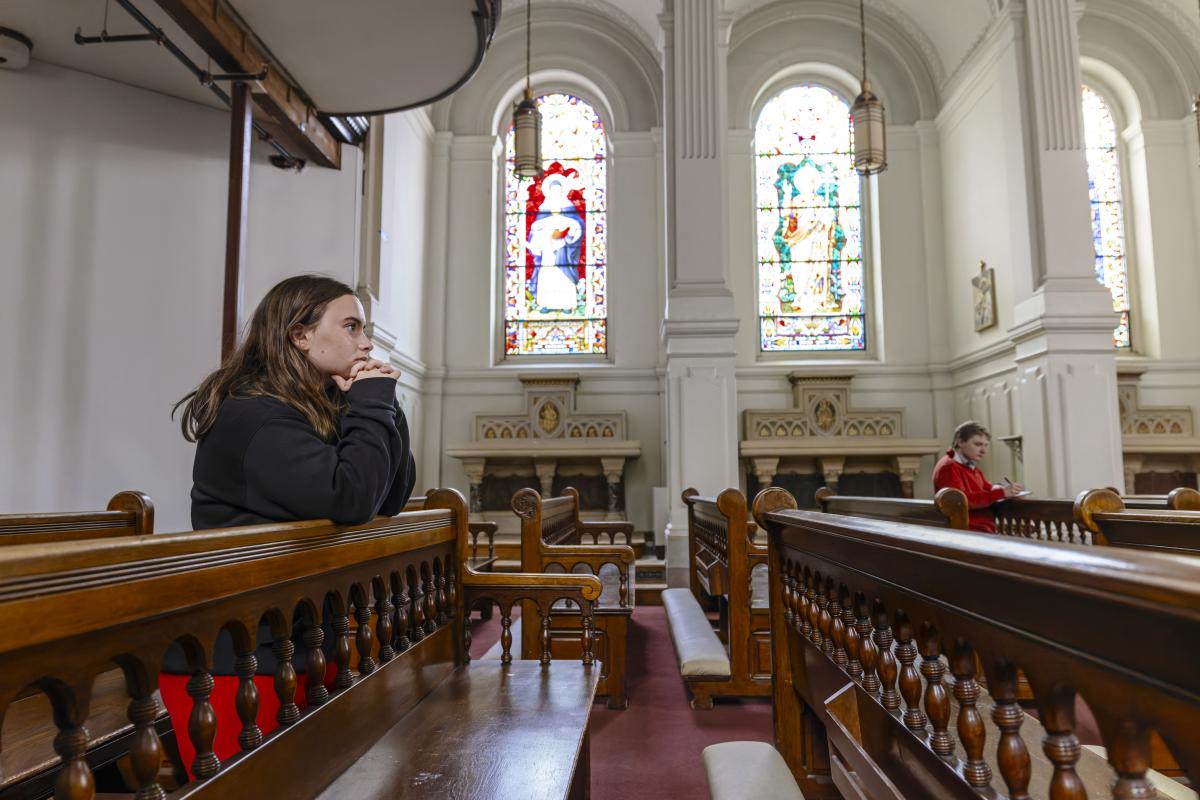
For anyone on campus, St. Paul's Chapel in Caldwell Hall is something of a spiritual home. I guess relating back to telling our own story better, a number of our alumni are on the path toward canonization. That's certainly something unique. Among them are Servant of God Sister Thea Bowman and Servant of God Father Emil Kapaun, whom students will experience in a really unique way next year during World Youth Day when they travel to Seoul, South Korea, and hear about that devotion from folks who have a great devotion to him locally in the local Church.
Arguably, one of the most famous alumni and former professors is someone who [was beatified in September] Archbishop Fulton Sheen. I did one of these Cardinal Perspectives interviews with Cardinal O'Malley, and he spoke about his time at Catholic University and serving for Archbishop Sheen in St. Paul's Chapel in Caldwell Hall.
Thinking about his time in that chapel and mindful that you are helping to lead a campaign to really preserve and uplift that space, tell us a little bit about that project and what that means to you to be able to lead a restoration project of that chapel in the same year that he's being beatified.
Father Aquinas Guilbeau
Yeah, this is really a moment of grace for the country, certainly, and for the Church: another native-born citizen of our country raised to the dignity of the altars, someone whom a lot of people still living saw on television when they were growing up. I was just talking to my dad about how that was a staple in his home with my grandparents when he was growing up: watching Fulton Sheen on TV every Sunday night. We'll be celebrating Mass in his honor soon enough.
It's probably one of the forgotten parts of Fulton Sheen's biography or one of the lesser-known or lesser-understood aspects of his biography that he spent a quarter of a century here at Catholic University, over a quarter of a century, first as a student and then for 24 years as a professor in both the philosophy and theology schools. I would like to think in a certain way, Catholic University helped make Fulton Sheen. He had incredible natural talent as a communicator and was a deep, deep, deep disciple and friend of the Lord and a priest.
He had those things before he came to Catholic University, but what I would like to think that he learned at Catholic University was that he became the master communicator he was through his personal study here, through the teaching of his classes here. Basically, he kind of crafted his material here and tried it out on the students. I can't help thinking that a lot of the lines, tropes, and themes that he poured into his TV show and poured into his public preaching later in life, he developed and honed here at Catholic University.
And, of course, it's the hours and hours and hours of prayer that he offered in Caldwell Chapel and St. Paul's Chapel and elsewhere around campus. One of the many beautiful aspects of his biography, Treasure in Clay, is that in one of the chapters, especially the chapter that he dedicates to Catholic University, Archbishop Sheen just mentions that walking from place to place or between classes or anything, he would just pop into St. Paul's to make a visit to say hello to the Lord present in the Blessed Sacrament.
That was just an expression of a deep piety, a deep faith, and a deep devotion that he had to the Real Presence. Later in life, he really preached, especially to priests, the necessity of the daily Holy Hour, and that has shaped generations of priests now in the United States, where diocesan priests all over the country set themselves down in their parish churches or maybe in a chapel in the rectory and spend that essential time before the Lord in prayer.
Fulton Sheen was really an apostle of that devotion, and again, I think that's the most important thing that I'd like to think he developed here at Catholic University. That chapel in Caldwell Hall, St. Paul's, is the oldest on campus and, some would say, the most beautiful. It won awards when it was opened in the late 1880s or at least it was recognized nationwide as a marvelous building and a marvelous church. It's seen some tough times. In recent years, we've accomplished a lot of the foundational and structural updates that are needed, but now what's left are the more cosmetic ones. The chapel needs new painting, new lighting, and a new sound system. The floors need to be redone, and the pews need to be redone. We found an old set of Stations of the Cross that once hung in the chapel. They need to be redone, and we'll put them back. It’s the organ, original to the chapel, that needs replacing, and so we'll be beginning a campaign very shortly as a way of not only beautifying and restoring a precious part of our campus but also honoring Fulton Sheen, who spent so many hours there praying and celebrating Mass. It's a way of our participating in celebrating his beatification by restoring to its former beauty and former glory a chapel that he himself loved so much.
Dennis Strach
Well, Father, before we let you go, I want to finish with something a little lighter. I'm going to take a cue and some inspiration from the Dominican Sisters Mother of the Eucharist, whose Open Mic podcast is topping the charts as we speak.
Father Aquinas Guilbeau
I saw that on X. I confess I haven't listened to it yet, but that's great.
Dennis Strach
Sister Miriam is actually an alumna. So tossing that out there.
Father Aquinas Guilbeau
Just another thing that Catholic University has given to the world.
Dennis Strach
There's always a speed round. So, we'll end with that if you're ready.
Father Aquinas Guilbeau
Sure.
Dennis Strach
Just quick answers here. Favorite place on campus?
Father Aquinas Guilbeau
There's this little stairway behind Caldwell Hall where each step is not even with the others. So, to my mind, that's the most medieval part of campus. As Dominicans, with our 13th-century hearts, we love those kinds of things. That's my favorite part of campus.
Dennis Strach
One thing every Catholic University student should experience before graduating?
Father Aquinas Guilbeau
The love of Christ. That’s what we exist for.
Dennis Strach
Current hobbies? How are you spending your time these days when you’re not working?
Father Aquinas Guilbeau
I like to run. I've jogged for a long time, so I try to get that in. But other than that, just reading various things.
Dennis Strach
I know that when you first came here, you had a sort of a speed round thing that is out on the web somewhere. So, besides the Summa Theologica and besides the Bible, what’s one book you'd put on every student's required reading list?
Father Aquinas Guilbeau
Can I say two?
Augustine's Confessions, so we get a male author there. And then The Dialogue by Catherine of Siena, so you get a female author there. Any student can spend a lifetime mastering those two books together.
Dennis Strach
One idea from St. Thomas Aquinas you return to most often?
Father Aquinas Guilbeau
That through faith, hope, and charity we come to possess a divine person.
Dennis Strach
Louisiana cooking or Dominican cooking? You're responsible for the cooking, aren't you?
Father Aquinas Guilbeau
So if we mean by Dominican, like from the Dominican Republic, I have little experience of that, and I'm sure if I did, I'd love it, and it might rival Louisiana cooking. But if we're talking about the Order of Preachers cooking and Louisiana cooking, Louisiana, obviously.
Dennis Strach
Are you still in charge of the menu in the refectory?
Father Aquinas Guilbeau
We do that for big feasts. I led the cooking team for Christmas last year. Of course, it was delicious.
Dennis Strach
Of course. All right, we'll end with this one, a little more serious. You've talked about mission, ministry, students, the Church, and the future of Catholic University. When you personally pray for Catholic University, what do you pray for?
Father Aquinas Guilbeau
Many things. We want the flourishing of our students and continued financial solvency, among other things. But I would say the biggest thing is that Catholic University fulfills the mission, remains true to her identity, and, in doing those things, is a real beacon of light, truth, and love, not just for our city and the Church, but for this country.
Dennis Strach
Father Aquinas, thank you. This has been a wonderful conversation, and we're grateful for the ministry you provide to the entire Catholic University community. Congratulations again on the upcoming restoration of our chapel. I know that'll be something very exciting for our entire campus to support and get behind, and it will be exciting to be in that space where Blessed Sheen celebrated Mass and visited the Lord in the Eucharist.
Thank you again for joining us, and thank you to our listeners for being here.
For more information on the Office of Campus Ministry at The Catholic University of America, we invite you to visit us online at ministry.catholic.edu.
Published on: Friday, October 30, 2026
Tags: Cardinal Perspectives, Campus Ministry, advancement