

The Law and Entrepreneurship Program (LEP) at the Columbus School of Law fosters professional and personal growth by developing practical skills and business knowledge, cultivating principled entrepreneurship, and introducing law students to a wide range of career trajectories. Anchored in business law, ethics, and service, this program prepares the next generation of lawyers to serve clients and advise founders with the mindset of co-creating within the context of entrepreneurship.
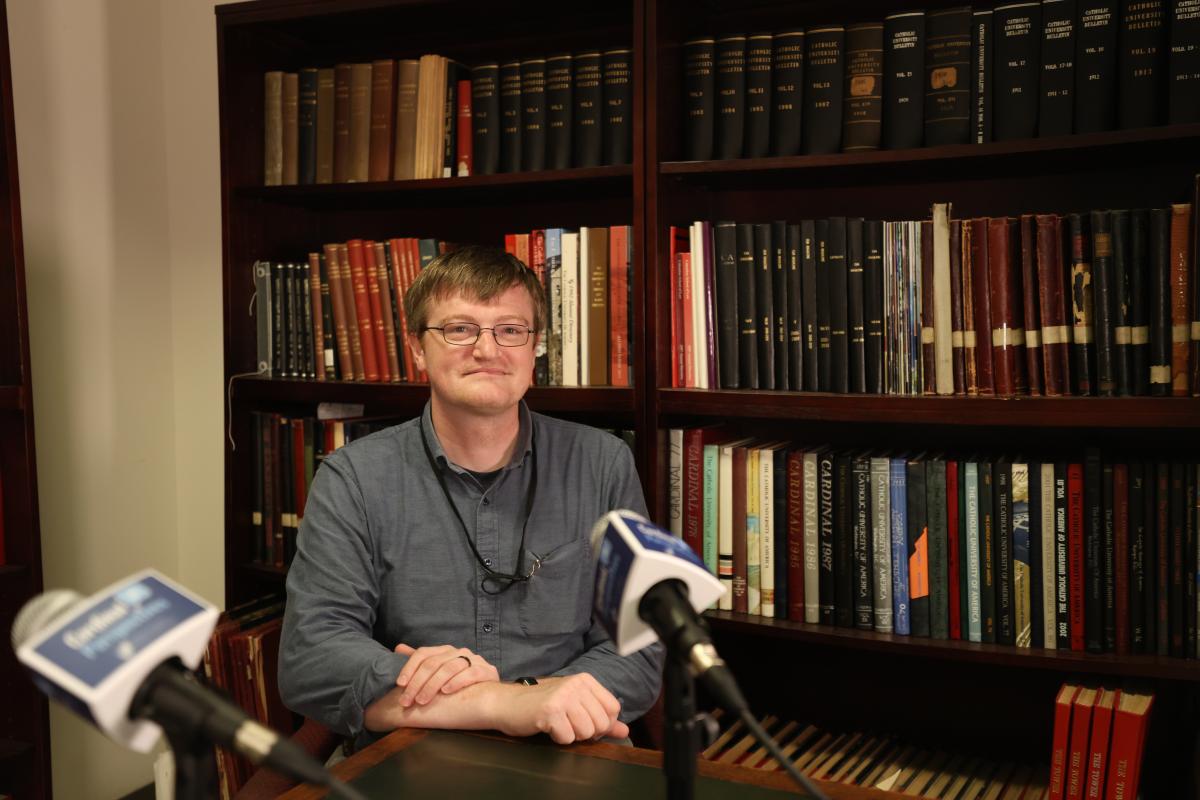
In this Q&A, we feature Professor Seth C. Oranburg, J.D., who joined Catholic Law this summer as co-director of the Law and Entrepreneurship Program. Oranburg shares about what drew him to law and entrepreneurship, what makes Catholic Law's curriculum stand out, and what is in store for the future.
How did you first become interested in the intersection of law and entrepreneurship?
My interest in law and entrepreneurship began in Dean David Zarfes's Corporate Lab at the University of Chicago Law School, a clinic where students did transactional work for Fortune 500 clients. At first, I participated on the Verizon team, building out a 50-state survey of do-not-call laws. But then I saw an on-campus flyer advertising a business competition at the nearby Booth School of Business Polsky Center for Entrepreneurship. I asked Dean Zarfes whether I could start a new team of Corporate Lab students who advised the Polsky competitors. He agreed, and through that work, I met some of the most interesting, dynamic people. Especially compared to the hum-drum work I'd done before in corporate, the novelty, complexity, and unscripted nature of supporting startups thrilled me.
This experience not only changed my career trajectory – I had originally planned to provide antitrust support on large corporate mergers and acquisitions at a firm in Washington, D.C., but pivoted to getting a California law license and practicing in Silicon Valley – but also alerted me to how clinical legal education changes students' lives. Even though my work at Catholic University is primarily doctrinal teaching and research, I love building and supporting experiential and clinical education here.
What drew you to Catholic Law and how did the opportunity to co-direct the Law and Entrepreneurship Program influence your decision to join the school?
Catholic Law offered me two irresistible career opportunities in an unbeatable location. First, I was looking to go beyond a pure law-and-economics approach to my research, especially in matters of public concern. At the Columbus School of Law, I found colleagues engaged with moral philosophy who made it clear that here I could achieve a more ambitious research agenda: namely, understanding and describing legal systems as tools and technologies whose virtue comes from supporting human thriving. My future work on law governing organizational and market behavior will tap into ancient wisdom on the nature of the human persons that these artifices must serve. Engaging with moral questions as well as economic ones will make my research life more fulfilling.
Second, co-directing LEP is an entrepreneurial opportunity for me as well as my students and their clients. As my co-director Professor Alexander Hoffarth says, now it's "a time to build." We are going to build a world-class program that harnesses Catholic University's unique strengths, which include partnership with the Busch School of Business's Ciocca Center for Principled Entrepreneurship, support from leadership and colleagues who recognize how supporting meaningful vocation dignifies the human person, momentum of a law school on the rise, and need in our local communities that we will serve. I'm very confident that we'll open new pathways for law students to pursue meaningful and productive careers in transactional lawyering.
One of those strengths, of course, is Catholic University's powerful position in our nation's capital. As an entrepreneurial attorney who deals in highly regulated areas, Washington, D.C., is a singularly awesome place for me to work.
Professor Alexander Hoffarth built a strong foundation for the program as it launched. As the new co-director, how do you hope to build on and enhance what was established last year?
This year is a time to build strength upon strength. Professor Hoffarth's energy, enthusiasm, creativity, and wisdom created a melange of opportunities from which we can draw. Now I can help us focus on deploying resources into targeted areas, including new certificate programs, new student fellowships, new scholarly workshops, and new public-facing events.
To put this in entrepreneurial terms, Professor Hoffarth delivered on proof-of-concept. Now we have our seed funding. This year we are going to market with a minimum viable product. We're going to meet and exceed expectations with innovative programs that will demonstrate how we're prepared to double down on what works. Then we're going to scale up, demonstrating that Catholic Law means business.
Are there any new courses, features, or initiatives of the Law and Entrepreneurship Program that people might not know about yet?
Our most exciting new initiative is the Law and Entrepreneurship Certificate. Students who participate in our curricular and co-curricular opportunities will receive a durable credential that demonstrates their practice-ready skillset. Supporting students throughout their careers is our number one priority, so we are most excited about offering them a value-add credential they can earn through additional effort but without additional cost.
We are also thrilled to begin producing high-impact community-facing programming based on annual themes. This year, our theme is "Entrepreneurship: Curing Poverty." I won't spill the beans on our keynote speaker just yet, but I'll say this: our program is so exciting that an internationally renowned entrepreneur and author waived her typical speaking fee to present to our community.
One thing to look out for is our more expansive Fellows Program. We’re building toward a two-year track that gives our most committed students opportunities they can’t get anywhere else: a practicing attorney as a personal mentor, a placement in the clinic or an externship, funding for travel to conferences, and, perhaps most importantly, our trust and confidence. We will empower student fellows to take on and succeed in leadership roles in LEP programming they “own” so they can build confidence in their abilities while cultivating the spirit of service.
New courses are also in development. We've identified and prioritized a list of specialized courses that support entrepreneurial lawyers – including venture capital finance, mergers and acquisitions, accounting and finance for lawyers – and are actively engaged in recruiting and retaining world-class faculty to offer more of these "private law" courses.
What does "principled entrepreneurship" mean to you, and how does that framing shape how you train lawyers to advise founders?
Principled entrepreneurship means being in partnership with suppliers, customers, employees, and other stakeholders. While some people have a negative view of capitalism as exploitative, we understand business partnership through the lens of Catholic Social Thought and economic ethics as "contractus societatis," which incorporates shared goals, solidarity, and fellowship. Human dignity is the core principle. We understand that while owning private property is a natural right of humans, we have moral obligations to use that property to elevate others.
In my Jewish tradition, this is what the great philosopher Maimonides called "shutafut," meaning collaboration. Expressions like "strengthening another's hand" or "teaching a man to fish" resonate with meaning in the Judeo-Christian tradition. We honor that shared tradition by teaching students to eradicate poverty through valuable business relationships that create and restore self-reliance. At its core, principled entrepreneurship dignifies the human person as a sub-creator in imago Dei. We empower our students to pursue justice by selecting the right projects and guiding clients to go beyond mere legal compliance toward ethical and moral economic enterprise.
What's a piece of advice you find yourself giving business owners over and over again?
Start business projects with candor. In the beginning, capitalize on excitement to have the tough conversations about what happens if things do not go as planned. I've never had a client whose startup didn't pivot as the real world teaches you what theory cannot. Sometimes things go better than anyone dreamed: are you prepared to capture that value? Sometimes things do not go so well: who's prepared to bear downside risk?
One of the greatest things a lawyer can offer is the wisdom encapsulated in that cheesy State Farm commercial: "We know a thing or two because we've seen a thing or two." Once a lawyer's gone through a few dozen startup cycles, she or he develops the virtue of foresight. Sharing that foresight with clients who are often starting their very first new venture is a gift worth giving.
What's your vision for the program in the next few years?
We see LEP following the model established by Catholic Law's groundbreaking public-law programs like the Center for the Constitution and the Catholic Intellectual Tradition, the Center for Law and the Human Person, the Center for Religious Liberty, and the Separation of Powers Institute. Those programs make Catholic University a thought leader when it comes to the relationship between citizens and the state. We envision LEP as complementing this with thought leadership when it comes to the relationship between private actors.
Is there anything else you would like to share about your background or what you are looking forward to at Catholic University?
Aside from the various ways in which I am confident that my professional ambitions will be nurtured at Catholic University, I am looking forward to developing my spirituality and Jewish religiosity here. Catholic University welcomes and supports all people of good will. That's not a tagline – it's my lived experience.
Not only is being on campus a joy (it's a beautiful place with green spaces you won't usually find so close to power centers), but also the Washington, D.C. area is a wonderful place to raise my family. I found an amazing community in the Kemp Mill neighborhood of Silver Spring. Whether I am in my house or in my office, I feel at home. After nearly twenty years of moving all over the country to pursue my education and career, I am looking forward to setting down roots in such a wonderful place.
Published on: Wednesday, September 9, 2026
Tags: Catholic Law, Columbus School of Law, advancement