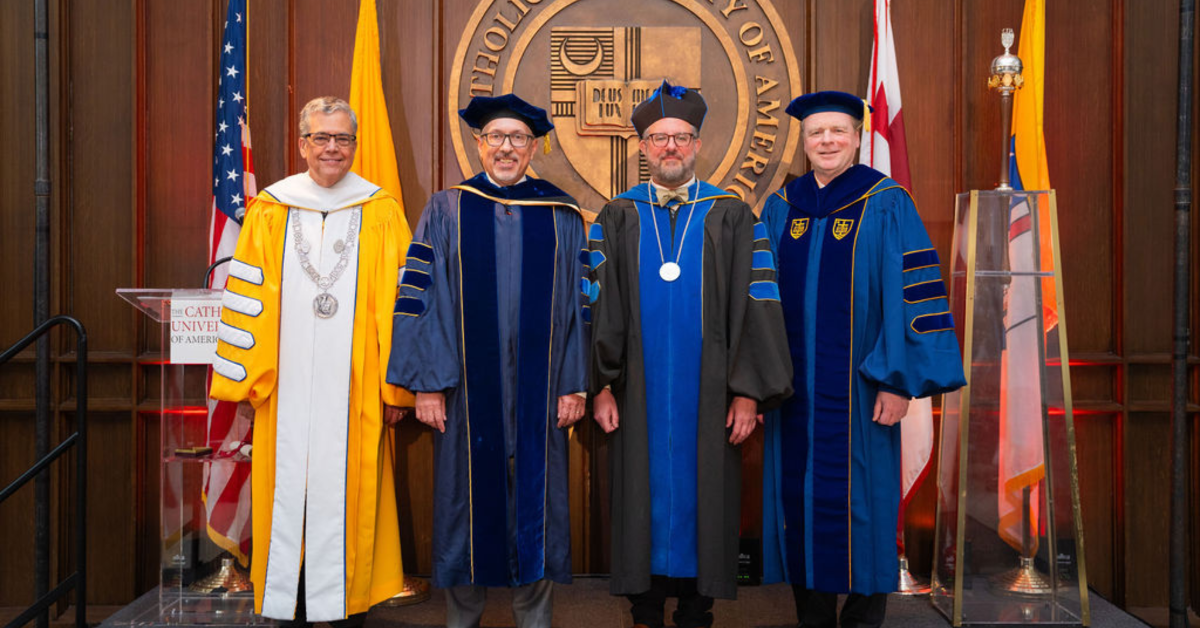

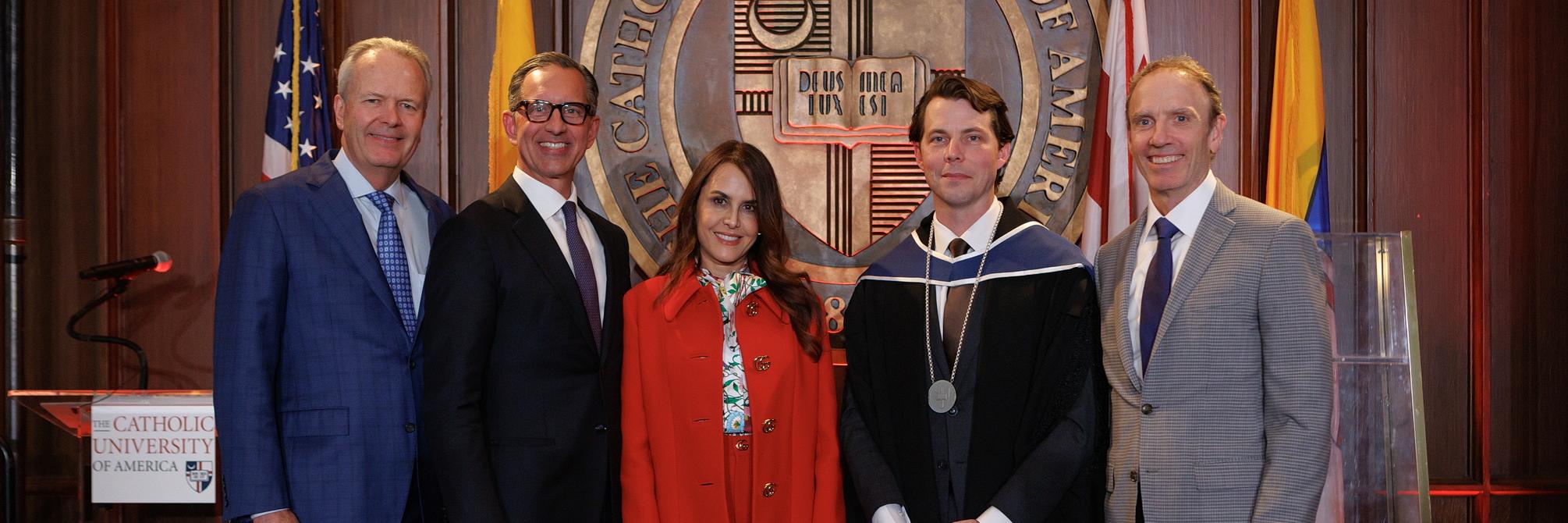
On Tuesday, March 24, the Busch School of Business celebrated the installation of Professor Nicholas Schmitz as the inaugural Trey and Nina Traviesa Endowed Chair in Finance. The ceremony marked a significant milestone for the school, underscoring its commitment to forming principled business leaders and advancing the integration of faith and finance.
Around the same time initial discussions for the creation of this chair occurred, Professor Schmitz was introduced to Andrew Abela, dean of the Busch School, by Father Aquinas Guilbeau, O.P., University chaplain and vice president of ministry and mission. Prior to joining Catholic University, Schmitz served in the United States Marine Corps, graduated from the U.S. Naval Academy, and studied at the University of Oxford as a Rhodes Scholar. He later earned an MBA from Stanford University, returned to serve on the faculty at the Naval Academy, transitioned to a role at Goldman Sachs, and served as an early partner and portfolio manager at the startup hedge fund Verdad Advisors.
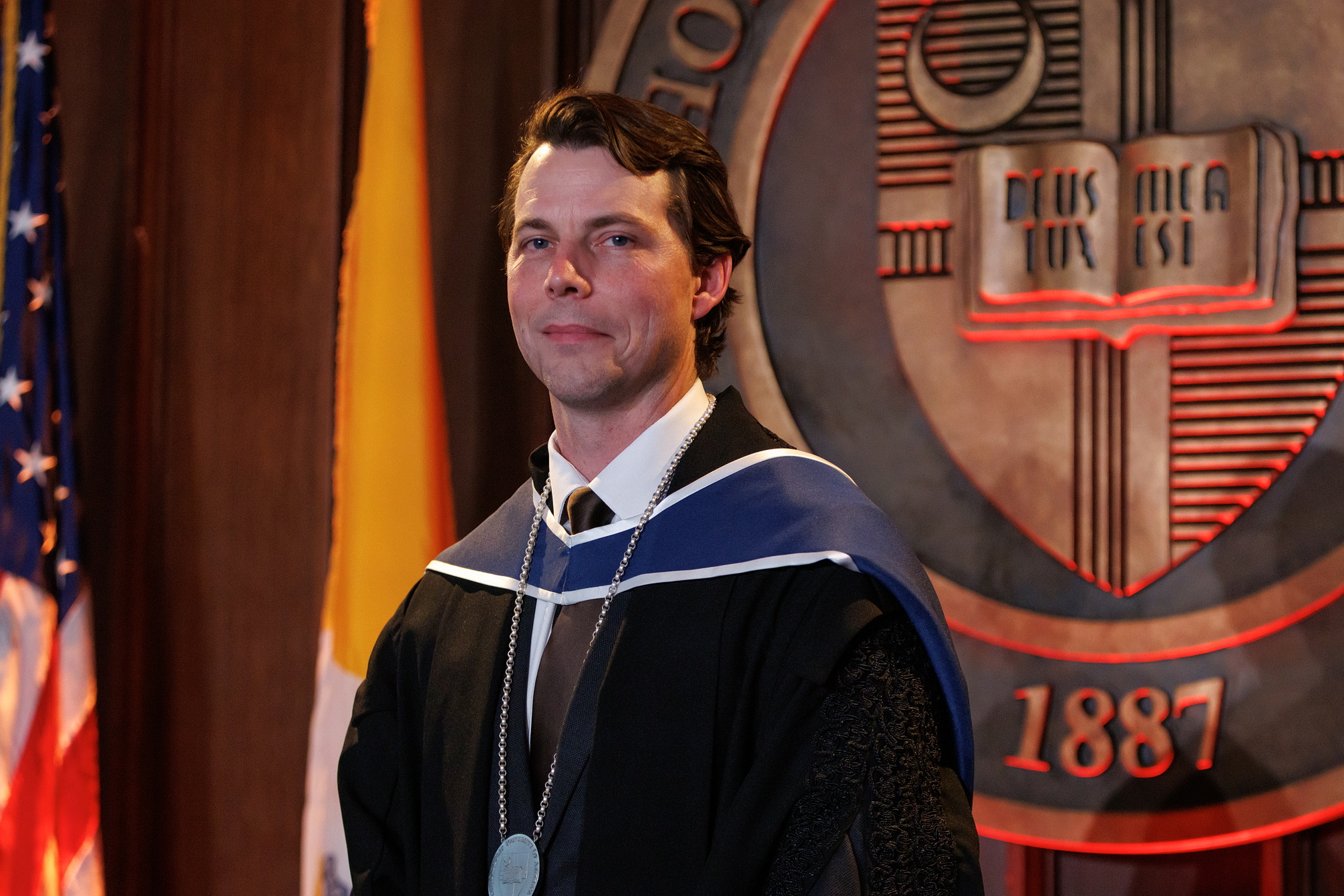
In his remarks, Dean Abela described Schmitz’s appointment as a “providential” fit for the role, “We needed someone who understands Wall Street, is deeply committed to the Catholic faith, and has the intellectual credibility of a professor. That combination is rare—but it is present in Nick.”
The Trey and Nina Traviesa Endowed Chair is the third endowed chair in the Busch School of Business. It was established through the generosity of Trey and Nina Traviesa, Leonard Leo (P’20, ’24) and the Marble Freedom Trust, Chris and Becky Lagan, and Tim Busch. Their collective investment reflects a shared commitment to forming ethical leaders in business and finance.
University President Peter Kilpatrick expressed gratitude to the benefactors and highlighted the broader significance of their gift.
“As Catholic business and civic leaders, the Traviesas’ commitment to faith, family, and service guides their philanthropy.” President Kilpatrick added, “Through this endowed chair, they aim to inspire entrepreneurial generosity and strengthen the Busch School as a place where ethical leaders are formed and sought out.”
Trey Traviesa, who serves on both the Busch School Board of Visitors and the University’s Board of Trustees, spoke to the vision behind the chair and the need for virtuous leadership in finance.
“Finance is good—it is a powerful bridge to many goods,” said Traviesa. “At the Busch School, the currency isn’t money, but souls. We are called to use our gifts to multiply those who will join our Father in heaven. This chair is part of that mission. We need God in every C-suite, every boardroom, every budget meeting, and every investment committee. Finance can be the means to bring Him there.”
The installation also highlighted the Busch School’s leadership in advancing Catholic principles in business practice. Dean Abela pointed to Professor Schmitz’s early impact in promoting the United States Conference of Catholic Bishops’ (USCCB) socially responsible investment guidelines.
“Within months of joining the faculty, Nick brought Institutional Shareholder Services (ISS) Inc. and Glass Lewis to adopt the Busch School’s guidelines as an option for investors—and he is continuing to engage major corporations and advocate against corporate policies that are hostile to the Catholic faith,” stated Abela.
As the inaugural chair holder, Schmitz described his role as “a sacred trust” and outlined his vision for forming students who combine intellectual rigor with moral purpose.
“My goal is to mentor students to become independent thinkers in finance—not parrots of consensus, but decision-makers with judgment and courage.” Schmitz continued, “If we graduate financiers who combine competence with character, their collective impact will far exceed anything I could accomplish alone.”
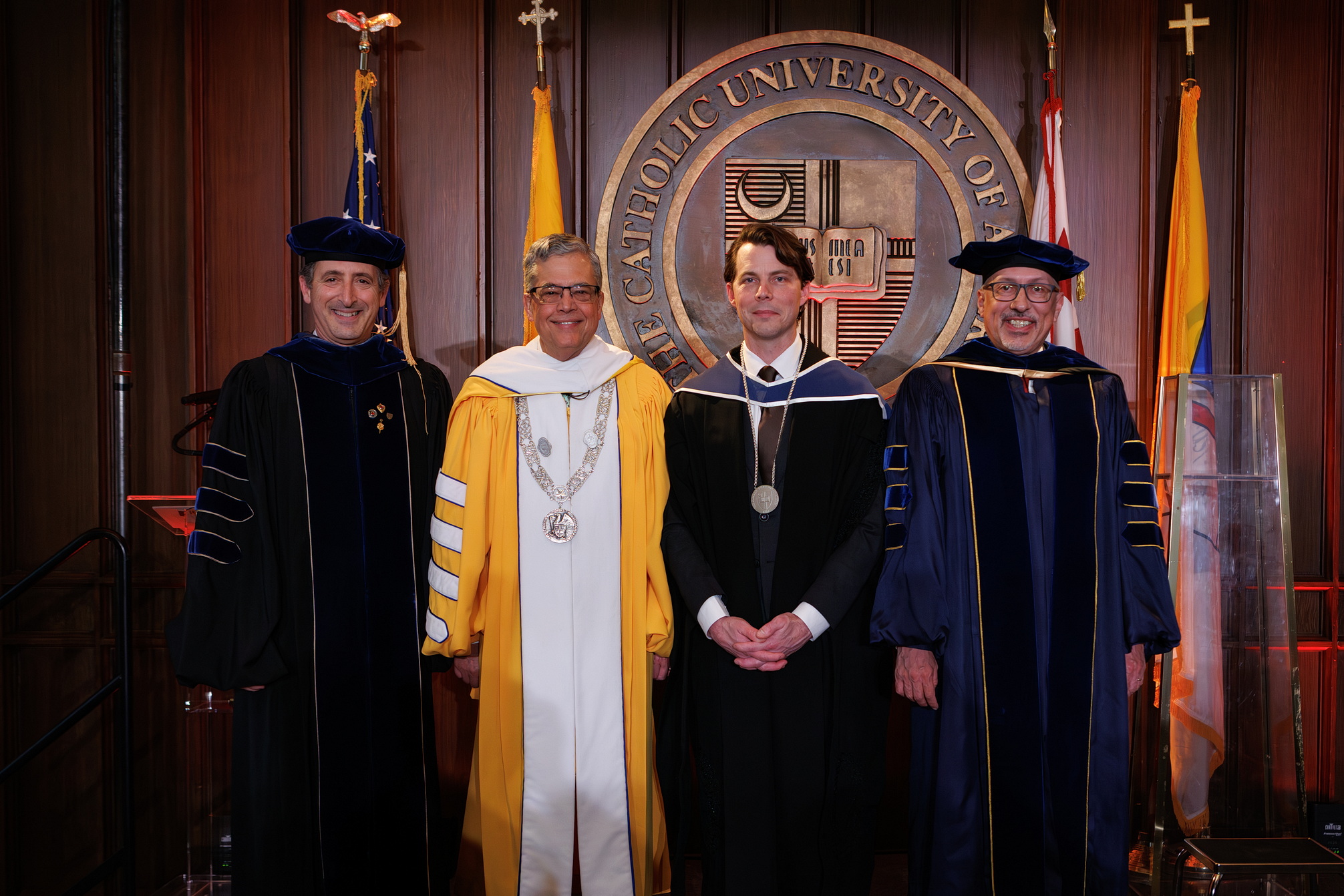
Through the establishment of the Traviesa Endowed Chair and the leadership of faculty like Professor Schmitz, the Busch School of Business continues to strengthen its role as a national leader in business education—forming graduates prepared for both professional success and lives of ethical leadership and service.
For more information about Professor Schmitz and his work, please visit this link.
Experiece the ceremony
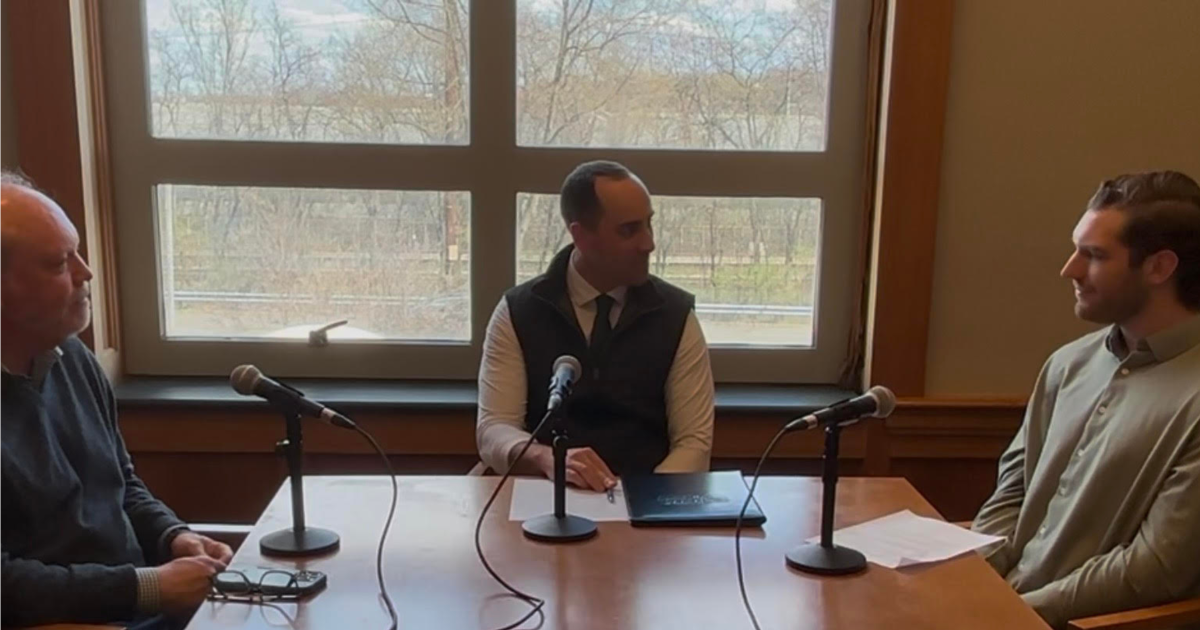
Please enjoy watching the ceremony and reading individual remarks.
Andrew V. Abela, Dean, Busch School of Business
Nicholas Schmitz, Assistant Professor of Practice (Finance), Inaugural Trey and Nina Traviesa Endowed Chair in Finance
Trey Traviesa, Board of Trustees, Catholic University, Benefactor
Read the Remarks
Michael Kish, Class of 2026
Good afternoon, and welcome to The Catholic University of America. My name is Michael Kish. I’m the student body president and a senior student of the business and philosophy dual degree program. I will be your master of ceremonies today.
Thank you so much for joining us on this special occasion, where we will officially install Professor Nicholas Schmitz as the Trey and Nina Traviesa Endowed Chair of Finance at the Busch School of Business.
I’m grateful to be a part of today’s ceremony, precisely because Professor Schmitz represents the highest form of what the Busch School accomplishes: the unity of rich fath and excellence in professional life. We’re grateful to have him teaching here at the Busch School, where he is beloved by his students for his blend of scholasticism, classical philosophy, and modern day financial principles in an engaging and novel way. That blend is exactly why I and so many others cherish the Busch School and her professors.
The relationships that students and professors make here are unlike any other. They’re rich, friendly, and rooted in promoting the virtue and spiritual wellbeing of each and every student. Professor Schmitz is the perfect example of the kind of teacher who is truly concerned with bringing out the best in us, and that’s exactly why we’re here to celebrate his installation today.
Andrew V. Abela, Dean, Busch School of Business
Honored guests, colleagues, students, friends: welcome.
It is my honor and privilege to welcome you all to this very special occasion: the establishment of the Trey and Nina Traviesa chair in finance.
I would like to share with you the history of the events that lead to the creation of this important chair.
The United States Conference of Catholic bishops issued a number of socially responsible investment guidelines — the initial one in 1991, an update in 2003, and a major update in 2021.
The earlier versions just focused on screening portfolios to make sure you don’t invest in companies that are largely focused on doing things that are intrinsically evil: pornography, for example. But the 2021 version had two new things: voting shareholder proxies and to engage with corporate management.
No one knew how to do that. So, I called a meeting, inviting the leaders in the Catholic investing space: the Knights of Columbus asset advisors, Christian Brothers Investment Services, Congress Asset Management — Chris Lagan is here with us today from Congress — and a few others. Also present were my colleagues, Busch School Finance Professors Dr. Irene Kim and Dr. Dan Svogun.
We had a very productive day going through the issues, but nobody could really figure out how to deliver what the bishops were asking for.
At the end of the day, one of the participants – not one of the ones I mentioned – said, “I think the Busch School should take leadership on this.” And he had this kind of smirk on his face that sort of said: “If you’re suckers!”
And in my naivete, I said, “Sure, this sounds like something we should do. We exist to serve the Church and nation, and this is very important to the Church and the nation.”
That led to a project that lasted about two years. Along the way, we came to realize why we were suckers.
It seemed that no one wanted to know. The attitude was, “Just leave us alone to invest our money, and we’ll just follow the older USCCB guidelines. Don’t cause trouble here.”
You see, the problem is every shareholder who owns any number of shares in a company is entitled to vote those shares at the company’s annual general meeting. But if you have any decent size portfolio, you may own dozens, perhaps hundreds of different companies’ shares. And at every annual general meeting, there would be dozens of shareholder resolutions that you would be entitled to vote on, potentially thousands of resolutions a year. Your average investor just doesn’t have the time, or even knowledge, for that.
So most investment companies actually just take care of the voting for their investors, and they did this by delegating the voting to two companies who collectively handle about 90% of this proxy voting business. The two companies are called Institutional Shareholder Services (ISS) Inc. and Glass Lewis.
“Who cares?” You might say. “Why not just let them vote on our behalf? It’s all sort of technical stuff, right? Why don’t we just vote with whatever management recommends and be done with it?” And in fact that’s what most people were doing.
The problem was an increasing number of resolutions were coming to these company meetings that were very significant from the perspective of our Catholic faith. Activists, who couldn’t achieve their socially progressive goals at the ballot box, were trying to remake our society through a back door, by getting corporations to enforce these doctrines.
Here are a couple of examples:
- In 2024, a shareholder resolution co-filed by Planned Parenthood asked Google’s management to review their search result policies surrounding “reproductive healthcare misinformation” — basically attempting to treat crisis pregnancy centers’ websites as “misinformation,” and have it suppressed in Google search results.
- In 2023, after Microsoft had declared that it would pay significant benefits for employees who abort and/or “transition” their children, a shareholder resolution by a pro-life organization asked the company to consider offering equivalent amounts to employees who choose to keep their babies or to adopt. The vote got only 1% in favor. If you owned Microsoft stock at that time, you very likely voted against this resolution, without even knowing it.
So we started to look into this, and we were told: no worries, ISS and Glass Lewis actually have a Catholic policy. You can select their Catholic policy and then all the shares that you own will be voted in line with Catholic teaching. Isn’t that great?!
We decided to take a closer look.
Drs. Kim and Svogun took apart the ISS proxy voting so-called Catholic guidelines, which had just recently — they claimed — been updated to reflect the newly revised USCCB guidelines.
Oh my. They crawled through 80 dense pages of small type, of the full list of ISS’ instructions on how they would vote your shares on any given initiative brought to an annual general meeting of any corporation.
There was hardly anything Catholic at all. I’ll just share the most egregious thing we found. There were guidelines about board diversity and the ISS guidelines said explicitly when measuring gender diversity on boards, any man identifying as a woman would be counted as a woman — in their Catholic guidelines!
This was just the most egregious; there were many others. So we contacted ISS about this and said, “Can we talk? We think you need to make some corrections here.” And they just blew us off. We pushed and we pushed, but we didn't get anywhere.
Enter the Traviesas. In June of 2023, Katie Garvey and I had a lovely dinner with Trey and Nina down in Tampa where they live. We told them about these efforts, and Trey and Nina said, “How can we help?”
“How can we help?” That’s a dangerous question!
We had several follow up conversations and concluded that we needed additional resources in our finance area, and particularly, someone who knew the ins and outs of Wall Street.
So Trey and Nina agreed to lead the creation of an endowed chair in finance. Now, for those of you who aren't familiar with academia, you should know: endowing a chair typically takes years. First, you have to raise the remaining funds, which means finding donors who share the vision and are willing to make a significant commitment. And then you have to find the right person to hold the chair — someone with the precise combination of credentials, experience, and character. In our case, we needed somebody who had a deep understanding of the ways of Wall Street, who is a serious and faithful Catholic, and who is highly educated enough to be credible as a professor. Not an easy combination to find.
So when Trey and Nina's generous commitment came in, I knew we had a long road ahead of us. But what happened next I can only describe as providential. Within only nine months — nine months — Leonard Leo, Chris Lagan, and Tim Busch all stepped forward to help us fully fund the chair.
So we started looking at candidates, but couldn’t find the right person.
And then, Fr. Aquinas, our new campus minister at the time, called me and said, "I recently met a guy with a background in finance, a serious Catholic, who is looking to make a career change." And I said, "Let's meet."
So he introduced me to Nick Schmitz. We got together and when I met Nick, I couldn’t fit the person with the resume. He looks like he’s 25 years old, but his background:
- Enlisted in the US Marines
- Sent to Naval Academy so that they could make him an officer
- Rhodes scholarship, studied at Oxford
- Deployed to Afghanistan to command a unit
- Later invited to back to the Naval Academy to teach there as a professor
- MBA at Stanford
- Worked for Goldman Sachs
- Was involved in a hedge fund that was very successful
I figured yeah, this guy might know a thing or two.
I was going to say “to make a long story short,” — but I realize it’s a bit too late for that!
So I will just say, I had Nick interview with my colleagues, and all were in agreement that he would be the ideal inaugural holder of the Trey and Nina Traviesa Chair in Finance.
Within a few months of arriving here Nick was not only wowing our students with his terrific teaching ability, he also worked with Professors Kim and Svogun, and with Jerry Bowyer, who is here today, to develop a more faithful set of guidelines, and convinced ISS and Glass Lewis to adopt them.
Which now sets us up well to address the third part of the USCCB guidelines, which is corporate engagement. On the strength of advising Catholic shareholders how to vote their proxies, Professor Schmitz is now collaborating with those who work with large corporations to advocate against policies that would be hostile to the faith.
One quick example from someone in the room here today — Tim Schwarzenberger of Inspire Investing, on behalf of Christian shareholders, recently convinced Costco not to sell the abortion pill mifepristone. A great win. And there will be many more wins to come.
I want to give a heartfelt thank you to Tim Busch, Chris Lagan, Leonard Leo, and most especially, to Trey and Nina Traviesa, without whom we would not be standing here today. Thank you!
Aaron Dominguez, Executive Vice President and Provost, Catholic University
Thank you, Dean Abela, and thank you all for being here this evening to mark this significant occasion.
As executive vice president and provost, I have the distinct privilege of celebrating the people and positions that embody the intellectual and spiritual life of this University.
Named endowed chairs are essential to advancing knowledge. They attract leading scholars, establish enduring faculty positions, and sustain a lasting commitment to academic excellence. We are proud to honor that tradition with the establishment of the Trey and Nina Traviesa Endowed Chair in Finance.
When the University began instruction in 1889, five endowed professorships were established, each dedicated to advancing theological and philosophical education within the sacred sciences. These early endowments were instrumental in reinforcing the University’s stature within the Catholic intellectual community.
While the financial requirements for endowing a professorship today have increased, the true value of these positions goes far beyond their monetary cost, reflecting instead the lasting intellectual and moral impact of the faculty who hold them.
The Catholic University of America has been a leader in academic excellence since its founding. Among business schools, which are increasingly popular nationwide, the Busch School of Business stands out. Our school’s goal is to transform the world of business into a force for good. Our commitment to a principled approach to economic life is steadfast, while our research and programming evolves to meet the needs of today.
In fall 2025, we launched a new MBA program, with in-person and online options. Now, our MBA program has been recognized by The Cardinal Newman Society’s Newman Guide, which identifies institutions that “refuse to compromise their Catholic mission.”
Excellence in research and teaching is also central to our mission. In 2025, we joined an elite group of business schools when we received AACSB accreditation - which is awarded to only six percent of schools globally. And just yesterday, it was announced that the Busch School of Business ranked #53 of the more than 500 accredited undergraduate programs in the country.
Our ability to attract the best and brightest of faculty and students is essential to our success and our continued growth.
Now, nearly 140 years after our first endowed professorships were established, the Busch School of Business is poised to lead the way forward—guided by our Catholic values, and committed to forming future leaders who balance business with ethics.
We take great pride in the Trey and Nina Endowed Chair in Finance. This endowed chair is made possible by Tim and Steph Busch, Chris and Becky Lagan, Leonard Leo and the Marble Freedom Trust, and a generous gift from Trey and Nina Traviesa.
I now invite President Peter Kilpatrick to the podium, who will formally accept the Trey and Nina Traviesa Endowed Chair in Finance on behalf of The Catholic University of America.
Peter K. Kilpatrick, President, Catholic University
What a joy it is to be up here with all of you, and it's a real honor to formally accept the Trey and Nina Traviesa Endowed Chair in Finance on behalf of The Catholic University of America. As has been mentioned, this endowed chair was a group effort by the Busch School of Business Board of Visitors members, Tim and Steph, Chris and Becky, Leonard Leo, but it was the lead gift of Trey and Nina that really made this happen.
As Catholic business and civic leaders, the Traviesas shared commitment to faith, family, and service has guided their work and philanthropy.
Trey Traviesa is active in education, public policy, and Catholic initiatives. He is a serial entrepreneur and CEO of MGT, a company that provides technological and advisory solutions for mission-critical problems. A former Florida State Representative and Navy Reserve officer, he was awarded the Pro Ecclesia et Pontifice medal by Pope Benedict XVI. In service to our community, he serves on the Board of Visitors for the Busch School of Business and the Board of Trustees of Catholic University.
Nina Traviesa, who previously worked as a fashion designer in New York, is dedicated to her family and civic service. She was appointed by Governor Jeb Bush to Florida’s Commission on Volunteerism and is active in community causes related to arts and education.
The Traviesas recognize the great need for virtuous business leaders and our unique ability to develop those leaders. Through their catalytic gift for the endowed chair, they hope to inspire other entrepreneurs’ giving and fortify the Busch School of Business as a place for ethical entrepreneurs to seek and be sought–by the leaders of today and the generations to come.
As President of Catholic University, I am immensely grateful for the generosity of Tim and Steph Busch, Chris and Becky Lagan, Leonard Leo and the Marble Freedom Trust, and Trey and Nina Traviesa.
It is now my great pleasure to recognize Nicholas Schmitz as the inaugural Trey and Nina Traviesa Endowed Chair in Finance.
A Marine Corps veteran and a Rhodes Scholar, Schmitz worked in investment at Goldman Sachs and a hedge fund before joining Catholic University faculty. He views the education of our students as “a sacred trust,” and seeks to combine the technical and the moral in finance.
Through his teaching, research, and mentorship, Schmitz will help shape a new generation of Catholic business leaders equipped to serve both markets and society.
Professor Schmitz, we welcome you warmly to this role. I look forward with great anticipation to the work you will do as an endowed chair.
Once again, it is my honor to accept this endowed chair on behalf of the University. Thank you.
Nicholas Schmitz, Assistant Professor of Practice (Finance), Inaugural Trey and Nina Traviesa Endowed Chair in Finance
President Kilpatrick, Provost Dominguez, Dean Abela, colleagues, friends, family, and especially our students—thank you for being here.
I also want to thank Fr. Aquinas, my fellow faculty, colleagues from Wall Street, brothers from the Marines, and most importantly, my wife.
Let me begin with a confession.
Two years ago, I didn’t know this was coming.
Twenty years ago, I didn’t know it was possible.
And as a Marine-turned-hedge-fund manager, I should admit something else: I didn’t even know what a “chair” was.
In the Marines, we didn’t use them. And on Wall Street, we used them far too much.
Twenty-seven years ago, I was a 17-year-old high school dropout without a GED. I had been kicked out of Catholic grade school—and again, Catholic high school. I’ve matured since then. Hopefully the third Catholic institution is the charm.
Back then, I had no intention of going to college. My interests were mostly the Beastie Boys, Rage Against the Machine, BMX biking, and ignoring other people’s rules.
So naturally—as many 17-year-olds might reason—I joined the most rules-based hierarchy on Earth: The United States Marine Corps.
I walked into a recruiting station in Rockville, Maryland and passed the Navy, Air Force, and Army recruiters, who looked… somewhat less enthusiastic about their life choices.
Then I met a Marine named Staff Sergeant Ashley. He was a 5'6" African American, maybe 210 pounds, with what appeared to be zero percent body fat, three gold teeth, and a smile somewhere between La Dolce Vita and Jack Nicholson in The Shining. He wore Marine dress blues like they were a three-piece Armani suit on steroids. And he played semi-pro linebacker on the side.
And I remember thinking two things immediately: First, this guy is WAY cooler than the Beastie Boys. And second, if I hang around guys like him long enough, I might accidentally become a better man.
What struck me most was that he carried himself according to a code.
He had grown up with almost nothing. But he possessed something rare: discipline, dignity, and purpose. He was rebellious in spirit, but loyal to something older and greater than himself. That combination stuck with me.
Like me, SSgt. Ashley also didn’t love pointless rules.
No GED? There’s a waiver. Colorblind? There’s a waiver. Underage? There’s a parental waiver.
But there was one non-negotiable requirement.
You had to be willing to suffer.
If you were willing to suffer, the Marines would take care of the rest. It sounded like a pretty good deal. And they would even pay me roughly half of minimum wage as a Private! People often underestimate the purchasing power of purpose.
After boot camp at Parris Island, I was assigned to the Pentagon. Another staff sergeant strongly “recommended” that I apply to a program sending enlisted Marines to the Naval Academy in Annapolis.
I assumed two things. First, that I wouldn’t get in. Second, that if I did get in, I’d fail out.
But it turns out the Marine Corps couldn’t fill its quota for enlisted candidates. And apparently nobody had written a rule requiring a GED. So they let me in.
At Annapolis, I was worried I would fail. Many of my classmates had perfect test scores. I had been a mediocre student on my best day. So I did the only thing I knew how to do.
I worked. Really hard.
And while many midshipmen thought of Annapolis as a prison—and in fairness it kind of is—I always felt lucky just to be there.
Something unexpected happened. The harder I worked, the more studying began to feel natural—even addictive. By my junior year I was ranked first in my class in both academic and military order of merit. One of my professors suggested I apply for graduate scholarships. I filled out the applications assuming nothing would come of it.
Eventually I found myself interviewing for the Rhodes Scholarship. Assuming I’d never get it, I just thought, I’m going to have fun with this.
Afterward, the chairman of the selection committee asked if I knew why I had won.
I told him honestly: I had no idea. The other candidates seemed much smarter and more impressive (they were).
He said something that stayed with me.
At the cocktail reception before interviews, they noticed that I was the only candidate talking with the other candidates rather than trying to impress the committee.
And during the interviews, I answered questions by saying what I actually thought, not what I thought they wanted to hear to win their prize.
Later in life when building a business, I discovered something surprising. Investors value the exact same thing.
Over time I’ve become convinced that a person’s long-term trajectory has far less to do with placeholders of pedigree than people think.
The rarest qualifications in any field are still the oldest ones: Hard work. Discipline. Integrity.
And a code you’re willing to pay a personal price to uphold.
Those qualities compound over time just like capital. My only concern today is that many students have been taught the opposite somewhere.
That success starts with networking, credentials, branding, and clever rhetoric.
But those are byproducts, and in every serious domain—military, markets, philosophy, or faith—the signal that something is real is much simpler.
You have skin in the game. Your words cost you something.
The ancient Greeks understood this. When Socrates refused exile and accepted death rather than abandon his teaching, he demonstrated that his philosophy was not merely rhetoric—it was conviction.
Christianity makes the same point even more powerfully. The central symbol of the faith is the Crucifixion of Jesus—the ultimate costly signal that truth and love are not merely ideas but commitments worth sacrificing for.
Markets operate well on a simpler version of the same principle. Investors trust people whose incentives, risks, and reputations are aligned with the outcomes they promise. People whose actions show that their words cost them something.
After studying philosophy at Oxford, I returned to the Marines and became an infantry officer.
Eventually I was given command of a platoon of 18- to 25-year-olds, and we were sent to Helmand Province in Afghanistan during the surge to fight the Mujahidin.
And it didn’t look particularly encouraging going in.
The battalion that deployed before us—3/5—had suffered casualty rates approaching fifty percent before clearing their objective. Those were numbers the Marine Corps hadn’t seen since Vietnam.
Our platoon was assigned to one of the most violent, southernmost outposts in the area.
I don’t have many words for this, but I’m grateful that all of the most senior Marines who were living with me on that patrol base and are still with us are here today—two outstanding Sergeants and a Lieutenant who voluntarily carried far more than their share of the burden. They know better than anyone what I’m talking about in this address—regardless of the field. I’ve seen it on display.
Experiences like that have a way of clarifying what matters—and what doesn’t.
After that deployment I was assigned to teach constitutional law at Annapolis.
Apparently, Marines with graduate degrees were sufficiently rare that the Marine Corps thought they should be used for teaching.
So I taught midshipmen about the Constitution shortly before they took their oath to defend it.
Eventually I left the Marines, went to Stanford to study business, and moved into finance. After business school, I worked briefly at Goldman Sachs and then helped start a hedge fund investing in deeply unpopular (at the time) Japanese equities.
Over time, the firm grew to about a billion dollars under management. And I noticed something interesting.
Experienced investors didn’t trust you because you had the most impressive pitch deck.
By the time they met you, they had already seen twenty MBA grad pitch decks that week.
What they trusted instead were costly signals.
For example: If you truly believed in a strategy, you had already run the additional analysis—even the ones no one would have known if you skipped. And to do that properly you actually have to know the academic literature to a fairly unforgiving standard. The entire asset pricing canon: the theories, the anomalies, the econometrics, the robustness debates. Not because you’re writing about it, but because it gives you the intellectual tools to separate durable insight from statistical noise. To reveal truths that produce meaningful results for real people who depend on you based on their bottom line.
But then you discover something humbling.
Finance is ultimately a forecasting profession.
And the forecasting literature—from psychology to econometrics—teaches a hard lesson: most predictions are wrong, most signals are weak, and most backtests are fragile.
So the real task is learning to separate the wheat from the chaff—distinguishing genuine information from the thousands of patterns markets will happily produce by accident.
And investors notice when you’ve done that work. They notice when you can answer their questions—not with slogans, but with evidence you dug into because their concerns and yours are fully aligned. The ultimate costly signal is simple: caring enough about their outcome to have already invested the majority of your own liquid wealth in the same strategy you are asking them to co-invest in.
If trading costs were a legitimate concern for investors, you had already taken responsibility for trading the positions yourself rather than outsourcing them, and you’d committed to limiting your business’s growth to safeguard your flexibility to perform on their behalf.
And if investors questioned whether the Japanese companies were real businesses, you did too, and you had already flown to Tokyo repeatedly—often on a shoestring budget—to meet management teams face to face.
There is no shortcut to that. Your actions have to demonstrate that your words cost you something. That you have skin in the game.
Eventually I left the hedge fund.
When I resigned, I didn’t know for sure what I would do next. Fr. Aquinas suggested I meet Andrew Abela.
When I walked into the Busch School, I immediately sensed something different, from my MBA and Wall Street experience. A Dalí crucifixion painting greets you at the entrance. St. Michael’s Chapel sits at the center. Faculty openly discuss truth and moral formation. And the students are remarkably polite—even without the threat of military imprisonment.
I realized something.
This school was not just teaching business techniques. It was trying to form principled leaders.
After 10 years on Wall Street, that felt like coming home to what I missed about the Marines.
I was asked to say what I hope to accomplish as chairholder.
The honest answer is: I don’t know. And possibly: nothing.
Before the administration cuts the microphone, let me explain.
Markets—and history—have humbled me enough times to know that the future is far less predictable than we like to believe.
In both war and finance, the biggest turning points are often unforeseeable and are actually the results of spontaneous circumstances and the initiative of those around you. Not you.
What matters far more than point predictions is positioning yourself according to time tested principles.
However, I do have three priorities.
First, mentoring students to become independent thinkers in finance. Not parrots of consensus—but decision-makers capable of judgment and courage. If we graduate hundreds of future financiers who combine competence with character, their collective impact will be far greater than anything I could ever accomplish alone.
Second, our Catholic investing initiative. I sometimes joke that Catholicism may be the most organized religion in the world, but it is simultaneously the least organized in capital markets. Catholics collectively own about twenty percent of public equities. Together with our Protestant brothers and sisters, Christians control more than half. And yet pastors across America often tell us the greatest threat to their congregations is the culture produced by the very companies we collectively own. That is a strange situation. We are the controlling shareholders… who forgot to attend the shareholder meeting. Carl Icahn would die for that kind of leverage. St. Paul changed the world with 0%.
Third, rediscovering a tradition. Two weeks ago I visited the Pontifical University of Salamanca. In the sixteenth century scholars there developed ideas that modern economists later believed were new—concepts about value, pricing, money, and the just price.
When economists like Joseph Schumpeter rediscovered their work, he concluded that these scholastic thinkers came closer than anyone else to founding scientific economics. Later Nobel market scholars like Friedrich Hayek were astonished by how sophisticated and durable those medieval insights had been.
What those scholars understood was something simple, but profound. Markets work best when they are embedded within a moral tradition that respects the dignity of the human person.
Finance guided by moral responsibility has produced extraordinary prosperity. Finance detached from it has—more often than not—produced catastrophic results.
Two things struck me while I was in Salamanca. First, the narrow street leading up to the famous entrance of the university is literally named Traviesa—I can’t make this up Trey. Second, I stayed at the Dominican Convent of San Esteban—again on the recommendation of Fr. Aquinas (Do whatever he tells you).
The convent is named after the Church’s first martyr, St. Stephen. And shortly after founding the Dominican order in the 1220s, St. Dominic sent his friars to the great universities of the age—Paris, Bologna, Oxford, and Salamanca—because he believed that new intellectual challenges posed by the rapidly evolving world required serious applied scholarship. Salamanca happened to be the closest Pontifical University to the most dominant markets in Christendom during the Golden Age of Spain.
Those Dominican scholars were not trying to invent a discipline much later called economics. They were trying to answer practical moral questions: how merchants should behave, how prices should form, and how justice could be preserved in rapidly changing markets.
What struck me most about the convent was the chapel beside the cloisters where those scholars studied and prayed every day.
On the high altar there was only one word.
Veritas.
Truth.
Not a slogan. Not a branding exercise. Just a reminder of the ultimate arbiter of their applied efforts professing markets and man.
I suspect those Dominican scholars took that word very seriously. Possibly even more seriously than the entire economics faculty of Harvard, which happens to use the same motto, but probably think differently about it.
Finance is often portrayed as a purely technical discipline. But markets ultimately run on trust. Trust in contracts. Trust in institutions. Trust in the character of the people making decisions. When those foundations weaken, markets weaken with them.
I think this institution founded by Leo XIII was historically positioned with quite the mandate to speak clearly about the topic of fiduciary duty in modern capital markets. And if we succeed here with our students, the graduates of this school will shape the culture of commerce in this Great Republic and beyond in ways far greater than any single professor could accomplish.
The Marines taught me that freedom requires discipline. Markets taught me that prosperity requires trust. And this University reminds us that both ultimately require virtue.
Those codes were hard-won over millennia of witness. They deserve to be boldly professed and passed on.
I’m just grateful to be here, and that you all let me serve as part of that communion. It’s a sacred trust and honor. Thank you.
Trey Traviesa, Board of Trustees, Catholic University, Benefactor
Nick, beautiful job. How about that for a guy who's going to be in front of students and young people learning what it is to do good things? This is more than a job that you have accepted, Nick. This is a mission and you will be successful and you are the perfect man for the mission.
Congratulations.
So I'm delighted to be with you tonight with my lovely wife, amazing wife, Nina, right over here. Please stand up for a moment.
And we get to recognize a lot of people and celebrate what's happening tonight, and especially for Nick, what a big night it is for him as we bring in this new endowed chair for The Catholic University of America's Busch School of Business.
It is incredibly humbling and something we're very grateful for to be involved in all the wonderful things that are happening here at Catholic University and the Busch School, the things that you all are doing.
As you can see, the chair bears my family name. It is an imperfect name for this endowed chair for at least four reasons.
- Brand. Translated from Spanish to English, Traviesa means, “mischievous” or “naughty girl.” Certainly not the brand identity we are going for here at Catholic University or for the target market “avatar” at which we are aiming the Busch School for enrollment.
- Origin. My family originates in Spain. Asturias, specifically, and our immigration story is one related to anti-Franco, even anti-Church, communists who resisted or fled. Apparently my kin fled to Tampa’s cigar factories in the 30s. Yet, here I am tonight, the great grandson of what I am sure were CINOs (communists in name only), spearheading the endowment of a chair in (effectively) CAPITALISM at the CATHOLIC University of America. God never loses battles. Thankfully, somewhere between the 30s and the 60s, my immigrant ancestors got it together and became dedicated to both. Nevertheless an inauspicious namesake origin.
- Insufficiency. The financial contribution Nina, my daughters, and I made to establish the chair was insufficient to complete the gift required to endow it. Without other names – Leonard Leo, Tim Busch, and Chris Lagan -- there is no “Traviesa Chair.” Thank you, gentlemen.
- Theft. St. Josemaría Escrivá wrote of “sacrilegious theft” – the act of taking personal ownership of or credit for that which is given to you by God. Rather than boast about or promote our accomplishments, he taught that we should see ourselves as “dirty paintbrushes in the hands of the master.”
So, despite bad branding, dubious origins, insufficiency, and sacrilegious thievery … the Traviesa Chair we celebrate tonight now is. Who other than God could render something so good from such a mess?
St. Josemaría is right, of course. God uses imperfect, ordinary people like us to accomplish extraordinary, divine work. In this light, the Traviesa Endowed Chair nails the brand identity we are going for. To represent and manifest in the world of business, through the business world’s femoral artery – finance - divine ends through ordinary means … Deo omnis gloria. All Glory to God.
But we have our work cut out for us. Historians trace the origin of finance back to 5000 BC Mesopotamia, where the first evidence of an interest-bearing loan made for agricultural purposes was discovered. 5,000 years later, finance has gotten pretty banged up.
Literature and movies have dramatized finance as dark and evil. Shylock the money-lender in Shakespeare’s Merchant of Venice, demanding a pound of flesh – a man’s very life - for repayment on a defaulted loan, leading to his own undoing. Remember Gordon Gekko in Wall Street – Greed is Good. Holy scripture….Timothy 6:10 – “For the love of money is the root of all evil.” Matthew 19:24 (himself a finance professional as a tax collector) recounts Christ’s own words – “Again I tell you, it is easier for a camel to pass through the eye of a needle than for a rich man to enter the kingdom of God.” Books about finance have been titled Barbarians and the Gate and Den of Thieves. And…wasn’t Judas effectively the Chief Financial Officer of Jesus, Inc.?
But, we know God created all things good. Finance included.
Finance is good and it is a powerful bridge enabling so many goods – the banking system that led to an economically and politically united nation after the American revolution. J.P. Morgan himself, once the world’s banker, saved the U.S. economy from collapse twice.
Finance is the “good” behind access to home ownership, innovation and the entire world’s rising standard of living. Every big idea on the way to a big reality rides and relies on finance to get there. And finance is an exciting and creative endeavor. An elevated and powerful form of the gift of reason God gave us, along with the freedom to use it, He hopes for good. Black-Scholes, CAPM, derivatives, chaos theory of markets. These are inspirations from that reason which define and derisk markets that affect everyone.
Finally, the coup de grâce pro-finance argument – Matthew 25:14 – the parable of the talents, where Christ himself uses an explicit finance metaphor to set the standard for man in relation to the generous gifts of the Father. Work. Co-create with me. Earn interest. Double your money or be “cast into the outer darkness to weep and gnash one’s teeth.”
In this teaching, of course, the currency isn’t money. The tender is souls. We are called to use our gifts (including our money) to multiply the souls who join our Father in heaven. That is precisely what we are doing here with this endowed chair. Use the reach and influence of grubby finance to make saints.
Why a finance chair? Half of the working world population is employed by an incorporated business. Over half of the CEOs who lead them have finance backgrounds. The second most powerful player in most corporate C-suites is the CFO. CEOs and CFOs make 80% of the high-stakes stakeholder decisions in corporations. Finance leaders make 80% of the decisions that directly impact half of the world's workers, and indirectly the other half. That doesn’t include the entire money management industry. Effectively all of the people who manage all the money in the world – and who carry the power of that influence – are financiers.
God longs to be in and we need God in every C-suite, every board room, every budget meeting and every investment committee. Finance is the perfect trojan horse.
That is what the group of us who made this chair possible hopes for – that the finance department at the Busch School becomes the leading factory churning out first servant finance philosopher saints, who will go into the world of business and bring God into the rooms where it happens. That these prayerful graduates come to lead the businesses of the world virtuously and receive the grace of courage to do the Lord’s will in this powerful global arena He made good.
The divine work has already begun. With almost immediate effect, this endowed chair at the Busch School of business, is bearing divine fruit. Due to the inspired work of and grace afforded to our warrior Finance Chair Nick Schmitz, the largest public company proxy voting firms in the world now follow the bishops of the Catholic Church, accepting the Busch School finance department’s research that established a new formulary for Catholic-consistent shareholder voting. This is a very big deal.
These proxy firms are the people who get paid to vote the shareholder “conscience” on behalf of millions of individual and institutional investors who collectively own $11 Trillion of invested wealth, 40% of whom are Catholic.
How do they vote board resolutions on behalf of Catholics? With impunity for Catholic teaching. Frequently supporting policies the Church defines as immoral. Not anymore. A few months ago these proxy firms accepted the Busch School protocol, developed from this chair, for Catholic shareholder proxy voting.
This is what Nina and I and our co-investors hope for in supporting this endowed chair. To teach finance students – soon to be finance leaders - to live their Catholic faith in the middle of the world and influence it for good through their work in finance.
Please pray for the Holy Spirit to guide this endeavor from infancy to apostolic impact at scale and to St. Matthew, patron saint of finance and bankers, to sanctify finance work here at the Busch School and everywhere.
Great things are happening here at The Catholic University of America. Thank you all for so graciously recognizing Nina and me, Leonard, Tim, Chris, Dean Abela, Nick, Katie, and so many others -- all the “dirty paintbrushes” -- involved in the Busch School. Deo omnis gloria.
Published on: Friday, March 27, 2026
Tags: Busch School of Business, Endowed Chair, Endowed Professor