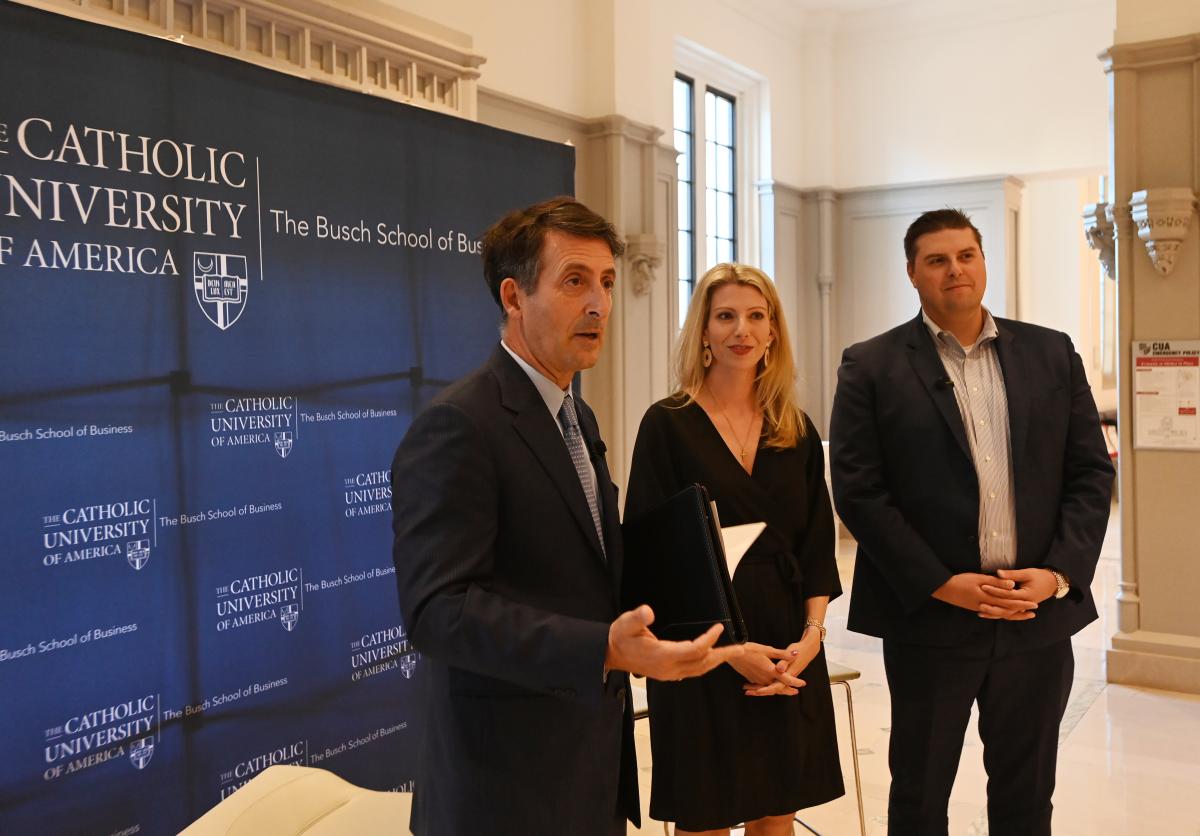
Welcome to Cardinal Perspectives, a series featuring in-depth conversations with alumni, students, faculty, staff and the extended family and community of The Catholic University of America.
W. Brian Walsh, B.A. 1990, is an entrepreneur and innovator with nearly 30 years of experience in fundraising, marketing, and financial technology. As principal and chief operating officer of Warfield & Walsh, he led strategy, creative, and analytics for leading nonprofit and religious organizations. He later founded Faith Direct, a pioneering online giving platform now used in 95 U.S. dioceses that raised over $1 billion and modernized parish collections.
Today, Brian serves as Entrepreneur in Residence at Catholic University's Ciocca Center for Entrepreneurship, where he founded VentureLab@CatholicU. He is also an active investor and advisor to early-stage companies. Beyond business, Brian serves as a community volunteer for multiple organizations in his home community of Alexandria, Virginia. He and his wife Kara have four children.
Alexander J. Hoffarth is visiting assistant professor and director of the Law and Entrepreneurship Program at the Columbus School of Law. Prior to joining the faculty in 2025, he was a senior associate at Hogan Lovells US LLP, where he advised clients on complex legal and business issues, including the design and execution of mergers and acquisitions, public and private securities offerings, corporate governance and subsidiary management, and multi-jurisdictional projects such as global carveout transactions. Prior to his practice at Hogan, Hoffarth clerked for Chief Judge Diane S. Sykes of the United States Court of Appeals for the Seventh Circuit. He received his J.D. and M.B.A. from the University of Virginia, where he was a member of the Virginia Law Review editorial board and the Order of the Coif. He earned his B.A. summa cum laude from Boston College, where he was a member of Phi Beta Kappa.
Hoffarth is also the co-founder of Aquilux Partners LLC, a holding company that exists to acquire, steward, and grow enduring American businesses in a way that honors faith, family, and the common good.
Joseph Nazzaro, B.S.B.A. 2023, is a third-year law student at the Columbus School of Law at The Catholic University of America. Originally from Brookeville, Maryland, Joe also earned his undergraduate degree from Catholic University's Busch School of Business, specializing in entrepreneurship and sports management along with a minor in mathematics. Joe was also a four-year member of the university’s football team, a two-year member of the track & field team, and a group leader in the Cardinal Service Corps.
At the law school, Joe serves as President of the Sports and Entertainment Law Society, the 3L Representative to the Council on Professional Conduct, a member of the Law and Technology Institute, and an Associate Editor of the school’s Law Review. Professionally, Joe spent nearly two years as a Law Clerk with the Major League Soccer Players Association and recently joined Gordon Rees Scully Mansukhani as a Law Clerk. He anticipates continuing with the firm after graduation in its commercial litigation practice.
*This transcript is based on an audio recording and has been lightly edited for readability. It reflects the substance of the conversation but may not be a verbatim record.
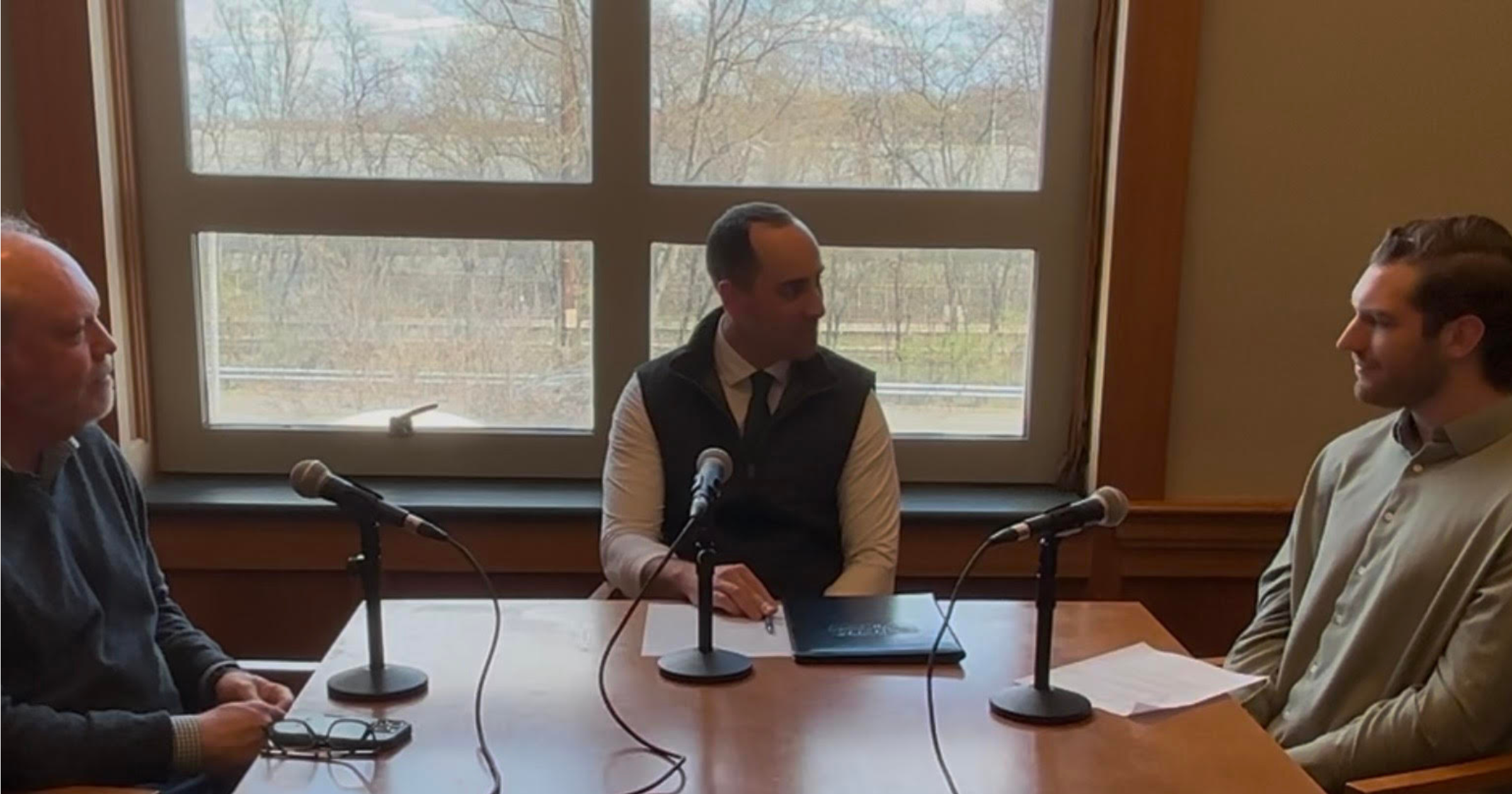
Joe Nazzaro
Professor Walsh, Professor Hoffarth, thank you both so much for joining us today. We'll jump right into it with Professor Walsh talking about the Busch School of Business. Can you start by sharing what exactly is the VentureLab@CatholicU and what prompted the Busch School to pursue a program like this?
Brian Walsh
Sure, thanks Joe. The VentureLab@CatholicU is essentially an incubator program for students and alumni that are interested in developing their own startup companies, their own businesses. I was fortunate enough to come back to Catholic University and started as an entrepreneur-in-residence.
Under the guidance of our leader at the Ciocca Center for Principled Entrepreneurship, Andreas Widmer, he said to me, “Figure out what you need to do here, what we need as a University to foster and grow entrepreneurship.” And within about six months we started to develop the concept about VenturLab, which essentially morphed into a program that enables students to pursue their entrepreneurial dreams.
We have a framework that we use. And it's now taught in the classroom as well. I teach two courses both to undergrad and grad and to independent study students as well. We feel it was a critical piece that was missing from that experiential piece of entrepreneurship.
And we're still new, we're four years into it, but we're starting to see a lot of great results and huge impact. So we're super excited about it.
Joe Nazzaro
Fantastic. And you mentioned that semester-long course that you teach to both undergraduate and graduate students. Can you walk us through what that looks like and the opportunities students gain from participating?
Brian Walsh
Sure. Great question. So in the course of a semester, the students develop their own business. It starts with trying to identify a problem. An everyday solution that they see is missing in the world. And those range from technology solutions to food related businesses, retail social media management for boutique companies, for example.
And during the course of the semester, we wrap it around what's called the Business Model Canvas. Basically nine components of startups that I think are critically important that students understand, things like value proposition, customer relationships, channels, revenue break even, competition, etc.
And throughout the semester, most of the curriculum is wrapped around podcasts of founders. That and businesses that we've identified that have great stories to tell can inspire students. And each week we spend one week on a particular component of the Business Model Canvas. It basically ends at the end of the semester with students presenting their company to their peers and others that we invite.
Not everybody that comes in the class wants to start their own business, but we do feel like we're equipping them with real knowledge on problem solving, ethical leadership, and just identifying issues that are important to them and also the Church to try to foster entrepreneurship for the good of others.
Joe Nazzaro
I remember when I had been in the Busch School during my time in undergrad going through that course, and I thought it was fantastic, going through all the aspects of the Business Model Canvas and getting to learn about all of the aspects that go into business and pursue each of them in depth in a way that I had never gotten the chance to before then, and really came to understand what went into making a business, getting it off the ground, all the thought that goes into it.
That was a course that I found especially valuable. So it's great to hear that it's still thriving. What types of businesses or ventures have emerged from the VentureLab so far?
Brian Walsh
We're really excited about some of the progress we've seen. Some of the newer ones, if you will, that I can highlight, include some that are AI/technology driven, using AI to develop technology that solves an issue.
One great example is GovRat. GovRat was created by a student that graduated in December and his business really was what I term an “in real life” situation. He worked on Capitol Hill. He was not a business school student. He was actually a political science major and identified while working for a congressman that contracts that are available for everybody from electricians to plumbers to contractors, state by state and federal were still being posted in PDFs. So he actually developed an AI-driven solution that completely changed the way that entrepreneurs and small business owners can identify business opportunities.
We're really pleased with how he's come along. He actually won a major pitch competition in D.C. He's now working with Alexander's program in the law school to get some guidance there, so it’s a great example.
We've got other students who have created things like medical devices for scoliosis. That is one of our prime examples from John Whelan, who graduated last year.
And then there are recent businesses that I can share that are very much in a developmental stage. We had one student that was super concerned about elderly people, as they're getting on in age, the inability to drive and get to appointments and do shopping and things like that. Her company was called Abu Go, which essentially is a concierge type of Uber for the elderly. And that's very much in the developmental stages, but I lecture a lot about Catholic social teaching, and that was a really fun result, if you will, to see that come to fruition.
And the students are coming up with stuff every day that I’m super impressed by. And I should add that, more than half of my students today are not business school students. We love the Busch School students. That's where we're housed, that's where we're from, so to speak. But more and more we're seeing students from architecture, engineering, biotechnology, and political science who have ideas that are really exciting and it's putting them into a plan that makes sense and helping them get to that next stage if that's something they desire.
Joe Nazzaro
It's phenomenal that students from all different corners of the campus are coming with very diverse business ideas that have been allowed to be fostered and grow through this program and add so much value to various aspects of business.
Finally, in what ways can alumni get involved with or support the VentureLab at this point?
Brian Walsh
One sits at this table on this campus. I've been around here a long time. I graduated from here a few decades ago and had the good fortune of developing a few companies, one of which I exited seven years ago at this point. And had the opportunity to come back to campus and give back.
Not everybody can do that for whatever reason, but what they can do – we're constantly looking for mentors in every area. Technology, finance, fundraising, meaning on the VC side, law, which has been a major plus for us, just in the last six months, because of the collaboration we have together now.
And they can weigh in on that expertise, they can speak to certain subjects that frankly I don't have the expertise for. So we're trying to continue that opportunity. The other way is to support the entrepreneurship program across campus. We need more not only mentors, but potentially entrepreneurs-in-residences if they have that desire and qualification.
Because the more students we can reach in the classroom, meaning extra sections of class, of the VentureLab course, I think the greater the opportunity, the greater yield in, in new companies that will come out of Catholic University.
Joe Nazzaro
And turning to you, Professor Hoffarth, with everything that's going on at the law school, can you briefly describe the Law and Entrepreneurship Program at the Columbus School of Law, as well as the program's three core pillars?
Alexander Hoffarth
Thank you, Joe. I appreciate you being here. Also, Professor Walsh was excited to chat about our collaboration between the Ciocca Center and the Law and Entrepreneurship Program.
For us at this program, it comes at a really exciting time in the history of the Columbus School of Law. As you know as a student here, we've hit our highest ranking in the law school's history. We have admitted our largest student class in the first year students, our 1Ls in over a decade. The number of students that have applied here for enrollment next fall has been just off the charts, and so we're really excited about what's to come just in the sense that we feel like we're at the best point ever.
And yet, there are opportunities to take that next step. And while we've invested so many resources into building our public law initiatives with our centers and our institutes, Center for the Constitution and the Catholic Intellectual Tradition, the Center for the Law and the Human Person, the Center for Religious Liberty, there's equally an opportunity to invest in our private law initiative.
And this Law and Entrepreneurship Program is a key piece of that. And so what does it look like? As you noted, we view it as three key pillars, and you've gotten to see just the beginnings of what all of those will look like once firmly established. The first piece, which we'll talk about throughout this conversation this afternoon is our Law and Entrepreneurship Clinic, which we launched this semester, which you fortunately took the leap to jump into and be part of our inaugural class and get to work actually with one of the entrepreneurs that Professor Walsh mentioned in his prior answer where our law students have the opportunity to take what they've learned in the classroom and apply it to the service of entrepreneurs in the Ciocca Center ecosystem, helping them with basic corporate governance, basic commercial contract drafting, basic intellectual property matters and basic employment law matters.
So it gives our students the opportunity to practice these skills and helps provide free legal guidance to a community, notably the entrepreneurs, current undergrads, and recent graduates of the program that don't have the financial resources to pay for council themselves.
Second, our curricular programs. So with the addition of new faculty, both practitioners and scholars, coming to the law school, there will be opportunities for more classes that are both doctrinal – learning the different aspects of corporate law – but then also skills-based courses where we get to learn about thinking about negotiations, business planning. Of course, accounting and finance is going to be a key piece of that, and there's ways we think that we can collaborate with the Busch School broadly on joint course offerings where both of our student bodies can be in the classroom together and learn about these different areas from an interdisciplinary perspective.
And then finally our co-curricular programs. And so whether that's speaker events and programming, and again, I think this is something we'll talk about, there's an easy way to collaborate with the VentureLab in the Ciocca Center here. Whether it's inviting an inaugural executive-in-residence to the law school beginning next year, whether it's pitch competitions or externships, other opportunities where our students can engage with entrepreneurs themselves or experience what it is like to be an entrepreneur beyond just sitting in the classroom.
Joe Nazzaro
I will say the Law and Entrepreneurship Program, especially at being built out this final year of my time in law school has by far been the most rewarding and exciting part of my year and probably of my law school career thus far, because I, like you mentioned, had seen all these gaps that were apparent in the law school.
So much is growing and developing here, but there was not this entity focused on the private sector that could really be developed here and could really be honed, especially because that is so prevalent in D.C. and around this area.
It has just been fantastic to be able to see that get off the ground. And as a soon-to-be alumni, I'm very excited to see how it will continue to be built out over the coming years.
So why is the Law and Entrepreneurship Program important and how does the program respond to current and anticipated demands and opportunities within the legal profession?
Alexander Hoffarth
You don't have to take a lot of time to look at the way in which the legal profession in this country is changing.
Whether it's issues with billable rates and costs and in-house counsel looking to find ways to reduce expenses for legal, whether it's the threats or opportunities posed by artificial intelligence, the profession is changing.
And our law school has to be at the forefront of preparing our students with the expertise, the skills, the mindset, and the vision to approach that. And I think it begins with the view, and I'm sure this is not going to be foreign to Professor Walsh in the Busch School world, but it begins with the view that already, you are an entrepreneur, whether you realize it or not. That each of us actually is an entrepreneur. We're the CEO or we're the COO of “You, Inc.”
And so if we look at our lives in that particular way, then there's a question of, “What do I need to steward well as an officer of a corporation?” And for us, what we've been talking about here, is it begins with a certain mindset. It begins with a certain realization that you have to have certain virtues that are at the core of your leadership, of your stewardship, whether it's vision, whether it's prudence, whether it's patience to make sure that you steward this well.
And so this program focuses again and again throughout these different pillars on what's the right mindset that you need.
And once you have the right mindset, then what are the skills you need to do that job excellently? Because we are called to do excellent work in the legal profession. Our clients – entrepreneurs up to Fortune 500 companies in private law – need to make sure that when you are doing a task for them, you're doing it well. You're providing them the best guidance possible. And so, to make sure that you know the different aspects of law and that you've had experience practicing those here in the classroom is essential.
And then finally, the vision. It's a recognition that we live in a world now where the opportunities are endless. The possibilities are endless for what you can do with a law degree.
To recognize that some of our students at the Columbus School of Law will go become lawyers at law firms of different sizes and advise clients, but some of our law students that become alumni may want to go in-house. May want to move on to the operations side. May want to invest in entrepreneurs.
Helping to introduce them to alumni and to friends of the Columbus School of Law of The Catholic University of America, and then exposing them to the richness of the Ciocca Center and the VentureLab offerings through the Busch School will help provide them with a sense of imagination of just the sheer myriad of possibilities that are in front of them.
We think it's important to provide that type of mindset, that vision, that skills, and that expertise so that our students can thrive.
Joe Nazzaro
I will say that you talked about being the CEO of “You, Inc.” That's something we've talked about in class a lot and that's something I feel has really resonated for me over the last few months, and especially as I'm setting out on my professional career, is something I'm really trying to incorporate into my life in any way I can.
It has really shifted my personal mindset of how I view my professional and personal growth and it almost brings me back to Professor Walsh's Business Model Canvas that he talked about with the VentureLab, that there are just these buckets of your life. And you need to be thinking about how you can maximize those to the best of your abilities.
Whether those be the skills that you need to succeed in the industry you want to be in, or building your network out, or just understanding how you can better sell yourself to get to where you want to be. This is all stuff that I have found very rewarding to bring into my life.
I feel as though I've already seen some fruits of it, and I'm very excited to see how that continues to develop. And that's something I can really thank the Law and Entrepreneurship Program for.
Alexander Hoffarth
I'm glad to hear that, Joe.
Joe Nazzaro
And then finally, how does the program support the law school's mission, particularly its goal of preparing practice-ready graduates?
Alexander Hoffarth
In terms of supporting the mission, I think there's multiple ways in which this does so. First of all, beginning with how it supports our mission as a Catholic university. Many different schools have a law and entrepreneurship program. Many schools have a venture lab. You can go out to Silicon Valley, you can go up to Boston. There are all these programs.
But what makes us unique in the way we think about this, and I think you would agree, Professor Walsh, is that doing it here means that we begin with a distinctive view of the human person. And a distinctive view of the nature of business.
That there's something about the business that is personal. That it's intimate, that it's responding to needs. As we hear from Professor Widmer, it begins with the question, “How may I help you?” It's relational. And so for us at the law school, when we are serving as advisors to these entrepreneurs that are immersed in this vocabulary that the distinctive virtue ethics curriculum of the Busch School and what it's teaching, beginning with its freshmen, we want to make sure that we can speak that language fluently. We think that is at the core of our mission.
Secondly, it's thinking about how are we serving our community around us. How are we taking the gifts, the education that we've received, and giving it away to those in need? And that can be the entrepreneurs in the VentureLab, it can be the entrepreneurs in northeast Washington. There are many folks that don't know what a covenant is, or representations and warranties.
But if we can share with them how those work in the contract that they signed with a vendor or a landlord, if we can help them understand what is an LLC, and why might that be a good idea for their fledgling business to protect themselves from liability that might come? For us, that's giving away what we have learned and that's making it rewarding as a result.
And then finally, we take pride in law school. You know this because you've heard this since you were an admitted student. We take great pride in making sure that our law students are ready on day one. That there's no training on the job. When you're an alumnus of The Catholic University of America Columbus School of Law.
For our litigators, there are plenty of ways in which they've been able to hone those skills through the richness of our offerings, both in our courses and our co-curricular programs. Now we can say the same thing about our transactional law students. Now we can say they've thought about how to advise clients. They've thought about how to draft well. They've thought about how to even think about negotiating for themselves, for their clients and supporting to make sure that their clients have someone at the table on their side that can help them out. Those things all are very much authentic to and consistent with the mission of this institution, and so we're excited to build from that foundation.
Joe Nazzaro
Opening it up to now, both of you discussing the partnership between the Busch School and the VentureLab and Catholic Law, can you guys explain how this partnership works and what it's looked so far and where you hope it heads in the future?
Brian Walsh
First of all, I think it's the most exciting collaboration we've had since I started the VentureLab a few years ago because it was so needed. And the enthusiasm that you bring to the table has been exactly what we needed. And the ability to come up with a concept where you hand us a couple businesses, we'll look at them and then decide who we want to work with, meaning law school students, with mostly undergrads or recent graduates, is phenomenal.
That opportunity for young entrepreneurs I think adds such great value to. The student experiences across the board here. I think it's great for attracting new students, both undergrad and law, retaining students and also, promoting now to say, “Look, you can come here and build a company and we can take you through all these critical steps.”
I'm beyond excited and if any, typically when someone asks me how things are going at the VentureLab, I immediately start with the new collaboration with what Professor Hoffarth has been able to put together has been amazing. So thank you.
And beyond that, I don't know if there's anything you want to jump in and add, Alexander, but we're super excited about where this has come in a very short period of time.
Alexander Hoffarth
I'm happy to just add a word to that Professor Walsh. And again, I think the feeling is mutual. I think it's been so exciting and enlightening in the last six, seven months, getting to know just the richness of the Busch School, which I had known positively by reputation before I arrived here last June, and now to be more fully immersed in it, my admiration just grows for what our students at this University in business are learning and are thinking about day in and day out.
I think that the partnership here really feels like it began certainly before my arrival at the leadership level of both schools. That this seemed like something where the law school and the business school are bright spots on the University campus, and what are ways in which we can cross-pollinate? What are ways where we can think about how we can help build on what's best and distinctive about the other institution?
Since I arrived, I've been spending time even sitting in last semester on Professor Widmer's class, just learning and listening to the way in which our business school students are being taught. And figuring out based on what I'm hearing, what can we do at the law school in this program to best serve and then to best partner with you all?
The clinic is the easiest example of that. When I was initially thinking about clients, we had overwhelming demand here at the law school. We had 14 students apply for initially four slots. We ultimately took six, all in their final semester of school, all excited by this opportunity.
But then the question from everyone here was, “Are you going to be able to find clients?” And I said to them time and time again, “Yes.” Because I know what's going on at the VentureLab, and so just in terms of building this program out, I came to you and your team and I said, “Here's what I need. Here's what we have for students, here's how we can support them. I need it good entrepreneurs for the pilot.”
And you provided all three of those two recent graduates, including one you mentioned with Skolios, and then one current undergraduate. And I think, and you can speak to this really well, Joe, because you've been at the core of this in the clinic and serving John and serving Skolios.
I think the relationship between our entrepreneurs and our law students has been phenomenal. It's been so exciting to watch them work together to help them build these incredible businesses.
Brian Walsh
And to follow up on that, the feedback from those founders, the entrepreneurs has been incredible.
And I keep tabs on them. That's what I'm supposed to do. And I did get one email completely unsolicited from one of the companies, the founders who's now on a second business. And he had nothing but glowing things to say about the law school students he was working with. He recognized how fortunate he was to have that opportunity.
And I think it goes back to something you said about, if you're a great entrepreneur, if you're the CEO of yourself, which I love – and by the way, I'm going to use that – I think that you are always talking about adding value, right? And I think we have really upped the value for students.
And it reminds me, I taught yesterday's lecture was on competition and I brought the students through two of the companies that I had started with and did a deep dive on competition and what I faced as starting three startups. And, some things went well, some did not.
And to me, ultimately what we are collectively doing is making this University a lot more competitive. And I hit that point home with, I mentioned the student before that won a major pitch competition. And I won't name the schools that were at the finish table with him, but he beat out and I will say that, and that's the competitive Cardinal coming out to me, a lot of very notable university students and it was a huge win for us across the board.
I think it's to your point, and some of the things you shared, it's just how we're preparing students and to face challenges to recognize what value is and how they can serve others.
Alexander Hoffarth
I would just add to that, I think what we've been thinking about more recently is how do we build beyond just the clinic, which has been a huge success. And what I think has been really exciting is, once already and once to come, we've had our clinic students. Visiting the Busch School as guest lecturers.
We had three of our clinic students sit in on the vocation of business class of Professor Widmer offers, and talked about the rules of the road with regard to building a business and using content from online. And then later this month, the other three of our clinic students will be coming in and joining your VenturLab course with one of your entrepreneurs and having an exciting and innovative workshop where there's an active conversation between entrepreneurs and law students that will help your VentureLab students start to think about, “Okay, here are all the different legal issues that our students are spotting for this entrepreneur that has this great business idea.”
Just spreading that collaboration throughout and even this week, right? The Law and Entrepreneurship Program and the Ciocca Center more broadly are partnering on a speaker event. We’re bringing in an individual who started as a venture lawyer. Then he became an entrepreneur and now he's a venture capitalist, managing partner, and investor, hits all the different aspects of what your students want to hear with entrepreneurship and venture capital. And then our students as a former J.D.
And so I think of those additional guest lecturing opportunities and those speaker opportunities where we can invite folks to campus and then share hosting duties, is going to broaden the impact beyond the immediate clinic.
Joe Nazzaro
And one thing I'd love to add is what you touched on with the partnerships of having the opportunity for clinic students to come speak to classes at the business school.
That was one of the most amazing full circle opportunities I've had probably in my life to this point of going to that vocation of business class. I had taken my first semester freshman year here about seven years ago that I still remember vividly taking with Professor Widmer. We walked through and thinking for the very first time, about how you would get a business off the ground.
And I remember everything about the class being so phenomenal. But even at that time, we didn't have these opportunities where other people were coming in and talking about the legal implications and how you would be able to use other people's content.
That was just very fulfilling to me to have the opportunity to come back to a class I had been in previously and talk to them and help to build on a course that has been well established here for a while, but to add even more value to it and help a generation of people that were where I once was seven years ago to come back and be able to contribute to them in some way was just really amazing.
Turning next, how does the partnership between the Busch School’s VentureLab and Catholic Law’s Law and Entrepreneurship Program contribute to the success of both programs? And how does this partnership make both of you the programs stronger?
Brian Walsh
Yeah. I think some of what we've hit on between the cross collaboration between speaker events and workshops and having law school students come into our undergraduate student VentureLab and entrepreneurship classes is a tremendous value-add for students.
They weren't necessarily getting that a year or a semester ago. And so it's all really exciting to see that that is becoming part of the curriculum in a deeper way. So it expands both the legitimacy, if you will, how we're trying to inform and equip students and entrepreneurs once they graduate here, and also the experiential piece as well, which is very much what the approach I've taken to teaching the entrepreneurship piece.
We certainly have other ideas that we have to collaborate on. But the immediate thing, having a major speaker come in – major meaning very accomplished, both in law and entrepreneurship – what a great opportunity. And then giving students the tools, the legal tools that they need as guidance has been really huge.
Alexander Hoffarth
I couldn't say it better myself. But maybe I can turn the tables and just ask you, Joe, you've been in both of these programs.
How have you grown as a law student and as a potential business lawyer because of the cross-collaboration between the Busch School and the law school?
Joe Nazzaro
I suppose it started when I was at the Busch School. That's really where I got all of my groundwork for how businesses operate, what mindset you should take when running a business. Understanding all the implications of forming a business. But it really didn't touch on the legal aspects very much.
I think I took one corporate law class, but it was still more business oriented. But then coming to the law school really gave me the opportunity to understand all the legal implications, get to really dive into all the things we talk about in the clinic, like corporate structures and funding and all the nitty gritty stuff that you really don't get the chance to get to in the Busch school because it's just more high-level and you get to learn so many different aspects like finance, like accounting, like sales.
The law school has really enabled me to hone in on the legal aspects of it, which is the part I've found to be the most interesting and the thing I'm the most equipped to add to a company or to a firm or to any clients that I may have.
Getting to see the development of myself from just getting this basic understanding of business and getting to hone in on what entrepreneurship looks like, being in the entrepreneurship program as an undergrad, to now having the opportunity to help others get their businesses off the ground and really walk them through the legal aspects of it, because that is, like we talked about, that's something they haven't really gotten the opportunity to be exposed to and not really what they want to think about, at the end of the day. They want to be more concerned with actually running the business, how to make a better product, and add more value to their audience and their customers.
But the thing that we are able to provide at the clinic and just from being law students with experience in this now is being able to take those complex legal concepts we've learned and water it down to a way they can easily digest and apply to their businesses and allow them to approach their business from a better angle.
Alexander Hoffarth
And I think one of the things that's unique about you and that you have a distinctive perspective that you can offer to this particular conversation, is this really a capstone experience for you. After seven years at this institution. As you said, you’ve not only gone back into the classroom to pay it forward to the next generation of entrepreneurs, bringing you back to your first semester.
In your final semester, you now are able to bring everything that you've learned at two different institutions, this interdisciplinary approach, and pay it forward to serve a client that’s doing some really impressive stuff in the medical device and in the healthcare space, trying to serve patients with a severe disability.
I'd be interested if you also might just comment on what that experience full circle has been like? That you're using not only the skills that you've learned at the law school but also the vocabulary. That there's something unique over the Busch School. All of that you're bringing together at the service of others.
What's that experience been like?
Joe Nazzaro
I feel that it's been a very smooth transition to get to talk to someone at the Busch School because I know and recall exactly what they've gone through. I speak the Busch School's language of Catholic social teaching, of the Business Model Canvas, the approach that they've been taught in school.
I completely understand because I went through it all myself and so that has really enabled me to hit the ground running when talking to them. It didn't take a whole lot of time to get acquainted and to understand just how their approach to business is because it's coming from a place that I got to spend four years learning myself.
And then one other aspect of my particular experience that has made it even more full circle is John, the CEO of Skolios, he was actually a former teammate of mine on Catholic University's football team. We had played football together for two years, had a close relationship playing that, and really developed a friendship through that and were able to get to know each other well.
And obviously since I had started at law school, I hadn't gotten to see him very much over the last two years, but it's just been such an amazing and fulfilling full circle moment to now, we are both pursuing our careers and going out into the professional world and trying to make our way and find our vocations and being able to work with one another.
I'm getting the opportunity for the first time to work with a client to do transactional work, to have those opportunities of meeting with someone and counseling while he's also getting the legal services he needs to help get this business going off the ground.
It's just been amazing that we have been able to take two different paths coming from the Busch school and have been able to merge them together for this time to set us both on an even better trajectory.
Alexander Hoffarth
That almost writes itself for a follow up Cardinal Perspectives, right? Former football teammates, now collaborators for an entrepreneurial venture
Brian Walsh
That's exciting,
Alexander Hoffarth
I wish every single one of my students could tell a story like this. But I think the goal for every one of the students in the clinic is to be able to speak as thoughtfully that same language that your students are immersed in, because I think that's what lawyers serving entrepreneurs at their best are supposed to be co-creators.
Brian Walsh
Absolutely.
Alexander Hoffarth
They are supposed to take their unique gifts to help create that value-add. That's what we're striving to form in our students in the Law and Entrepreneurship Program to best be able to serve any client you send our way.
Brian Walsh
Absolutely. And we look forward to that collaboration.
And I think when Joe was in my course to use the analogy, we were like a plane. The VentureLab was a plane that took off. We didn't have any seat belts, didn't know where the exit signs were, and hopefully we had a pilot. Some days he was there, some days he wasn't.
To see the development of it for me has been super rewarding. And I agree the story with John Whelan is a great one. And also the character of these guys shines through, which is to me the most rewarding thing about teaching here. It’s working with students like Joe and John and the list goes on and on, and how rewarding that continues to be.
Joe Nazzaro
Thank you both so much for being here today. This has been a tremendous experience for me to be able to reflect on both my time in the Busch School as well as the law and entrepreneurship clinic, and it's really exciting to see all the developments this partnership has formed over the past year and will continue to grow throughout the coming years.
Thank you. So thank you both very much.
Published on: Thursday, May 7, 2026
Tags: Busch School of Business, Ciocca Center for Principled Entrepreneurship