
Welcome to Cardinal Perspectives, a series featuring in-depth conversations with alumni, students, faculty, staff and the extended family and community of The Catholic University of America.
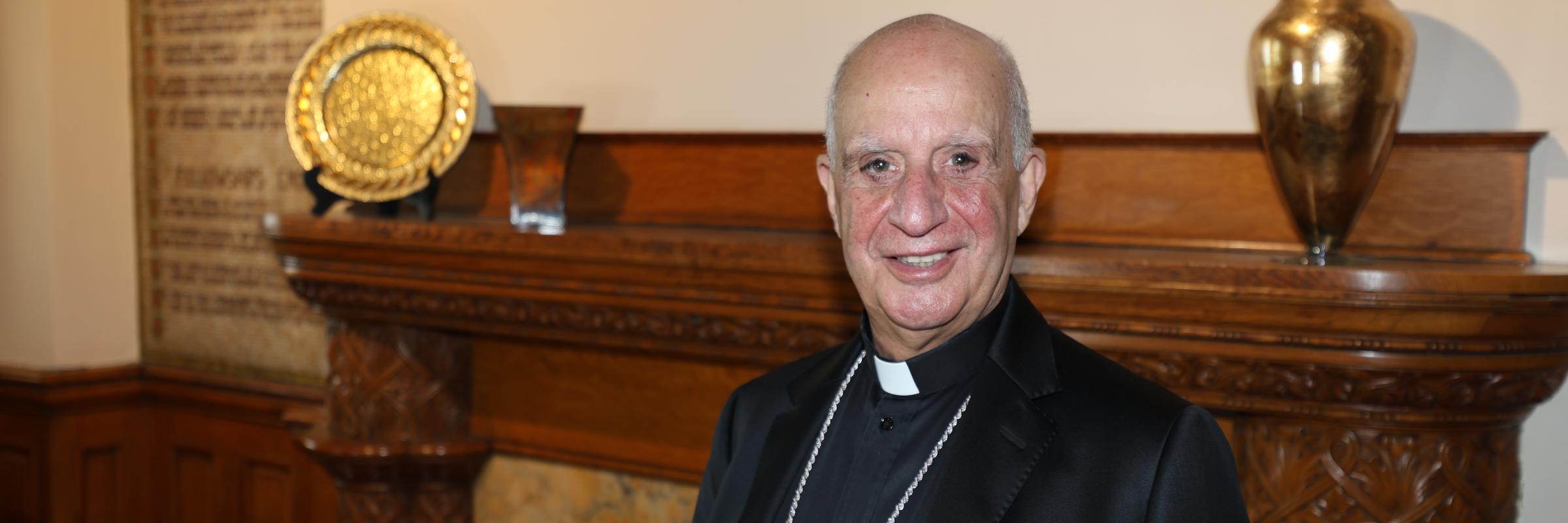
We are honored to share this conversation with Archbishop Salvatore “Rino” Fisichella, pro-prefect of the Vatican’s Dicastery for Evangelization. In that capacity, he led the Holy See’s preparation and organization of the Jubilee Year 2025, which welcomed more than 33 million pilgrims from 185 countries to Rome. He is also a member of the Vatican dicasteries for the Doctrine of the Faith and for the Causes of Saints.
Born in Codogno in northern Italy, Archbishop Fisichella was ordained a priest for the Diocese of Rome in 1976. In 1988, he became an auxiliary bishop of the Diocese of Rome and Titular Bishop of Vicohabentia. He was appointed archbishop in 2008 following his appointment to the Pontifical Academy for Life.
In 2010, Pope Benedict XVI appointed Archbishop Fisichella president of the Pontifical Council for Promoting the New Evangelization. In 2013, he was named president of the International Council for Catechesis. He has also served in various Vatican curial positions, as rector of the Pontifical Lateran University, and as a chaplain to the Italian Parliament.
A specialist in the theology of Hans Urs von Balthasar, Archbishop Fisichella taught fundamental theology at the Pontifical Gregorian University and at the Pontifical Lateran University.
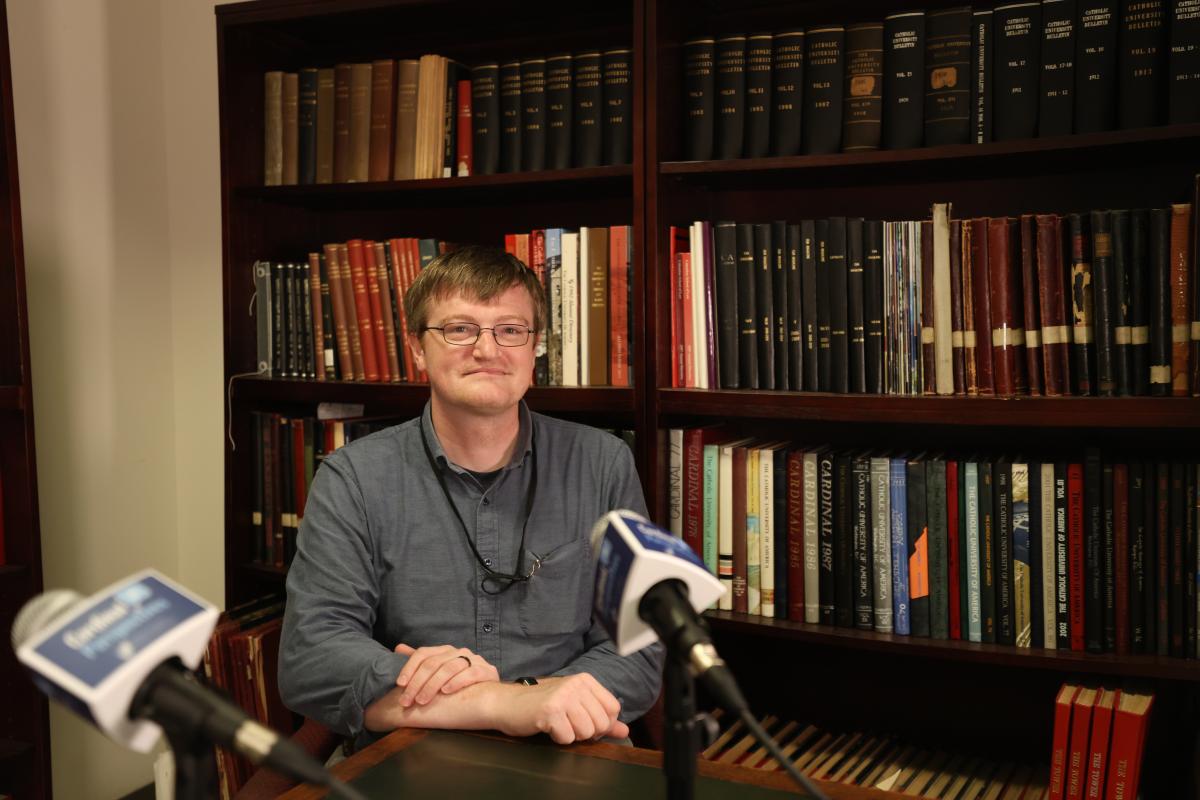
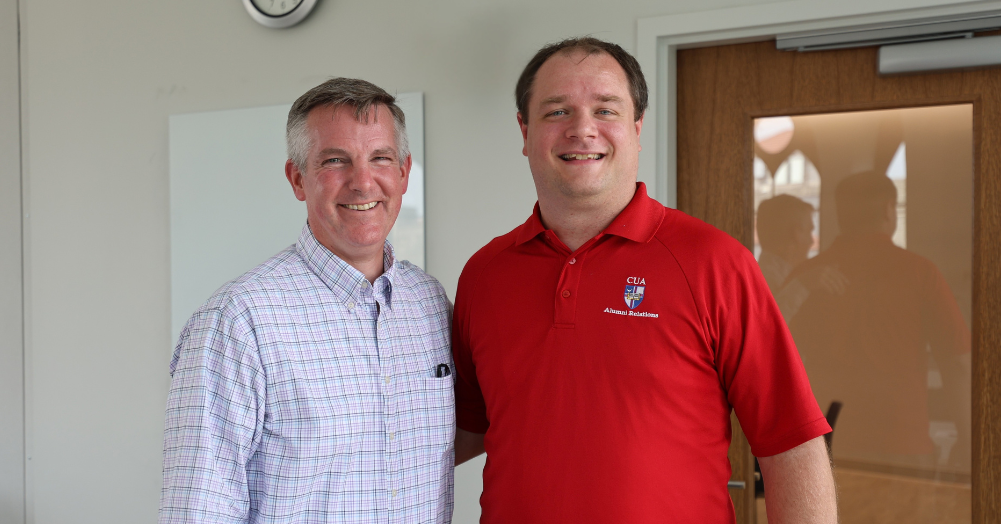
This episode is facilitated by Dennis Strach, director of diocesan engagement at Catholic University.
*This transcript is based on an audio recording and has been lightly edited for readability. It reflects the substance of the conversation but may not be a verbatim record.
Dennis Strach
I want to welcome our audience to another installment of Cardinal Perspectives. I'm Dennis Strach, the director of the Office of Diocesan Engagement at The Catholic University of America, and I'm joined by His Excellency Archbishop Salvatore Rino Fisichella, the pro-prefect of the Vatican’s Dicastery for Evangelization.
Your Excellency, welcome back to Washington, D.C., and to The Catholic University of America.
Archbishop Fisichella
Thank you. My greetings to everybody.
Dennis Strach
Thank you for taking the time to speak with me. Archbishop Fisichella, one of the main reasons for your visit to our campus was the presentation of a public lecture, which you delivered just last night as part of the University's Welcoming Children in Worship initiative.
For our listeners, this program is funded by a generous grant from Lilly Endowment Inc. and is led by our associate professor in catechetics in the School of Theology and Religious Studies, Dr. Jem Sullivan. Your Excellency, your lecture was entitled, “Liturgical Prayer Transforms the Church.” And I'd like to begin by asking you some questions around the theme of your talk because it was such a very rich reflection.
Perhaps it's helpful to define some of the terms that we will be using throughout our conversation today, so that we're on the same page with our listeners. So maybe you could just give us a very quick definition. What do we mean when we speak about catechesis and evangelization?
Archbishop Fisichella
I would say that first of all, we need to speak about evangelization because catechesis is a part of the evangelization.
Catechesis is a moment, is a mediation, for the evangelization. And what does it mean, evangelization? In my mind, it means to share with others the beauty of an encounter. Our life is a continuous search to be happy. A continuous search to give a sense, a meaning to our life. And, we can have several different methods, different responses for that.
We can think, for instance, about how many schools of philosophers we have in this 2000 and more than 2000 years. They are an attempt to give an answer to the sense of life. To share the experience of an encounter, it means to share a witness that as a believer, there was a moment in your life in which you encountered Jesus Christ – not as an idea, not as an utopia, no, a real encounter with him.
He came to me. He came in an encounter to me. He wanted to talk with me. And, this is the beauty of our religion. God speaks with us and God loves to stay with us. It's not just a special moment in history, no, it's a continuity. And for this reason, we have, as believers, we have the responsibility not to take just for ourselves, the joy of this encounter, but to share with everybody. Because, this is the heart of the evangelization.
Because to evangelize, it means to share the love and mercy of God to us. The gospel, normally when we think to the gospel, we think about the four different gospels. But, the gospel, the unity of gospel, is the revelation of God's love. God loves you. God is close to you. He's not far away from you. In every moment of your life, you can encounter him.
And this is the evangelization. This is the way to say the Gospel remains alive in our life. The Gospel continues to be announced, preached, [and] testify in our history.
Dennis Strach
And that encounter, as you mentioned, isn't just a one and done thing. It doesn't happen one time, but it happens each and every day there's a renewal in that encounter and what the Lord is doing in our hearts.
And so one of the access points for us in that encounter with the Lord is prayer. And that was another very strong theme of your talk last night. Many people who are listening haven't taught prayers, the Our Father or the Rosary or things like that, but not all of us have been formed well in the task of praying which is less the, maybe the recitation of prayers but like you mentioned a more relational joining of hearts and souls with the Lord.
And your remarks last night really challenged us to think about prayer in more expansive ways. It's not really something to be manipulated, but something that is rooted in the groanings of the heart and in silence. You mentioned, “One prays when one is in the presence of God. Prayer is being aware of his presence. It goes beyond needs and feelings. It's Christ praying in us.”
Can you expand on that for us?
Archbishop Fisichella
Yeah. I think that often, when we speak about prayer, our mind goes immediately to prayers. Our Father, Holy Mary, the Rosary, all the prayers that we know since we are a child. And they are good. They remain a good prayer for us.
But my mind was to give a challenge to people today, especially to youth, because [sometimes] they don't know, really, how to pray. And this was the same–this is amazing–but this was the same experience of the first disciples. They didn't know how to pray, but they saw Jesus pray, and that is very important.
Our experience of prayer, our prayer, it is like a request, because is the experience that Jesus was praying. So as Jesus prayed, also, the disciples need to pray. And our prayer is not just to pray Jesus Christ. The most important thing is in our Christian prayer, Christ prayed together with us.
Normally, we don't think about that because we stop ourselves to the prayers, but there is a ground, there is a foundation of our prayer. And our prayer, we pray because Jesus prayed. We saw Jesus pray like the disciples. And for this reason, we ask Jesus, “Jesus, [teach] to us how to pray.”
And Jesus responds to us. There is a response. Jesus says that before the prayers, there is the behavior of the believer to pray, and that means to stay in the presence of God. That means to be conscious that I am in the presence of the Lord. And my prayer is not an utopia, is not something theoretical, that no one will listen to me.
No. My prayer is to understand that I am in front of God. Now, what do you do when you are in front of God? The first reaction is not to speak, could not be to speak. What can you say to God? The first reaction should be to stay in silence. [It is] the marvelous of this experience that you are in a condition to receive something from God.
So prayer, first of all, in this consciousness to be in the presence of the Lord, becomes also the condition to understand that before my personal prayer, there is the word of God coming to me, which becomes itself a prayer. I give you an example. In the Bible, we have the book of psalms. What are they?
Our poetry is the word of God given to us. And every day, in different moments of our day, we pray with the word of God. That should be interesting for us, that we don't know how to pray. We don't even know the content of our prayer. As Saint Paul is very clear, we do not know what is necessary. And this is the experience of our poverty, to be humbly before God, to be in silence, to know that we need to learn once again.
And then we take the word of God, and this word becomes our prayer.
Dennis Strach
We talked a little bit, too, about how that relational prayer takes us outside of ourselves. It helps us from being self-centered. We were just in another meeting together and we were discussing how the phone hasn't remained an instrument, but it's become the whole of our existence and a culture in and of itself.
And in that way, that silence that you spoke about can be very difficult to cultivate. For many of us, when we're bored, we find something to do on our phone or we check our email or go to an app or something or scroll on the news or whatever it might be.
What might be some recommendations for beginning to cultivate that silence when there's a disconnect of the mind and the heart, where we know it's important but to be able to enact it and live it and really allow it to take hold of us and transform our lives in that relational prayer, how might we cultivate silence? What might be some good first steps to be a little more conscious about that space in our lives?
Archbishop Fisichella
Thank you for this question because I love to speak about silence and this is the scandal that to understand what silence is, we need to speak. It means, we need to break the silence, but we could not forget that first of all, silence is a language. Silence is the source, the fountain of language.
If there is no silence, even in our experience, when you are a child, a few months [old], nature itself put you in the condition just to listen. If you don't listen, you are not able to speak. For this reason, nature, for months, for about one year, obliges you to stay in silence and your condition is just to listen.
After that, you can speak. You can say, ‘Dad.’, You can say, ‘Mom.’ You can say everything because you heard it. Now, in our experience, also, the [field of] philosophy speaks about the value of silence. Heidegger, a great philosopher of the last century, who influenced the thought of the century. Heidegger was the philosopher who spoke, saying that, “Man is language.”
That means that everything you are, human nature is language. And it is language when you speak, it is language when you move your hand. It is a language when you have a dance. It is language when you have music, when you compose music. Everything – all the human experience is language. Now, silence is at the beginning of language and at the end of language.
If you put everything together without a space of silence, you could not understand anyone when he speaks. For this reason, I know that today we are fully in immersion, in words, in everything. You go on the street, and everybody is with telephones and chatting and messaging on WhatsApp..
You don't have any more space for silence, and this is, in my humble opinion, this very great danger for humanity, because if there is no silence, you lose yourself. You lose the condition to reflect on. You lose the capacity to speak again with a new language. You lose the possibility of a personal encounter.
Language is also that my eyes are in your eyes, and then we can speak also with the silence of looking at each other. If we do not have this moment, we lack something very definitive, very important for our life. For this reason, I underlined the necessity of silence as a beautiful experience in our life. To find, in your day, a few minutes in order to stay alone with yourself in silence.
If I am not boring you, I would like to give you an example because this is my personal experience and I must confess, it was a great experience. When I was a young teacher at [Pontifical] Gregorian University, I was, before going to the university or going back from my class, stopping in a church, a small church, in the downtown, in the center of Rome where there was 24 hour exposition of the Holy Sacrament.
I was to enter and to make my prayer. So [one time] I entered, there were just two people [present], so no one was there. I entered the church and I was kneeling and looking at the sacrament. I was praying. But, two, three lines before me, there was a poor man, sick, this [type of] man that you can find in our stations everywhere, [afflicted with a] mental sickness.
And, I didn't care about that. I continued to pray. At a certain moment, this man turned to me and said, “Shhh…” You can imagine my reaction, because there was no one in the church. And I said, “Be quiet. Don't do anything because you cannot [be] the reaction."
And I continued my prayer or probably I was continuing my illusion to pray because after five minutes or less, the same man turned again to me, and said, "Shh," with a finger on his mouth. I looked around me and there was no one speaking.
But anyway, for the third time, after a few minutes, the same person turned again and with the finger [to his mouth] said, "Shh." Believe me, I understood that that was an announcement for me. God told me, "Please, stay in silence. Don't multiplicate your words. I know what you need. I know very well what you need. Be in silence when you are standing before me.”
And now, this is an experience from 30, 40 years ago, but it remains in my heart like [it happened] today. For this reason, I think that the experience of silence, I expect it. I wrote about silence at that time. I wrote an article about the importance of silence, but I didn't know yet what silence, really, real silence was.
A person, a mentally sick person, taught me the true sense of silence. And I think that this is important to share with people, to know it, because you become rich. It's a richness in your life. Understand, please, the value of silence, and you will understand yourself better.
Dennis Strach
That's beautiful. Thank you for sharing that, and that posture of openness that allowed you to perceive a stronger message from the Lord through that individual.
I want to transition from empty churches to full churches. I want to speak to you a little bit about your work in the Jubilee Year. I know many of those listening would be familiar with your work because of your role in the Jubilee Year and around that theme of Pilgrims of Hope. First of all, congratulations to you and to your entire team.
Archbishop Fisichella was, of course, tasked by Pope Francis to organize the Jubilee Year of Hope, which engaged millions of the faithful, obviously in their home diocese throughout the world, but also brought some 33 million people from some 185 countries around the world to Rome, marking one of the largest religious gatherings certainly in modern history with tens of thousands of people, pilgrims, in Rome on an average day.
What an incredible experience to lead the universal Church in a moment like this and also a huge undertaking. How did you witness ... I'm curious, how you personally witnessed the Jubilee renew the Church's missionary impulse.
Archbishop Fisichella
I can say that the Jubilee was a great experience of faith, first of all, celebrated not only in Rome, but in all the world. [It was] an experience of faith because it was the Jubilee of Hope, and in a peculiar moment like ours, in which we can see violence, we can see people in such confusion that they don't know where they are going. Humanity is in a big fragmentation and speaking, reflecting, about hope, it was great.
It was a response to a request, a hidden request in the deepest [part] of our mind and our heart. So, I can tell you that from our observations, the Jubilee was a great experience of hope. Normally, we don't speak about hope. As a believer, we speak about faith and charity. And all the time, we speak of faith, what is faith, charity, the necessity to be a witness, to do charity...
We don't speak about hope. And I think that one year in which the Church reflected on hope, it was a grace, God's grace. Incredible. Because, it was a renewal of our community. It was the attempt to look towards Jesus Christ and to know that he's coming to us, to give sense to our present.
Normally, when we speak about hope, we think immediately about the future–and this is right. But when we speak as Christians, as believers, when we speak about the future, we speak about the sense of our present, [and] the responsibility to build up our present in order to give a future to ourselves and to the next generation.
So it is a call of responsibility, and that was in my mind, that remains also as the characteristic of the Jubilee 2025. But of course, it was a great experience of meeting people from all parts of the world. Rome, at that moment, for one year, was the capital of the world–really–because we had about 156 nations present every day in Rome. An experience unique for the city, for the diocese, for the Church, for the universal Church.
But that gave you the sense [of what it is] to be Catholic. To be Catholic, it means to be universal. It means that everywhere you go in the world, you have a family. You have a community. You have a church where you can pray and you can understand what you say, even if it’s said in another language with all the rites and everything. But, it doesn't matter–it is the unique faith, the unique charity, the unique love, and the unique hope.
And then it was a great experience, especially [because] we had about 35 different big events during the Jubilee. [We had events on] Jubilee for Catholic East, Jubilee for governments, Jubilee for people in prison, Jubilee for adolescents, Jubilee for youth. Jubilee for priests, for seminarians–we had several of that [type].
But in my mind, it remains, of course, the Jubilee of youth. Because, think about that, 1 million and 200,000 people are present in the same place. And then, praying, and then listening, singing, to make the experience to be one body. People from around the world, together, enjoying and respecting each other, loving each other, fraternity, silence. It was amazing. Believe me, it was amazing.
For one hour of adoration, silence. One million – more than one million – youth in silence. A total silence. Just prayer, silence, and prayer in silence. It was amazing. The celebration of the Holy Eucharist on Sunday, and then [followed by] the words of Pope Leo–words that were very, very demanding.
Pope Leo made a speech. [It was] very, very demanding, [and was] asking the youth to answer to the word of God addressed there. And, when there is an encounter with God, you cannot stay neutral, you must decide. You accept, you welcome him in your life and [it] cannot be any other way... And the demand of the Holy Father Pope Leo was really a moment of grace, I think, for youth, asking them to be strong, asking them to look at the future, asking them to be engaged in the community, asking them to make alive the Church.
It was a very peculiar moment that you could not forget.
Dennis Strach
We'll put a link to Pope Leo's comments to the youth and the Mass for the Jubilee of Young People in our show notes so people can take a look at those remarks and reflect on them. Mindful that we're here at Catholic University and, thinking about your own story, you received your doctorate in theology from the Pontifical Gregorian University where you taught for some 20 years.
You are a professor of fundamental theology and also the rector of the Pontifical Lateran University. As we sit here on the campus of The Catholic University of America, which is the national University of the Catholic Church in the United States founded by the U.S. Bishops in 1887, what do you see as the role of a Catholic university today in forming missionaries of the Gospel?
Archbishop Fisichella
Thank you for this question because I think that at times, we [take it] as obvious to have a Catholic university, and then we don't realize the responsibility for the Church to have an institution like that. Because university, by its nature is universal, is open to welcome everybody.
University, the word ‘university,’ means universal. It means to welcome. It means to build up your life in a condition to accept everything in your life. But Catholic University has a responsibility for the Church, because the nature [of it] is formation of our youth. And this is not just cultural formation.
Each university must have experts in all the sciences. But we need, as a Catholic university, we need to give all the sciences a special remark, and that is to give the presence of something deep that you are called to find. It means to teach in some way to our students that they need to have a broad reason, [to be] capable understanding not only the peculiarity of the science, but the reality itself.
You have the responsibility to give an ethical order to the sciences because without ethics, don't think that science is neutral. Science depends on a philosophical or economical or financial understanding. Now, for this reason, we need to put something more important, more human within science. And this is to address, and this is our responsibility, to address science in humanity, [and] how science can serve to grow up in humanity.
How can science be useful for faith? In a context like ours, I cannot forget what the rector of the University showed me yesterday. He showed me the main door of the library, across the main door of the shrine. And he told me, “See, when we founded the University, we thought that science, reason, and faith, they are not opposite. They need to speak to each other.”
Now, in a context like ours, let me remember one of the best teachings of St. John Paul II. Fides et Ratio. Faith and reason. How can both serve the human person and serve the Church and serve humanity, in researching the good for everybody?
Unfortunately, we are living in a period in which there is a terror, a philosophical terror, that says that reason is weak, [and] is not able to reach the truth. And this is a big problem for us, because when, and if, reason is weak, faith is also weak. Economy is weak. Politics is weak. Everything becomes weak. And for this reason, we need to have a strong reason. Faith can defend the autonomy and the value of strong reason. I think that this is one of the tasks that the Catholic University can have.
Of course, Catholic University should be also able to express an experience, a spiritual experience, and to give also to everybody, to all the students, to people working in the University, to give the true understanding of faith, the experience of prayer, the experience of fraternity, and love for each other.
Dennis Strach
Archbishop Fisichella, maybe just transitioning now, in this final portion of our conversation together, to your current role and just helping our audience to understand how you assist the Holy Father in Rome. Archbishop Fisichella, in 2010, Pope Benedict appointed the Archbishop to what was then the Pontifical Council for promoting the new evangelization.
And you were the first president of this council, which really sought to build upon the vision of the new evangelization as understood by John Paul II. And of course, later in 2022, the Council became what is now part of the dicastery for evangelization of which you are pro-prefect. This might be a term that people don't understand, so I want to ask you a little more about your work.
Thinking about Vatican dicasteries and how these things work, can you tell us in your role as pro-prefect, what are your primary responsibilities? What's your purview? What does a typical week look like for you?
Archbishop Fisichella
A very busy week. Anyway, we don't speak about my own week.
I think that the question is very important to share what the Dicastery for Evangelization is and better [to share] the first section, because the Dicastery for Evangelization has two sections. The first one is mine, where I am the pro-prefect, because the Pope himself is the prefect of the dicastery to give a sign that evangelization is the most important thing that the church needs today.
But, the second section is for the new churches. That means for Africa, Asia and all the locations in the world where the announcement of Jesus Christ is not yet done. The identity, the nature of the dicastery of evangelization is, first of all, to understand that we are living in a peculiar moment of our history. That means the necessity to have a new evangelization. That was the insight of Saint John Paul II. When looking across, back to Krakow, looking across in Nowa Huta, it was a new quarter of Krakow. John Paul II said, “Looking at the cross, I am thinking that this country, thousand and thousand years ago, was evangelized. Now, we need a new evangelization."
What does it mean? We don't evangelize because there is a big crisis of faith. We evangelize because Jesus himself taught us to share the gospel. That for us is important. You can have, and you have in each period of our 2000 years of history, we had big, or more or less big, crises of faith like today. But this is not the first reason to evangelize.
The first reason is, as I mentioned at the beginning of our talk, is to be obedient to the Word of God. Jesus at the end, told his disciples, "Go around all the world and preach the gospel and baptize." That means, give to the world hope, give to the world a word of hope, because without you, there is no more hope in the world.
There is no one announcing hope, announcing the beauty of the future, the beauty of your history, the beauty of love, the beauty that, the announcement that there is bad, there is violence, there is everything that we know daily, but the victory is given to the good. The victory is given to love.
And that is our task in the world today. The dicastery needs, first of all, to understand why we are in this historical situation. Don't be surprised, but what we are living as a cultural understanding goes back to one man, Friedrich Nietzsche. We didn't understand – the Church, at that time, didn't understand how [influential] was the thought of this man.
The temptation to say that there is no one truth, and even if there is a truth, you cannot reach it, because everything is opinion. And look at that, in our language, in our common daily language, the expression everywhere in all the world, the expression is, ‘my mind,’ ‘in my opinion.’ We put in our language what is really the condition of the culture of today: opinion.
But if there is opinion and there is no truth, where are you going? You have no more direction. You don't know anymore the goal of your life, where to address your life with a special principle, with a special foundation, with a special capacity to give an answer to your personal questions.
You need. You desire. The human person desires the truth, desires the knowledge of truth. And we start in, first of all, the different cultural context, how to put the gospel in a kind of inculturation. And of course, one of the competences of the dicastery is the catechesis, because catechesis, as we said at the beginning, is a mediation of the evangelization.
What we need today– this is, at the end, the art of our daily work–the responsibility to understand that we need a transmission of faith. We are in a historical moment in which there was, about one century ago, there was a break in this transmission of faith. And then, we needed to overcome this break and to have a continuity in transmission of faith.
Generation by generation, they need to deliver, each order, the same content and the same gospel of our Lord.
Dennis Strach
I want to ask you, just in relation to that, about how the technology piece comes to bear, because, obviously, we are dealing with the emergence of artificial intelligence. And you have spoken many times on the Church's need to embrace emerging technologies, but maybe what opportunities and risks do you see in using AI tools within catechetical formation?
Of course, there's a number of different lenses you might consider there whether it's authority or the mediation of the truth there or the role of a human catechist in that transmission of faith. What might be the opportunities and challenges you recognize already in these early stages?
Archbishop Fisichella
I think that artificial intelligence created by persons, so created by science, by technology, is a big challenge, but this is also a very good opportunity. We need, first of all, to see the positive that is present in the discovery of science. And then, we could not forget that every day, we are using artificial intelligence.
I fly to Rome tomorrow and with artificial intelligence from the beginning until the end, because the pilot is doing nothing, it is all artificial intelligence. Think about the healthy use of artificial intelligence – how good is the challenge to create in a better way the health of people, to take care of people, everything.
I think we should, first of all, understand the good of this richness made by science and technology. But there is also a risk, a very big risk, that you become passive and you are not free anymore. In my mind, the challenge given by artificial intelligence is, first of all, to put yourself, to put each person, in the condition to understand that freedom and truth belongs to you, not to artificial intelligence.
You should use it with responsibility. You should use it in a very human way, and every discovery of science, if it's not addressed, to make humanity more rich is not a discovery, but remains something – the fruit of economy, the fruit of something different from the progress of humanity.
On the other hand, I am touched by how artificial intelligence can have such a great memory. Memory for us, because every day we lose memory, we lose something of ourselves, and then, artificial intelligence has a memory, an immense memory, but it's static. It’s not dynamic. That makes the difference between artificial intelligence and my poor, limited intelligence.
My intelligence, my memory, in transmission of faith is dynamic. I transmit something that is the fruit of my experience, my living experience. It's not something static that you do with information, nothing else. It has a great memory, but it is not creative. I think that we should think about that. How we have a responsibility to keep alive, to keep freedom, the search of truth, and the capacity to create something very human.
Dennis Strach
Of course, Archbishop Fisichella, one of the things that is particularly meaningful for us here in the United States is the connection we feel with the Holy Father, the first pontiff from the United States, which we were all very surprised about. All of the commentaries assured us there will never be a Holy Father from the United States.
And so, the person we saw up here on the balcony in St. Peter's was a man known to many of my own friends and colleagues as Father Bob and they knew him or were classmates with him. And as you mentioned, you worked very closely with him. Just this past week, we marked the one-year anniversary of the death of Pope Francis and once again, someone else that you worked very closely with and spoke with on a regular basis.
As it relates to your work, how do you see continuity between Pope Francis and Pope Leo and their approaches to evangelization, and where do you see meaningful differences or emphasis in their style?
Archbishop Fisichella
The best of each pope is to be different from the predecessor. And, I think that this is the richness of the Church because Pope Leo is the successor of Peter. He's not the successor of Francis.
And, we need to understand that the responsibility of the Holy Father is to be in the succession of Peter. That is the most important thing to underline. But, I think that for my daily work, Francis and Leo, they have clear intelligence about the priority and necessity of evangelization.Think about that.
In June, the Pope invited for the second time all the Cardinals to be in Rome and to stay together and to reflect together. And, he asked all the cardinals to reflect on the document, the first document written by Pope Francis, Evangelii Gaudium, the necessity of evangelizing.
So I think that on this aspect, there is a great continuity between Francis and Benedict, between Benedict and John Paul II, between John Paul II and Paul VI. Because I can tell you, I said once when speaking with the Holy Father, he quoted Evangelii Nuntiandi, and I told him, "Holy Father, thank you for your quotation of Evangelii Nuntiandi, because Evangelii Nuntiandi, written 50 years ago, it remained the Magna Carta for evangelization.
And then, Evangelii Gaudium is, I would say, a reflection, because he's written, explicitly written, in the Evangelii Gaudium that it is a reflection on Evangelii Nuntiandi. So, the two main documents remain for Pope Leo, the same, with the same value.
But by chance I have with me, because I think it will be beautiful to share with you, the first speech, the first homily of Pope Leo. One year ago, he said, "I was chosen without any merit of my own, and now with fear and trembling, I come to you as a brother who desires to be the servant of your faith and your joy, walking with you on the path of God's love, for he wants us to be united in one family. Love and unity, these are two dimensions of the mission entrusted to Peter by Jesus."
Pope Leo is walking with us and his responsibility is that from this world emerges unity and communion. He is the servant of the unity of the Church. He is the servant of the communion within the Church. And I think that in this continuity with Peter, you can recognize the task of evangelization today.
Dennis Strach
Your Excellency, I know that you need to depart here soon to prepare to celebrate Mass on our campus, at the Basilica of the National Shrine of the Immaculate Conception. So I just want to thank you so much for being with us. Before we depart, would you offer your blessing to our listeners?
Archbishop Fisichella
With pleasure.
Lord, remain with us. Teach us how to pray and why we need to pray. Give us your grace in order to share with everybody that we will meet in our day, the joy of the Gospel and to make in our life, in our style of life, make evident your love for us. We pray to you with the intercession of Our Lady, who is a witness of your love for the Church and for all humanity.
And may God bless you, the Father, the Son, and the Holy Spirit.
Dennis Strach
Amen. Archbishop Rino Fisichella, thank you so much for being with us. And thank you, our listeners, for joining us. For more information on Welcoming Children in Worship, you can visit: welcomingchildren.catholic.edu.
Published on: Monday, June 1, 2026
Tags: Cardinal Perspectives, Office of Diocesan Engagement, cardinals for christ