
Welcome to Cardinal Perspectives, a series featuring in-depth conversations with alumni, students, faculty, staff and the extended family and community of The Catholic University of America.
Today we welcome Jennifer MitchellMayer, B.A. 2000, an alumna from the National Catholic School of Social Service. After earning her undergraduate degree at The Catholic University of America, Jennifer obtained a master’s degree in social work from Columbia University. Her career spans leadership roles across the public sector, nonprofit organizations, and higher education in New York City, advancing trauma-informed practices and equity through a systems-level approach.
Jennifer has led major citywide initiatives, including serving as a founding leader of Mayor de Blasio’s Community Schools initiative and helping expand the nationally recognized NYC Success Mentoring program. She has taught and guest lectured at institutions including Columbia University, Hunter College, and the City University of New York School of Law. Her experience also includes serving in child welfare, youth services, and forensic social work, as well as roles within the City University of New York system focused on mental health and student support.
Fluent in Spanish, Jennifer has extensive experience working with immigrant communities and vulnerable youth. She is a certified Mental Health First Aid trainer, an experienced grant writer and speaker, and currently serves on the Board of Directors at Groundswell, a New York City nonprofit organization that serves youth.
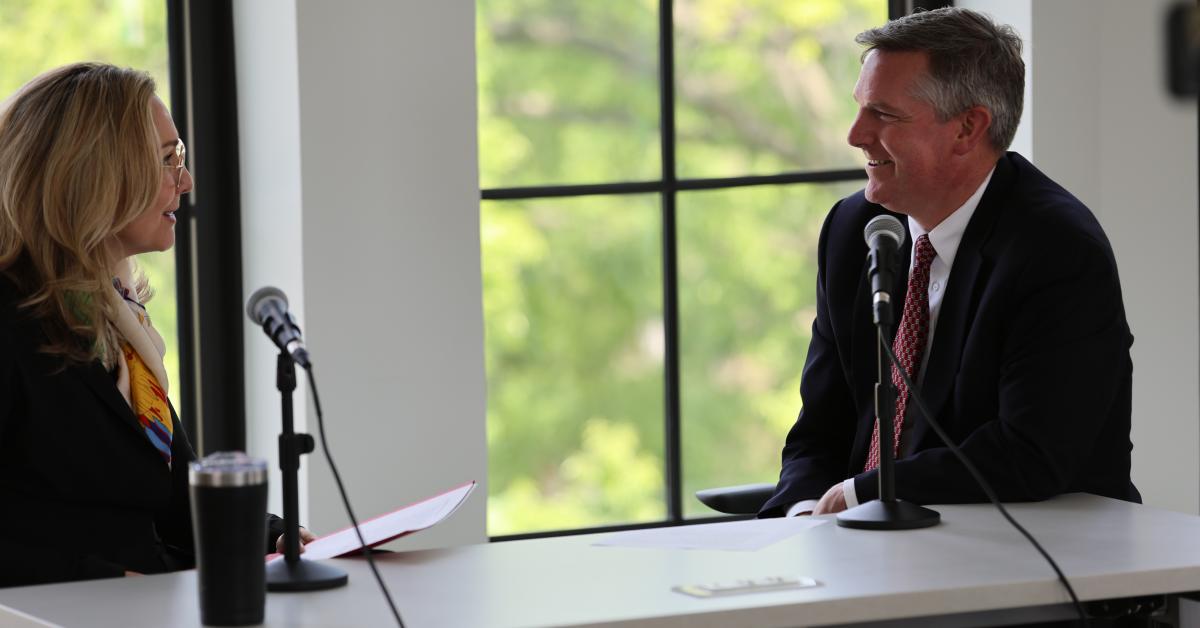
This conversation is facilitated by Elena Forbes, director of advancement for the National Catholic School of Social Service and the Conway School of Nursing at Catholic University.
*This transcript is based on an audio recording and has been lightly edited for readability. It reflects the substance of the conversation but may not be a verbatim record.
Elena
So thank you so much for joining us today, Jennifer. I'm really glad that you're here and we get to chat. Why don't you take a moment and just tell us a little bit about yourself and your story.
Jennifer
Thank you so much for having me. It's amazing to be back on campus. So I got my bachelor's in social work-- a class of 2000, and it was a really incredible opportunity.
Since receiving my bachelor's in social work, I went on to get my master's in social work, my M.S.W., and have built my career as a social worker in New York City where I've been for the last few decades.
Elena
What brought you initially to Catholic University?
Jennifer
When I was in middle school and high school, I did a lot of volunteering and I did a lot of volunteering with homeless shelters and soup kitchens, things in that vein. I was really attracted to the idea of service. For me, I was so excited about the intersectionality of faith and service.
I really loved the aspect of Catholic social teaching and what it really means to be in service to those who really need it. Around that time, in the 90s, I was really excited about the work that Mother Teresa was doing and what Mother Teresa was talking about, having dedicated her life.
Her quote was “wholehearted service to the poor” and I was just really struck by these amazing, iconic leaders. I was thinking of Dorothy Day, who in the 1900s was leading the way in the Catholic worker movement in New York City, in the lower east side. So thinking about this exciting, intersectionality of service and faith. I was really feeling drawn to social work. Really not so much even as a career, but more like a vocation– as a calling. I just felt so excited when I had the opportunity to come and be here. It just hit me when I was 18, this idea of a pathway that would connect faith and service in a way that just felt so dynamic and authentic. But especially to be able to do that here at the Catholic University of America. It was really life changing for me.
Elena
That's wonderful. I think that's something that's pretty indicative of a lot of the students that go through NCSSS and come out both at the undergraduate and graduate level.
How have you seen that vocation translate into your career?
Jennifer
I think the piece of social justice was really one of the grounding pieces of the National Catholic School of Social Service. And the program was really that piece about fighting toward equity. I think what was really so striking to me is knowing that we live in a world that is not equitable and there are so many systemic barriers that people can face. And I think what was so compelling about this school and about this work was how do we really create systems level change.
That was the piece that was so striking to me. It was how do we create change on a larger level? I think also being in the backdrop of where we’re working and having opportunities and internships and studying. In our nation's capital in Washington, D.C., there were so many incredible opportunities to look at this work. Not just from a clinical lens, but from a policy and systems-level lens.
I think that's something that I really brought with me into my career.
Elena
So was there an experience in particular that's worth noting from when you were a student?
Jennifer
Yes. There were so many really great things. I had incredible professors and really dynamic classes, but I think what really stood out to me was the internship experiences.
When you're getting your bachelor's in social work, you are also essentially getting the first year of your master's. So if a person goes straight to their Master of Science in Social Work (M.S.W.), it's traditionally a two year program, but if you get your bachelor's in social work, you're essentially doing some of the master's requirements in your bachelor's experience.
Then from there, I was able to get my one year advanced standing. I was able to get my M.S.W. in one year because of all the things I had in my Bachelor of Social Work (B.S.W.) experience. But one of the things that was so incredible, I had so many internships in my junior year and my senior year, and that was life changing because of all the things that I was able to learn in the classroom. I had an experience in the internships to really bring that to life.
And one of the internships that I had was the juvenile drug court in Washington, D.C. It was really groundbreaking because this was actually one of the first courts in the entire country that were leading diversion programs for young people who were involved in the justice system. Instead of going to jails or that route, they had an opportunity to divert them to educational programs or community support or connecting back to different job training and things like that. My supervisor was a social worker and an attorney. I got so many experiences there that were really incredible and I would say, fast forward to my career in New York City, I have had an opportunity to work in the court systems.
I've worked in the criminal Supreme Court in New York City and many legal systems, so that experience gave me a lot. But I think what that experience taught me was that piece of innovation that was so groundbreaking because it's like, we're seeing this challenge of what's happening to young people who are involved in the justice system, and how do we create this really innovative solution where we can change the trajectory in a different way?
That was just so groundbreaking to have that internship and to see how the social workers and attorneys were creating such an innovative new way of looking at how we work with young people. I think what I learned so much was that, again, that piece of how social work is really about systems level change.
We don't have to be complacent and just feel like this is the way things are, but it's like we can really be in a position to create systems level change. So having that internship in the juvenile drug court and other internships really gave me such a powerful experience because it brought all the things that I was learning in the classroom and really brought them to real life application. So that was really positive.
Elena
It sounds like you also had a really strong interaction with people in other disciplines and other industries who are also sort of part of a multi-sided care team, for lack of a better phrase.
Is that something that you see in your day-to-day? Where does the social worker fall into the equation?
Jennifer
That's such a great question because I think that's what's so incredible about social work is that it's systems-level work.
What I learned in school was this piece of we're looking at a person in the environment. We're looking at not just a person in isolation, but we're looking at how they connect to their entire environment. So how they connect to their neighborhood, to housing resources, to healthcare sorts, to all of these different pieces.
I think what that translates to as a social worker over the years I've had an opportunity to work within so many different systems. And I guess that is what makes social work so unique is that you have an opportunity to work systemically and across different disciplines. People can serve in the education system, you can work, do forensic social work, you can work in hospitals, you can work in community based organizations.
So many different things. And I think that's probably the biggest thing that I love about this career is that there's an opportunity to be able to intersect with so many different disciplines and really create change from a systems level.
Elena
Obviously the work that you're describing is pretty intense. You're dealing with folks who are at risk, who are going through some really challenging life circumstances and life situations. I feel like that can be probably pretty emotionally demanding of a social worker, as well as the person who's receiving your aid and your expertise.
How did your education prepare you for coming to terms with that in the real world?
Jennifer
That's a great question. I think my education really gave me a deep experience in the power of perseverance and really intense fortitude and hard work. From my experience, I think this might be true for many students, as well, I was balancing not just classwork and internships a few days a week, but I also was working through school, navigating the financial aspects of being in college.
I was glad that I had an opportunity here to study and work on campus. I also worked outside of campus and was a resident assistant at the House of Quinn. Balancing all of these different pieces between school, interning, working, RA, and of the different things, really taught me that piece of what it means to balance. All these different things I know that it's gonna be worth it on the other side.
One thing I'd love to share is that where I think I saw this really clearly is that right after I graduated, I went straight to get my M.S.W. in the advanced standing program at Columbia and really built my career in New York City and had just started in the field. September 11 happened and I worked with a lot of families that were very much impacted by the terrorist attacks of September 11.
That experience taught me so much about the impact of trauma and complex grief and what it means to do this work when there are so many other things that are happening and impacting in so many different world events that are taking place.
Then fast forward to five years ago when we had the COVID pandemic. Being in social work in New York City, we were right in the eye of the COVID pandemic. And even though we're five years out, we're still really seeing the impacts of that very acutely.
I think this has really made me reflect on this work, it is very complex. There's all kinds of things happening in the world that we can't predict or be ready for. But everything that I learned here, really taught me this place of if we're leading with strength, if we're leading with love, if we're leading with compassion, if we're leading with having an informed lens to whatever comes our way.
I think that's what really has kept me grounded. Like everything that I learned here, it's like it's taken me through all the different things that have unfolded. And maybe things that I may not have ever expected, but I felt very grounded in those experiences.
Elena
It's interesting that you say the leading with phrase, because our new tagline on campus is Lead with Light. So we very much still embody that with our students.
In that vein, what advice would you give to a student that's looking, maybe graduating with a B.S.W. or pursuing their M.S.W. right now, about to graduate and enter the field? What advice would you give them as they're entering the world of social work?
Jennifer
So I would have two key things that really stand out to me. The first one would be to build out your network.
Elena, I love what you were saying before about that piece of systems and connecting with people that are both in the social work world and also adjacently in other professions. And I think that's the biggest thing is like really building out a strong network.
Some years ago, I had a supervisor who said “You never want to work in isolation. It's dangerous to work in isolation”. And what she meant is this idea of you never want to work in a bubble, as it were.
You really want to make sure that you're having support around you in different ways. What that looks like is really thinking, not just in your workplace, but really beyond in the communities that you're working in. I know the school has many great alumni networking events.
I would definitely encourage people to do that, if there are other coalitions or different groups to be a part of. So for example, one thing I got to do in New York City was I've been a part of a lot of different task forces over the years. I was part of Mayor Bloomberg's task force on chronic absenteeism.
I was part of a youth homelessness task force. In recent years, I was a part of the mayor's office of immigrant affairs, a task force to support asylum seekers.
So all to say I think if there's ways to build out your network in your community through different coalitions or working groups or alumni mixers, whatever that looks like, but really having a robust network. It's going to be incredible.
I think as you're moving through your career and different stages of your career, it's so nice to have that network around you.
The second piece of advice I would have is really letting yourself be adventurous with trying new skills. Again, with social work, it's such a broad experience. There's so many different things you can do.
So for me, one thing that was really exciting a few years into my career, I was able to do some grant writing. That was so fantastic because it led me to this path, even though I was doing clinical work– I began to do more work around funding and around development and I realized I really love grant writing and that side of building out and growing the work and sustaining it.
That was really exciting to me. I'm on a board of directors now at a nonprofit and doing some development work and it's like that's been really exciting. But just like trying different things or I think trying different modalities. So if you're in a career where maybe you're just maybe you're working with individuals, maybe let yourself lead some groups or, do something, in your community. I think really being able to put yourself out and try different areas of practice and trying out new skills and not being afraid to just try something different. I think that's a thing that really can make you feel really nurtured in this work because there's like a lot of different areas that you can go. So building out your network and really allowing yourself to try different modalities and learn new skills.
Elena
Would you say in social work that those two are almost intertwined in some ways? When you build out your network, you identify new skills that you wanna test out and vice versa, you meet new people and you try new skills and they all follow each other.
Jennifer
Absolutely. I really love that I think one of the things about social work as well is that we're actually required to have professional development as part of when you become a licensed social worker. That's part of what's built in, is you're required every year to have to keep doing professional development. But it's the best thing ever because this work is always changing and it's always growing.
Our work is also rooted in evidence-based practices. So all the time there's always like new modalities that are coming out, new evidence-based treatments. There's new organizations that are trying revolutionary new strategies. And it's so important to continue to learn. And I think that's something that I really got here at Catholic University was that it was such an incredible education and I really did get that message doesn't stop here.
All the great stuff that I learned here. There was always that message of you always get to keep learning and to keep growing. And that's another thing that I think makes social work such an exciting field because you're never stagnant. That's what I love about it, it has kept me sustained over the last 26 years being in the field. You know that there's always new things to learn and you can always keep growing and there's always just something new to try.
Elena
What's the up and coming modality? What do you see as the future of social work training or continuing education? Right now, at least for you.
Jennifer
I think the biggest thing that I have seen is around trauma-informed care. It actually came out of forensic court based social work. The question was when people were navigating the justice system, were they a victim or a survivor or just navigating different aspects of going through the justice experience. A lot of times what they found was that it could be very re-traumatizing for people to not only go through something that's really traumatic, but to also have to tell that experience over and over.
Whether that's to therapists or to police officers or to their attorneys or telling that story over and over can be re-traumatizing. And within the forensic social work community, there was this idea of okay, how do we make that experience when we're working with people and interviewing and having them tell their story?
So how do we navigate the nuance of working with someone where we're supporting their healing? We're not re-traumatizing them, but we're really working in a way that's honoring what they've gone through. And then I think where it originated trauma--informed, and then where I think it's expanded is what I've seen over the last maybe decade or so. It's really had a growth in schools, right?
How do we make our schools trauma informed, community-based mental health? How do we make those services trauma informed in all the different modalities, hospitals? So how do we help people who may have a complexity of different traumas? A lot of times people, we may not always see it on the outside, but people may be holding onto a lot of traumas.
That's one of the things I've seen that our field is really recognizing in a different way, is how do we really honor and recognize that and conduct our services in a more trauma informed and supportive manner. There's a lot of different evidence-based strategies that are emerging and growing now around trauma-informed work.
Elena
It's really great to hear. We just got a really large grant in that space for the School of Social Work, so it's good to know that we will have some very prepared students entering the field that are on the forefront of that space.
Hopefully, we'll see some rewards for that. Now to flip to the student that may not necessarily be sure about their path in social work, there's a lot of different avenues to take, particularly if this is the type of work you wanna do. What would you say to them? What would you say to convince them to pursue social work as a career?
Jennifer
First I would encourage them to think about volunteering or maybe getting an internship. It's a chance to try out different pieces of the work, because I think sometimes, people might think, before I commit to studying this for any length of time, maybe I want to see if this is right for me.
If someone may say you know what, I think I want to go back and maybe get my master's in social work, but I'm not quite sure and I might say try some volunteering in your community. I think trying that out can be helpful. In my experience in working with people who are newly entering the field, it's like you wanna try out different modalities because a person might really love working with individuals.
I don't really love working with groups or I love working with groups, but I don't wanna do systems level work, or maybe I don't wanna work individually. There's so many different modalities, there's so many different areas of social work.
A person might really find themselves being drawn to School-based work or community-based work, or maybe private practice or maybe development or maybe public policy. It's such a really broad field, and I think that by getting some internship experiences and trying it out, they can see which area of social work is really appealing to them.
And related to that, I think what is so incredible about the social work programs is the internship and the real life work experiences go hand-in-hand with the academic piece. So I think as people are trying out different sides of the work, it shows them which pieces they might gravitate toward.
Elena
Why do you think it's important for other alumni and like yourself to stay connected to NCSSS and the work that's happening on campus?
Jennifer
I think it's really important to be able to support the next generation of social workers. It's really important to have a space of giving back to the profession. About 15 years ago I got my Seminar and Field Instruction (CFI), which is a credential that you have where you get to supervise people who are getting their NSW or BSW.
In that experience, what the professor shared with me is this moment to give back to future social workers. That really impacted my thinking about it as we think about people who are entering the profession. How do we continue to support and grow people who are entering this profession?
So when I was here, we actually had a really fairly small but mighty graduating class. The experience was transformative. For me, it just shaped my career in so many ways. I am genuinely excited to think about how we're growing and shaping all the new social workers that are entering the field and I think it's just so essential to think about how we are investing in this profession. It's so important.
I feel now, more than ever, it's such an incredible and impactful profession and career. And if there are ways that we can support future social workers, if we can support this amazing institution. It's really incredible. So to keep supporting and also growing and expanding this work.
Elena
What does giving back mean to you as an alumni?
Jennifer
I think it can look a lot of different ways. I've been really excited to see the really incredible alumni work that's happening in different cities. So in recent years, I've been able to connect to the New York City alumni chapters which have been fantastic. Not just for social work, but for people who studied a lot of different majors here in school.
I think the alumni gatherings in different cities are fantastic. It's a way to connect people who've just graduated who are just entering the field and maybe people who've been in the field for a long time. It's like there's a lot of different ways to build what we were talking about before, building those networks and I think definitely.
Financial support, whatever that may look like, is important as well. If there are opportunities to be able to do that. Mentoring opportunities, I think for people who like students who are looking at the school and thinking is this right for me, I'm not sure. Because it's a big commitment to whether you're getting your B.S.W. or M.S.W. or maybe an online certification.
It's a lot to think about as people are discerning if this is right for them. I think being able to be in a space of saying this is what the school did for me. This is how it was like, really transformative, for me and for my career. And I think being able to share those experiences is really helpful on the other side for people who are thinking about possibly being here.
Elena
That's wonderful. How do you see technology playing a role in social work?I think a lot of the field, generally right now, is dominated by the rise in AI and the rise in technology. So where do you see that playing a role in social work practice?
Jennifer
Love that question. What was really interesting is I found during the pandemic, as and of course being in New York City, we were right at the center of the pandemic when our whole city and everything shut down and everything went remote. And I'm gonna admit to you that prior to that, I was definitely the biggest skeptic in doing work remotely. Very skeptical.
So keeping in mind that I came into this career, everything was always in person all the time. Prior to that, I couldn't even imagine doing work remotely. To me this was going back. I literally thought that the antithesis of this work must be in person. That is where this work happens.
However, and here's where I changed and shifted my thinking when the pandemic happened. We all were like, now we're gonna work on Zoom and we're gonna have virtual sessions. I was working in the university counseling setting, as part of CUNY, instead of being on campus and meeting for therapy sessions in person again, right?
Everything went on Zoom during the pandemic. And to my surprise, as a skeptic, what I noticed was not only was it very effective as far as just still being able to connect and have really impactful therapy sessions. But what I actually found was that in some ways it was even more impactful because it took away some of the barriers of people coming in to get treatment.
Because what I noticed was, and we kept, we looked at this analytically, right? We looked at the quality. The quantitative data, but also qualitatively, we would continue to ask people about their experiences and we heard this again and again from people who said, you know what? I'm balancing school and work and family demands and all of these different things that actually getting into my therapy session is one more thing. But you know what, if I can just have it over zoom, it actually eliminates some of those barriers. And we found that our engagement, and our attendance or retention numbers.
So fast forward to five years later where what I've noticed is that maybe a good thing that came outta the pandemic? What I'm seeing is the majority of different social services, at least I would say in New York City. What we're seeing is everything is hybrid, giving people the option and the choice.
Would you like to come in person to engage in various services or would you like to have them virtually over Zoom? And what I've learned is by giving those options takes away some of those barriers and actually increases people's ability for accessibility for services.
So I think that's one of the biggest pieces that I feel like has been a benefit. And I think we're really at the forefront and we're gonna continue to see different changes to come. I would really say, social work is so much grounded in change and I think it's important that we keep an open mind.
Just as I was able to shift my thinking about the benefits of being able to also work virtually. I think having a change mindset and not being stuck in like doing things a certain way, but to have an openness. And knowing that our world is always changing and how can we change with it?
And I think there's been a lot of interest, especially in higher ed. There's been a lot of interesting conversations that are around. AI is here to stay. It's not going anywhere. So since it is here, how do we continue to change and adapt with it? And just not being resistant to change, but keeping an open mind for where that can take us.
Elena
I think that's a really healthy approach. And I will say it sounds like social work in general is an industry that prioritizes adaptability. It sounds like a lot of that is tied to how you as a professional develop your skills in a way that removes those barriers to access.
What are some of the skills that you think are really important for a social worker to have?
Jennifer
I love what you said about that piece of adaptability. I think that is such an important piece that grounds the entire conversation we've had around that ability to navigate change.
There's always gonna be change, there's always gonna be changing circumstances around us. And this work is really grounded in being able to pivot and adapt to different changes. I think the other one is just a concrete skill. I'm really grateful for my professors that were my language professors and Spanish professors specifically.
I think being able to speak another language is definitely an asset in social work. For me, I was able to continue to study Spanish while I was here. It's my second language, and I have a lot of gratitude for my professors who were able to support me in that journey. I am now entirely fluent in Spanish and that's been a huge skill because I am a social worker in New York City, but really anywhere, I think being able to have another language is a really important aspect.
I would say another thing, it would be within keeping an open mind to learning and using different skills. So being able to have clinical skills, but also being able to have policy level skills, being able to do grant writing and funding, being able to just really use yourself in different ways I think is really important.
I believe the biggest thing that sets social work apart is we're not working in isolation. We're always working with an eye toward all of the different systems happening in a broader way in our communities and in our country, and how different laws and different changes are impacting our clients and impacting our work.
I would say that was something really unique and special that I got here at Catholic University because we were doing this work. The nation's capital in Washington DC was this incredible backdrop to really understanding the different policies, the different political changes that were happening around us and how those systemic policy level pieces were impacting the work.
I think that's something I really carried with me, always looking at things from a broad sort of systems level perspective.
Elena
So what's the one thing that you could recommend to an undergraduate student that they should be able to say they took away from their time on campus at Catholic University?
Jennifer
I would say take advantage of all of the different resources that you have around you. I think one thing I really loved about my experience here on campus was that I was able to really have support on all sides. I was able to connect with fellow students. I was able to really connect with my professors, and I actually had some really amazing professors that were really just an influential part of my journey.
But also, all the different other programs on campus. The campus ministry was really beautiful. A lot of the different clubs and programs on campus were great. Resident life while I was an RA was great.
And something really great to be a part of, and I would really encourage students to know that there is support around them. For me, I also worked really closely with the financial aid office and I actually worked there at the financial aid office, when I was doing work study.
Just knowing that there's all of these different things that you can connect with. And knowing that you're here in a campus that's a beautiful campus, but also in the heart of Washington DC, for students to really take advantage of that. Whether that's having an internship or a job in Washington, DC or even just so many of the different cultural opportunities that are in Washington DC, I think that's something that's so powerful.
There's all of these incredible things on campus and within the broader Washington DC community. I would just say for students to let themselves enjoy and take advantage of all the different supports that are available.
Elena
Wonderful. Thank you so much for taking some time today to share your story and who you are now as an alumna of The Catholic University of America and a very successful professional social worker out in the field doing big things and changing the world.
Jennifer
Thank you, Elena. Thank you so much for having me. And just thank you so much for everyone here at the University who are doing incredible things every day.
Published on: Friday, May 15, 2026
Tags: Cardinal Perspectives, NCSSS, advancement