
Welcome to Cardinal Perspectives, a series featuring in-depth conversations with alumni, students, faculty, staff and the extended family and community of The Catholic University of America.
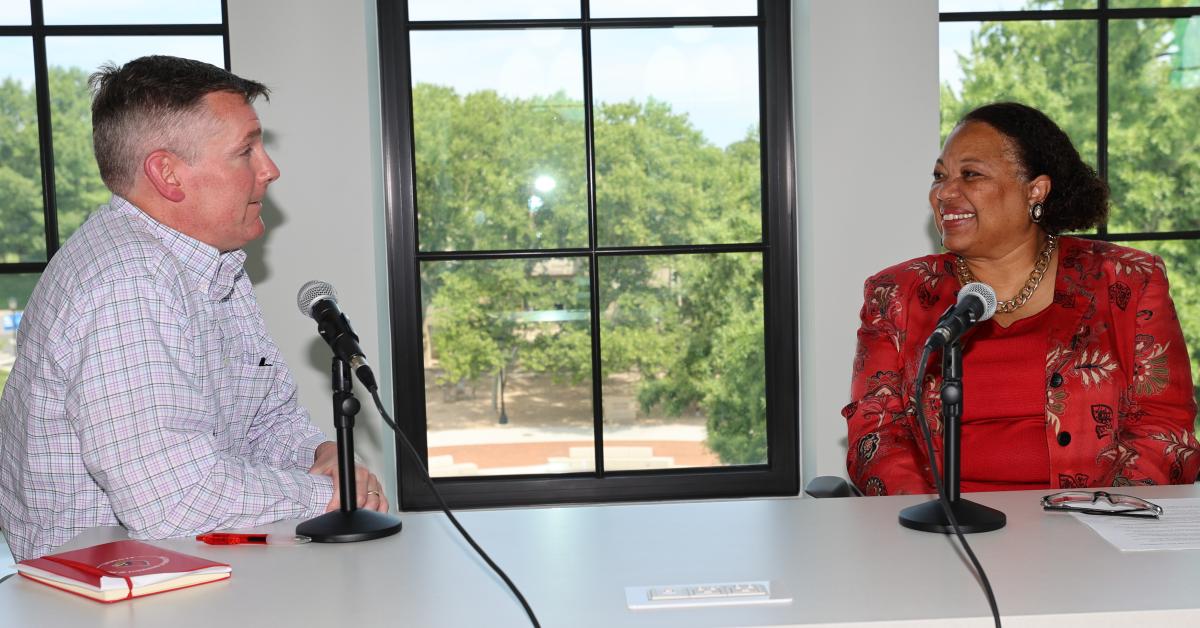
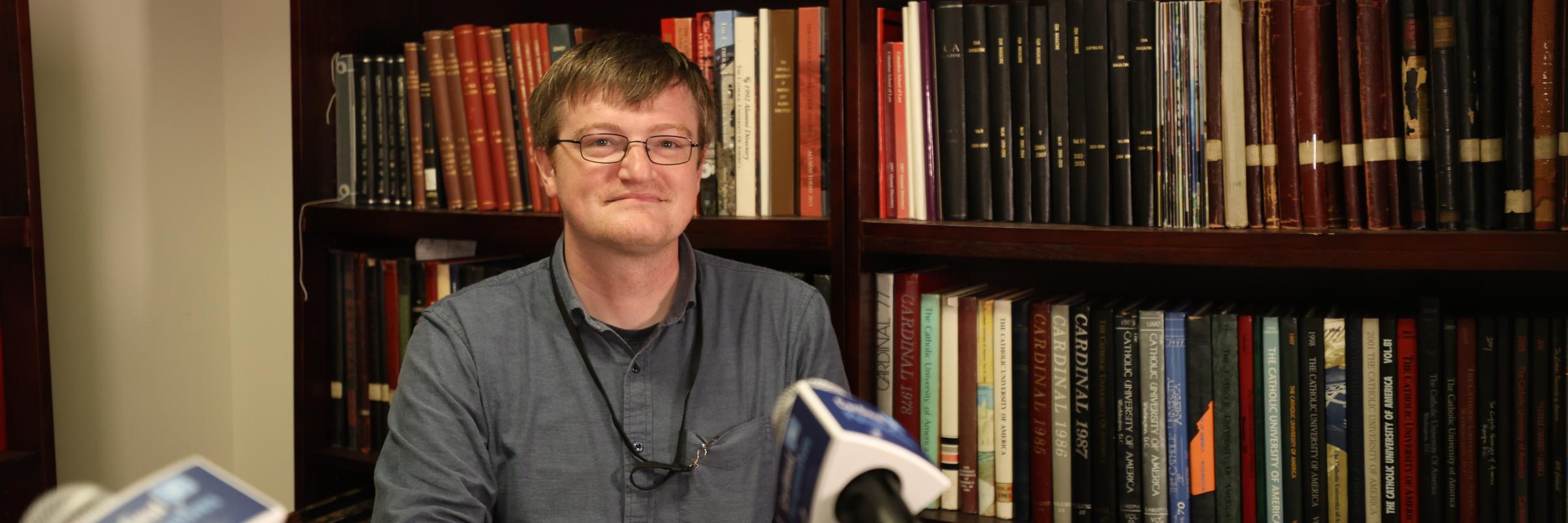
Shane MacDonald is curator of digital and museum collections at The Catholic University of America Special Collections. He also teaches at the University as an adjunct faculty member in the Department of Information Studies.
Shane received a Bachelor of Arts in history from Oberlin College before earning a Master of Arts in history and a Master of Science in Library and Information Science, both from Catholic University. He also holds a Digital Archives Specialist certification from the Society of American Archivists.
Shane began his public history career as a volunteer, first at a living history museum in Nebraska, then at the American Red Cross National Headquarters in Washington, D.C. He joined Catholic University Special Collections in 2012, starting as a student employee before moving into a staff position.
This conversation is facilitated by Audrey Hill, senior associate director and writer for advancement communications at Catholic University.
*This transcript is based on an audio recording and has been lightly edited for readability. It reflects the substance of the conversation but may not be a verbatim record.
Audrey Hill
Welcome to an episode of Cardinal Perspectives. I'm Audrey Hill, a writer in the Division of Advancement, and I'm pleased to be joined today by Shane MacDonald, curator at The Catholic University of America, where we dive into some of the archives. Great to be here in the archives itself.
So let's just start broadly. What archive question do you get asked the most?
Shane MacDonald
I would say there are two ways to approach that question. The first is, what's the trivia question or historical question we get asked the most that we usually then prepare for? We've gotten asked a lot, what do you have on Fulton Sheen, who was just beatified? Or is there an exorcism room on campus? Or when did women first get admitted to campus? In those cases, we've often anticipated or prepared materials like blog posts, digital collections, so we can easily answer and provide resources to people.
The other question we always get, which usually most archivists get, is what's your oldest object? What's your favorite object? What's the most surprising object you have in the collections? And that can, the oldest is always going to be the same, but the other ones can vary based on, you know, what's my favorite at the moment? Or how do I want to surprise the group of researchers or students coming in?
Audrey Hill
What is your favorite at the moment?
Shane MacDonald
My favorite at the moment is a signed picture of Al Capone we have in the collections that was signed and gifted to a Chicago-based crime reporter in the 1920s and 30s who unwittingly befriended Al Capone while doing coverage, whose papers we hold in the collections.
Audrey Hill
I love that. So then stepping into something a bit specific, but also far back in time, where was the Middleton House and what role did it play in early Washingtonian society and then later on campus?
Shane MacDonald
So the Middleton House is the oldest structure on the campus at the time. It dates back to about 1803 and it is roughly where the Pryzbyla Center is, the student union today. The early history of that is when Thomas Jefferson, then president, invited Samuel Harrison Smith and his wife, Margaret Bayard Smith to come to D.C. to start in the capital's first newspaper. They settled here, built their house, and along the way they hosted a number of dignitaries throughout their time, including Thomas Jefferson, the Madisons, Henry Clay, and other figures who would come here.
This was a very rural area. So it's kind of like going out to the countryside for a nice meal. Margaret Bayard Smith actually wrote a book about her time here that kind of details all the social life. So it's a great resource if you want to read about this perspective of life here on what would be Catholic University's campus, but also an early kind of D.C. social life. They had the house until the 1830s when it was sold to the Middleton family.
At that point it became a slave plantation, this region. Then in the 1860s, it ceased to operate as that and was sold to the bishops in the 1880s. After that point the Paulists actually moved in, the Paulist Fathers, and ran their own school there for a little bit before it became a dorm called St. Thomas Hall. It housed the National Catholic School of Social Services. So, the social work program for a number of years before it was demolished in the 1970s, through what was called in the student newspaper a terminal case of “fire code-itis”, that they could not update it. They could not update it enough to salvage it.
Audrey Hill
That's fascinating. It's interesting to think about this part of D.C. as the country.
When the bishops bought the building, did they know that it was going to become the University?
Shane MacDonald
I think so, yeah. And they knew a lot of religious orders would probably build houses or acquire properties nearby because Caldwell was the first building. So when the Paulist Fathers, which was an American-born religious order, wanted to be associated, they needed a place nearby, and they had this house right there to just move into.
Audrey Hill
That's fascinating. And then what can you tell me, speaking of the origin of the university, about the Caldwell Cornerstone and what it contains?
Shane MacDonald
Oh, yes. The Caldwell Cornerstone, which you can go and see, still has a big number on it. The cornerstone contains, as the tradition at the time, a newspaper, that day's newspaper from all the local newspapers in D.C. at the time, including the Post, the Washington Star, and a number of others. It includes denominations of U.S. currency from, I think from a penny to a dollar in multiple forms. It also includes the statutes of the University and the invitation to the cornerstone ceremony as well.
Allegedly - I've seen some sources for this, and some sources don't have this included - it includes the original letter sent by Pope Leo XIII to Cardinal Gibbons, giving his blessing to the founding of the school that we usually use as our marker of the founding of the university in 1887. So the original letter is allegedly in the Cornerstone. We have the envelope that it came in in the archives, and the letter is potentially on campus, but it's not very accessible.
Audrey Hill
And so if it's not there, we don't know where it is.
Shane MacDonald
Yeah, it may have been, and it may not have been. I've tracked it with the Archdiocese of Baltimore because they would hold Cardinal Gibbons papers and it's not there, they don't have it. Of course, when they had this cornerstone ceremony they had President Grover Cleveland, who was there at the time, along with Cardinal Gibbons, who was also there at the dedication of the building.
Audrey Hill
That's interesting. So, it was a huge deal even at the time.
Speaking of presidents, can you tell us about who visited the Pope Leo XIII statue?
Shane MacDonald
So then-President Theodore Roosevelt visited it in the early 1900s, about 1904 or 1905. Of course, it was very rural, the countryside around here. At the time, there's only a couple buildings. The buildings that most people would know today on the campus would have just been Caldwell and McMahon Hall.
So he was riding, according to the story, with two Secret Service agents or their equivalent at the time, just out for his evening or afternoon ride around the rural part of D.C.
And he came across a group of students who were practicing singing outside Caldwell Hall post-Mass, and he just heard them. So, he came up and asked what are these buildings around here? And of course, I imagine the students were awestruck because here is the president of the United States just riding up on a horse.
They told him this is The Catholic University of America. The president happened to be friends with a professor on the campus, Maurice Egan, who was an English professor and would later serve as his ambassador to, I believe, Denmark. And there were times, they had White House events where he was introduced to William Butler and other other types of literary dignitaries. So Egan apparently had talked up the statue to the president.
The president told the students that my friend has always talked about this amazing statue of Pope Leo XIII and “I'd love to see it.” So the students, of course, guided the president to the building, and showed him the statue. Apparently, the president was impressed and exclaimed how exciting it was.
Now, just to add to the story, this wasn't his first time Theodore Roosevelt was on campus, which is kind of funny because he, long before his president or vice president, actually came and gave a talk in McMahon Hall in the late 1890s when I believe he was secretary of the Navy. He gave a talk about George Washington as a model of leadership. We don't know the room he spoke in, just that there's just a little blurb in the Catholic University bulletin that Secretary of the Navy Theodore Roosevelt is here to give a talk this day.
Audrey Hill
It's amazing that students could just have an impromptu meeting with the president.
Shane MacDonald
And, I don't know about the Secret Service agents, because I think he just told them to stay here and he went inside with the students. I assume he left his horse there. He certainly was not riding it into the building. But the statue is in the same spot it was when he visited. It’s been there since 1896.
Audrey Hill
So that's amazing. And then the University's wind tunnel seems quite pioneering for the age. Who was the mechanical wizard behind it and what did he accomplish?
Shane MacDonald
Around the same period, kind of the 1890s, early 1900s, the professor Alfred Zahm was the professor of mechanics or physics on the campus at the time. And so he was a well-known aeronautical kind of innovator at the time. This was before the Wright brothers, there's of course, a lot of people trying to figure out how to develop first flight. And he's one of those people. He went to Notre Dame as an undergrad and was apparently notorious for creating or building items that he would throw off buildings or use clotheslines to test his experiments.
So his brother was the president at Notre Dame. I think he got away with stuff. At Catholic University, he would basically conduct experiments in McMahon Hall. Because this is where most of the faculty, other than the theological and philosophical at the time, were located. Apparently he would fire little cannons to try to test like aerodynamic forces and all that. And I assume the facilities or someone got tired of him firing cannons.
And I wish we had a little bit of a picture or just an example of those cannons. I'd love to see what they were like. So they built him a building on campus so he could just experiment to his heart's content.
It was one of the few buildings that had constant power. At the time electricity would be cut off around nine o'clock at night to the dorms and to the buildings. So students would have to study by candlelight. This was kept on at all times because he would be experimenting all night there.
Which is why the students nicknamed him the wizard, because you could just see lights emanating from his space and in this building. He kind of made several breakthroughs in aviation that still influence us today including developments on skin friction and aerodynamic drag. But, also what's called the Zahm shape – a kind of torpedo-like shape. He first kind of experimented and developed it right there in this building.
He eventually left the University to be a member of the successor organization to NASA. So he continued to live in D.C. and was very instrumental until he also passed away in the 1950s. He also got to see space exploration develop. He got to see from early aviation to basically the first development of man-made objects in space.
Audrey Hill
He was a pretty foundational figure in the field.
Shane MacDonald
Oh yeah. And, just to even tie back in a little trivia too. His brother was a priest and administrator at Notre Dame and was also friends with the University. He was friends with Theodore Roosevelt and they actually went on an expedition to the Amazon in the 1900, 1910s after his presidency. There are all these interesting little connections of Theodore Roosevelt everywhere during this period of time.
Audrey Hill
A real Renaissance man.
And what contributions did Catholic University make then to nuclear and physics research during the 1940s and 1950s?
Shane MacDonald
Beyond hosting a number of faculty, particularly some faculty who were leaving Europe because of rising Nazism and fascism, we hosted figures such as Karl Herzfeld, who was an emerging physicist, and Lise Meitner, who was the co-discoverer of nuclear fission. He had a guest faculty spot here for a year or so. But also in the 30s and 40s, we were one of the few campuses in the U.S. that had an atom smasher. There's amazing photos of religious sisters working on it in our facilities, which is just really exciting.
So basically because of this history in the 30s and 40s of nuclear and as well as physics research on the campus, and our D.C. location, we were a central spot for post war development with cold war and nuclear physics. And the atomic energy commission actually paid for a training nuclear reactor to be installed on the campus in 1957.
There is a great photo of the then-Rector McDonald blessing it when it arrived. This was used to train mostly nuclear sub operators, but also some engineers for facilities. It had apparently only enough power to light a single Christmas tree bulb, but it moved around. It was decommissioned by the 1980s, but that's one of the legacies and one of the most tangible legacy we have. Plus, there were other figures like Clyde Cowan, who was the co-discoverer of the neutrino, actually was a faculty member here.
He passed away before his team received the Nobel prize for it. But we have his papers as well. And of course, like today with the Vitreous State Laboratory on campus, there's still research going on in physics, nuclear, and safe nuclear storage. So there is this long legacy that goes back to kind of the earliest years of nuclear physics.
Audrey Hill
I think what this conversation is showing to me is how this D.C. location and all these important figures and research are all interconnected.
Shane MacDonald
Oh yeah. So I think the central location really helped to play a predominant role between things like nuclear research, the nursing school, physics.Then of course, the physics department did a lot of interesting things from developing a tornado machine in the 60s. Professor Chang created this tornado machine, which would replicate little tornadoes. There's some fun photos that show how tornadoes form and their life cycle, which has helped improve detection technology and save lives since then.
Audrey Hill
That's amazing. And then moving from science more into perhaps, drama and the arts, what can you tell me about who Father Hartke was and what was his legacy?
Shane MacDonald
Yeah, Father Gilbert Hartke, he's everywhere in the arts, he's a larger-than-life character, even about 40 years after his passing. He's still kind of prominent, and casts a long shadow. He was a Dominican priest, originally from the Chicago area, but spent most of his life here in D.C. He lived at the Dominican House of Studies and founded Catholic University's drama program.
In the late 1930s, there was a predecessor organization that he managed and he was involved until his death. He did retire in the 70s, but he kept being involved. And so he was very instrumental in creating what was then one of the first academic drama programs in the nation. Not just founding this, but he was extremely well-connected to basically the world of drama from Hollywood to Broadway to the USO to the local theater scenes. He shaped generations of actors and thespians, including John Voight to Susan Sarandon to so many names.
Audrey Hill
John Slattery...
Shane MacDonald
Yes, John Slattery. So many figures that have credited him with their kind of move to acting, to voice acting, to just getting inspired. But he also shaped the local theater scene so much in terms of he helped co-found what was today the Olney Theatre company. He led his students in USO tours around Western Europe. I think he even did a little tour in the Eastern Bloc for a little bit.
And there's great photos that we have in the collection of them going to Greenland. The students all bundled up, getting ready to do a production. But also, he helped desegregate theaters in D.C. by cooperating with Howard University.
You see his name come up a lot. We get it, we got an object recently, a couple years ago, from an alum who, of course, studied under him. It was kind of an interesting thing that shows his legacy and his continuing impact on people.
The item was just pieces of wood and cloth that was from his director's chair that apparently one time, it collapsed under him. You know, for whatever reason, it was probably just old. He laughed it off and kind of left to go clean up. But the students came and fought over pieces of it. Because they wanted the legacy of Father Hartke. She kept this for years and then donated it to Drama, who then gave it to us. And, you know, it looks effectively like trash. But it says something about how meaningful he was to some of the students.
Or the fact that even now, we've had students who come in in classes to visit, who are drama students, who, when I pull out his papers and they see his letters, it's such a meaningful occasion for them.
These were students who didn’t know him personally. He's been deceased since 1986. But it's still so meaningful for him to see the letters he wrote to students and see he's giving the same advice they get now. And also, this is the person who created this legacy for the University.
It's just amazing to have that impact both here, broader in the theater world, but even in the local theater scene. He was also deeply connected to the world of politics. He befriended every president from Truman to Reagan.
There's a story that when he said, "I'm just a humble friar, I like to hide in the corner of a room." One of his Dominican friars joked, “I didn't know there was a corner in the Oval Office.”
As an example of his influnece, he was even asked by Jackie Kennedy to be one of two people to stand vigil over her husband, John F. Kennedy's casket while he lay in state. It shows the connections he had with these figures in national and local politics and theater.
Audrey Hill
Wow. And so I think it sounds like he's an example, not just of how D.C. influenced Catholic University, but how Catholic University influenced the city.
That's great. So one of my favorite pieces of art on campus is the painting in Mullen Library. So can you talk a little bit about what the Washington Color School is, as well as that particular piece of art?
Shane MacDonald
So the Washington Color School, of course, it's always hard to describe, especially an abstract expressionist movement, but it is an abstract art movement that started here in D.C., largely from the 50s through the 70s. It featured the use of large amounts of color to create non-representational images, shapes and patterns.
Audrey Hill
Very gorgeous.
Shane MacDonald
Kenneth Noland and Gene Davis are often seen as kind of the two foundational artists, and some of the other big names you can see at the National Gallery of Art, like Alma Thomas and others.
Go check them out if you haven't seen them. We have some Gene Davis pieces as well, but our most prominent is the Kenneth Noland piece displayed in Mullen, this large kind of bright color abstract painting of a kind of a diamond shape that Kenneth Noland donated himself to the university in 1962.
He painted this in 1961. It's called Pool. He donated it because he would teach here periodically, and he had a connection to the University.
I think that's just an amazing way to point to the birth of this D.C. art movement that has this connection to Catholic University as well. What's really interesting, too, is the history of it. It unfortunately was damaged in a fire in Salve Regina, the art school, in the late 60s, and also had other issues, but it was conserved in the early 2010s.
And so what you see now is a kind of the University-dedicated resources into restoring it to kind of its original grandeur. So it survived all this time and, and was a gift from the artist himself that saw the value of donating it here.
Audrey Hill
And speaking of art. How was Catholic University's lost Rembrandt etching rediscovered, and what is its significance?
Shane MacDonald
So that Rembrandt, which is a little small print, was discovered or rediscovered, however you want to frame it, by then-University President David O'Connell in 1998, just after he took office. He was sorting out stuff in the presidential office, where there's a bathroom, apparently looking for some paper towels, and just noticed a framed thing under the paper towels, and picked it up. I was like, this looks cool, and kind of looked it up.
It wasn't really shown to some predecessors of mine in special collections until 2009, when they were said there's something special here. And it was, so they worked with some experts that authenticated it, which led to a student-led, exhibit and art contest in 2010. I think it was kind of exciting that both you had the curator at the time, but also a grad student who was curating this exhibit. So it became this student-led thing, and students actually created artwork inspired by the piece, which kind of shows a man kind of dozing a little bit.
It had a handwritten note on the back from 1903, written in French. So the student translated it, which helped really kind of with the provenance and developing the history. Of course since then there's been a lot more research on it including working with some of the National Gallery of Art folks to identify it. It's believed it probably wasn't printed in Rembrandt's life, but it is using his original print, but polished up, and it's a kind of a second reprinting.
They have a version of the same one, but apparently it's a third one, so ours might be a little older and closer to Rembrandt, but it's kind of this exciting history that's still developing along the way.
I think it's a great story of how treasures are out there and can be found in the most unlikely places.
Audrey Hill
Well, especially, it seems like, here in the archives.
Shane MacDonald
Yes. And, and we don't even know how it got to the President's office. That's the other surprising thing. It's still not unclear how it ends up in the bathroom? Who, who left it? And it could have been one of President O'Connell's successors who had it and just, like, I'm gonna leave this at the building, like, or an art faculty member or anything like that.
Audrey Hill
Amazing. What important aspect of Catholic University history do you think is underappreciated or hidden in a bathroom or not well known on campus?
Shane MacDonald
Yes. The one thing we've kind of already hinted at this a little bit underappreciated is the connection to D.C. Because we can talk a lot about how it's influenced everything from Catholic social work and drama around the nation and everything, including, one of my favorite examples too, is the faculty here who helped construct some of the New Deal legislation under the FDR administration.
And these are all great, these are very important topics, and we have researchers coming, but we often sometimes overlook the intimate connection with D.C. itself – especially the Brookland neighborhood.
I mentioned how this was just rural, this was farmland, basically when the university first came here and how Brookland as a neighborhood grew up with the University and they've influenced each other since then. You know, and including, like, there'll be a soon an exhibit in the library about the development of the metro station and how that's part of the, part of that development came when the Brookland neighborhood resisted the development of freeway here and worked with the University to fight against freeways and develop the metro system that many of us still use today.
And, and so how connected it was, whether that's the local theater scene, the development of the Brookland neighborhood, development of local policies or local infrastructure, we have alumni who work everywhere from Library of Congress to D.C. government to you know, non-profits or the United States Conference of Catholic Bishops.
Audrey Hill
So this has been fascinating. I appreciate all the different stories you've been able to tell us.
Is there anything else you would like to share about being an archivist at Catholic University that we haven't touched on?
Shane MacDonald
I like to share about this especially with budding archivists who are interested in the field or historians – it can be really fun. I mean, we always joke, like, I can't believe I get paid to do this, you know.
But also, there's also a challenge. We have to shift gears between different disciplines, from theology to history to working with oil paintings one day, to medieval manuscripts, to Al Capone photos to Father Hartke wooden debris.
That can be challenging, but it can also be fun. And, along the way, what's really exciting is how you're involved in every process.
I think sometimes when people see us, they're seeing the end result of the process of the records, because we're pulling them and showing them. But we're there at the beginning of talking to the donors, getting the objects here, preserving them, rehousing them, maybe in safe storage, maybe making inventories so they're accessible, promoting them, then pulling them for the researchers and talking with them or teaching.
And I think that's kind of exciting to be there along the journey with this object the whole way, and, and to see it come to fruition when someone, a class holds the object, or it puts it on display, or a researcher cites it in their book after all that work. We're not the ones typically interpreting it, we're here making it accessible and preserving it for current and future generations, and, and to see that kind of thing along the way.
Audrey Hill
Thank you so much, Shane, it's been a real pleasure, and I appreciate your knowledge and your passion for all these amazing histories here at Catholic University.
Shane MacDonald
Always exciting to share this and always open to people to come in for appointments.
Published on: Friday, October 16, 2026
Tags: University Archives, Cardinal Perspectives, advancement