
Welcome to Cardinal Perspectives, a series featuring in-depth conversations with alumni, students, faculty, staff and the extended family and community of The Catholic University of America.
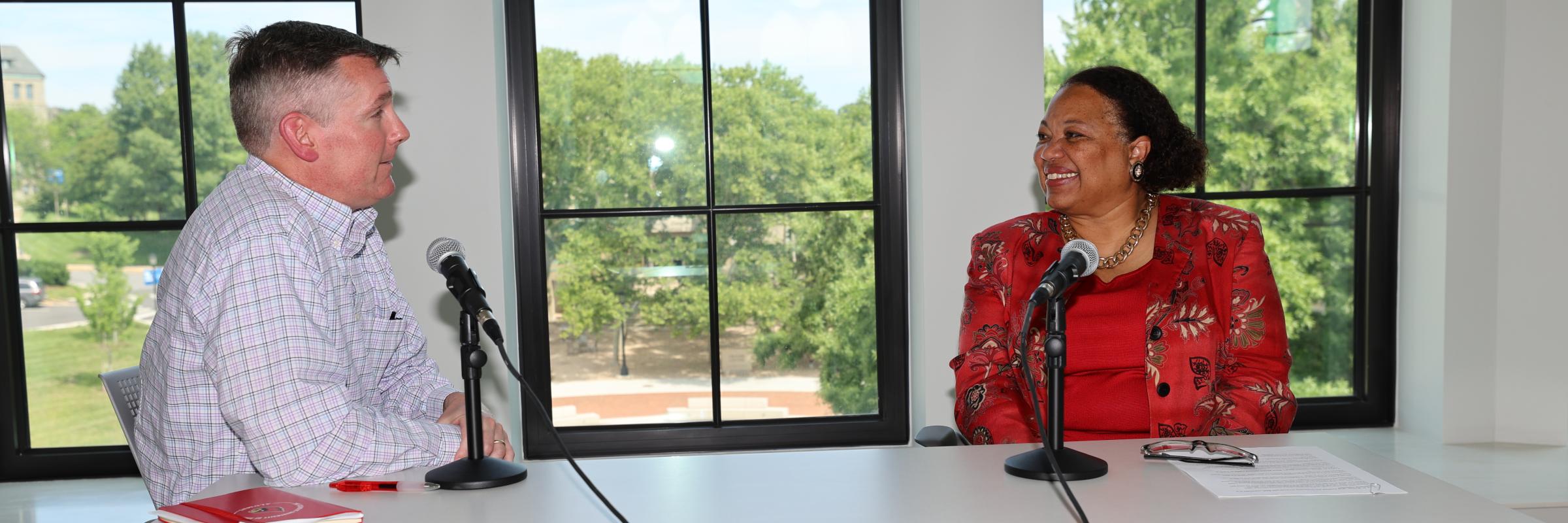
We are excited to feature Robyn De Wees, B.S.E. 1987, chair of the Catholic University Black Alumni Network.
After graduating from The Catholic University of America with a bachelor of science in engineering in 1987, Robyn began her career as a software engineer, eventually rising to the executive level at Northrop Grumman. With more than 30 years of experience in STEM fields, she has made significant professional and volunteer contributions.
A driven and accomplished leader, Robyn has earned several prestigious awards, including the Black Engineer of the Year Award for Corporate Promotion of Education, the Women of Color Award for Exceptional Woman of Color in Technology, the University of Maryland Baltimore County Center for Women in Technology Exemplary Industry Mentor Award, and First Baptist Church of Glenarden STAR Ministry Volunteer of the Year. Her commitment to mentoring and volunteerism has been a key aspect of her impactful career.
Robyn is the founder of O Line Coaching & Consulting, where she specializes in helping individuals and organizations develop leadership capacity. Through her work, she fosters diversity and inclusion by encouraging her clients to think differently, achieve transformative outcomes, and create lasting economic impact. She has built her coaching practice on a deep passion for mentoring, supported by the International Coaching Federation’s Associate Certified Coach certification and Leadership That Works – India Professional Coach certification.
Robyn is the inaugural chair of the Black Alumni Network at Catholic University. She is married to Jerrold Witcher, a fellow Cardinal who graduated with a degree in electrical engineering. They live in Bowie, Maryland.
This conversation is facilitated by Brain Kohler, assistant vice president for alumni engagement and annual giving at Catholic University.
*This transcript is based on an audio recording and has been lightly edited for readability. It reflects the substance of the conversation but may not be a verbatim record.
Brian Kohler
My name is Brian Kohler and I am the assistant vice president for alumni engagement and annual giving here at Catholic University. I’m a proud member of the class 2001. I'm joined today by, or with Robyn De Wees, an engineering degree recipient from the Class of 1987.
Robyn, thank you so much for being here today.
Robyn De Wees
Thank you for the opportunity. I'm glad to be here. This sounds like it's going to be fun.
Brian Kohler
Oh, it's gonna be a great conversation. So, Robyn, could you tell everyone a little bit about yourself?
Robyn De Wees
Sure thing. I spent about 35 years working in the aerospace and defense industry, mostly locally here in the Washington, D.C. area, and I had a very successful career. I started out as a software engineer and worked my way up to an executive role. I spent most of those 35 years at Northrop Grumman. After I retired and I retired early, I knew I wanted to mentor and or coach people, help them with leadership skills and development.
Brian Kohler
Oh that's fantastic.
Robyn De Wees
So I became certified. And I started my own business called O Line Coaching & Consulting. I'm the founder of that organization, and I coach a lot of early career people helping them to prepare themselves for the workplace and to understand themselves better as they strive for their leadership objectives.
The other thing that I do that's almost a full time job is I am the inaugural chair of the Black Alumni Network here at Catholic University.
Brian Kohler
Well, that's an impressive background, especially, when it comes to your mentoring and your leadership. You know, one of the things that we certainly want to do here at Catholic is help all of our students launch themselves and provide mentorships, not just when they're students here, but also as alums as well. So thank you for doing that.
All right I always kick it off, when talking to my fellow alums with what's your favorite Catholic University memory.
Robyn De Wees
So I'm going to share two. The first one I'm obligated to share, but it's actually true. I met my husband here. He graduated from Catholic University as an engineering major a few years before I did. So, one of my most memorable events is meeting him. Now, there's controversy with that too, because we do not agree on how we met, or where we met.
And we've enlisted friends and family and, and most people won't chime in. We've been married for almost 35 years and we have not resolved it yet.
Brian Kohler
That's fantastic. I love that. My wife and I also met here, and we also kind of go back and forth on when did we actually meet? She said, because she was a year behind me, that she actually saw me before we officially met – so a very similar story.
So, many of us have similar stories. But you said there were some other memories you want to share?
Robyn De Wees
If there is a memory, one of my, the most memorable times I had here at Catholic University was playing intramural flag football. It created a passion in me that exists to this day. And, I was invited to participate on a dorm team. I didn't live on campus. I was a commuter. And that meant that I had a bit of a different experience than a lot of people.
So it was nice to be included, to be invited to, to play flag football. And we won every year we played. It taught me a lot about the game so some of my best memories are playing flag football here at Catholic.
Brian Kohler
That's fantastic. And I love the fact that as a commuter student, you also found a way to get involved. You know, when it comes to really having an enriching experience here at Catholic, or any college, it's about involvement.
May I ask what position you play?
Robyn De Wees
I played the offensive line when I was here at Catholic and occasionally the defensive line. So primarily the line – I'm not fast. And I don't like to run a lot. So, give me short distances and a little bit of physicality, and I'm good to go.
Brian Kohler
How fast were you able to see how Catholic University helped prepare you for your life, both personally and professionally?
Robyn De Wees
Very quickly. Professionally, the engineering school provided a rock solid foundation for me in engineering and the way engineers think. Like I said, I started out as a software engineer and made it to an executive level at a fortune 500 company. And I owe a lot of that to Catholic University. I'll use football as another example.
When we talked about inclusion, there's both belonging and inclusion. It was nice. I felt like I belonged because I was invited to the team, but there was a little bit of controversy. There were some women on the team, and at a certain point that felt because I wasn't part of their dormitory, I shouldn't be getting as much playing time or I shouldn't be starting.
Brian Kohler
Wow.
Robyn De Wees
And so they said that to the person who invited me and she had a conversation. She's one of my dearest friends to this day, Maureen Favo. And she said, “Look, you know, the women would like more playing time. So I'm going to pull you to the side.” And I said, “Okay.” Honestly, in the moment it felt some kind of way.
Was it because I wasn't part of the dorm? I really felt included when I was invited and I was playing and getting to know other players. Was it because of my race? Was it because I was too physical? Was there something that I wasn’t doing right? It began to cause me to question things.
So there's this subtle difference between belonging and inclusion that sometimes – particularly if you're part of an underrepresented group – begins to cause you to question yourself. And so you're not showing up fully because you're trying to fit in or you're trying to understand where you have opportunities to improve. Or at least that's the way I felt.
Eventually I got back to my playing time and was a little bit more accepted by the team. I felt, but that's foundational because those are some of the experiences I also had in the professional workplace where I had a degree. I had experience, and sometimes I questioned whether I really was included, whether or not I was really part of the team.
Brian Kohler
What I loved about that is the fact that it took others to really help you feel you belong. Shout out to Maureen for helping you. When it comes to belonging, when it comes to inclusion, every student needs someone else.
Let's talk a little bit about your work in the Black Alumni Network. Its mission, its purpose, and what you love about it?
Robyn De Wees
Sure thing. I think the Black Alumni network is about community building. It's about inclusion. It's about connecting with people. It's about finding your group. You don't have to be a Black alumni. But if there's interest around those things related to Black alumni, Black students, then this is an opportunity for you to get involved.
I think about my experience here at Catholic University. One of the areas and ways that I grew was I met people from different cultures. This had a huge impact on my life with my exposure to the broader world, to international types of initiatives, to being comfortable in international settings. I played a lot of intramural sports. I used to play volleyball with the Arabic students and the Latin students.
They all spoke their native languages. And somehow on the volleyball court, I seemed to understand. And I was the only female, too. There was a real sense that they wanted me there and that I was welcomed. And so there's a big difference when you feel included in activities and events.
Catholic University provided opportunities like that to connect with and meet with people from diverse backgrounds. It really helped me to grow as a human being. Those skills also came into play in the workplace. When I was approached about the Black Alumni Network Board, even before being asked to be the chairperson, I used a coaching technique on myself because I said, “What's my why in this?”
And there's a technique called “expanding the view.” And I looked at participating from my perspective, but also from the perspective of another student who's currently here that maybe looks like me or is an engineer. I looked at it from the perspective of my husband. I looked at it from the perspective of the dog. I mean, I really tried to look at it from different obscure perspectives and write down what I could bring to the table to help this network go forward and in the end, I said, there are a lot of reasons.
My background has afforded me opportunities to be involved in startups. And that's really the way I see this is like a startup business. I want to grow. You want it to be solid. You don't want it to be something that is flailing and after a year or two, it's gone. How do we build a structure that is strong?
And even if we're going in wrong directions, we can course correct. But how do we build something that can grow within Catholic University's community? And that's the reason that I joined. So we're focused on connection. We're focused on community. We're focused on faith. I love the fact that this University is a religious university. We don't have to be apologetic about prayer, about bringing God into the conversation.
And I think that's very much needed now.
Brian Kohler
I completely agree. And as I’m listening to you talk, it’s reminding me of the teaching of Saint Francis of Assisi. Saint Francis always taught that you want to seek to understand.
When you expand your view and you look at things from different people's perspective, you gain a deeper understanding and therefore a deeper connection, which is what the Black Alumni Network is all about.
We're stronger when we understand each other. We're stronger when we expand our view. And, we're stronger when we have groups like the Black Alumni Network. So thank you so much for your leadership there.
Robyn De Wees
You're welcome. It's been a pleasure.
Brian Kohler
What are some of the programming opportunities and actionable items that the Black Alumni Network really takes on?
Robyn De Wees
The Sister Thea Bowman Graduation Celebration was the first event we were involved in, and we partnered with University staff and faculty. And we came together last year and this year to recognize students who exhibited the characteristics of Sister Thea Bowman. So this year there was a nomination process that people could nominate graduating students, based on what criteria they felt these students met that aligned with Sister Thea Bowman.
The students who were honored get a kente cloth. And we see this is not just an event, but it's a rite of passage, part of what we want to do is we want to get the students before they're gone, to let them know your things are changing. This is still your University. You are still needed. There are students who are coming in this new freshman class that you're probably more closely coupled with than any of us.
The memory is still fresh of what it's like for you coming in. So we want to get them before they go into the world and think, “Let me just go ahead and move on. The University doesn't care about me.” That's absolutely not true.
The University cares. The Black Alumni Network cares. The Alumni Association cares. We want these students to stick around. Whatever little bit of time you have to contribute is appreciated. It doesn't have to be hours. It can be simply showing up at an event. It can be a note of encouragement to someone.
One of the events we also had during Cardinal Weekend, the Aubry-LeBuffe Scholarship and Black Alumni Network Reception. It was this year combined for the first time.
Most people aren't aware that Aubry and LeBuffe are two people who attended Catholic University, they worked at the University, and they were also given honorary degrees about two years ago. And there's a scholarship in their name that is geared towards students. A lot of people just aren't aware of who they are, what they contributed, their impact.
For the first time, the Black Alumni Network actually manages that event. And I'll tell you, this is where I kind of broke down at the event when a number of people told me – we've been waiting for this. We've been waiting for a network of Black alumni to come together to have events that highlight some of the accomplishments that we've made or are here to help students to see that there are black alumni who have had just amazing levels of success. Not that it's not talked about, but sometimes you miss it in the mix of communication.
Brian Kohler
In today's world, there are so many things coming at us. It's important to take a pause and pay attention to certain things that are really important.
Robyn De Wees
We give our time and our money to those things that are important to us. So, it was the first time for some that they felt coming together gave them that opportunity. And to just hear people say that to me, as I walked around the room and introduced myself, it was the first time they had come back to campus.
They were waiting to see how they could get involved. And it truly moved me to tears. I was full of emotion and full of joy and in the questions, maybe the doubt of am I doing the right thing? And by making a difference to hear that without soliciting that kind of feedback was key.
Brian Kohler
That's a beautiful moment. I've been in Catholic education for well over 25 years and you have to hang on to those moments. You do question, “Am I doing the right thing? Am I having an impact?” But I think in both of those occasions with celebration and the Aubry-LeBuffe celebration, I think you're really seeing the fruits of your labor.
So I really applaud you for what you're doing.
Robyn De Wees
Thank you. And it's truly a joy. I mean, it definitely honors one of my personal core values is community and family. And when that comes together, I mean, it's just 100% fulfillment. It's 100% that you are in the right place.
And I'll add one other thing that we're doing is mentoring. You know, I heard President Kilpatrick talk about mentoring in various communications, both written and verbally. Dean Brown in the engineering school has talked about mentoring. This is my heart, my passion. And when we started Black Alumni Network, I said, “We will have a mentoring program.” And people came back later and said, “We didn't think this was going to work out. It's just very difficult to do.” But I was determined if we did nothing but we needed to touch the students, this would be a way to do it.
And so we set up a mentoring program through the National Society of Black Engineers. The student chapter here does a great job with engineering. We don't need to worry about that, but it's the softer skills helping the students prepare their resumes, prepare for the interviews, and have an elevator speech. To follow up after going to a career fair, we constructed sessions to talk practicums to talk with students about these skills and connected them with a mentor.
We set up another mentoring program. We called it “Spread Your Wings.” It’s for anyone that's a longer term mentoring program where we meet students and mentors one-on-one.
Part of being an engineer, I'm very process oriented. There are a lot of statistics and tracking that we're doing. But the survey came back and said things like, I can't believe how well I was matched with my mentee. It's like we're the same.
Brian Kohler
Matching is really key.
Robyn De Wees
Absolutely. And the beauty of both of these programs is you don't have to be here.
Brian Kohler
Yes, virtually.
Robyn De Wees
Absolutely, we're reaching back to alumni, who are all across the country, a very diverse group who have stepped up to say they will mentor a student.
Brian Kohler
And they're going to have a direct impact.
Robyn De Wees
I could use up the entire hour with the positive stories that have already come from just this first year.
Brian Kohler
That's awesome. And it's really impressive to see. You know, I think back to when I was a 22 years old, a politics major here at Catholic University, I really could have benefited from that sort of support.
Could you talk a little bit about how alumni get connected with the Black Alumni Network?
Robyn De Wees
There are a couple of ways. One is they can go through you – Brian Kohler – through the The Office of Alumni Engagement at cua-alumni [at] cua.edu or 202-319-6039
Or they can also email me at deweesr [at] cua.edu. You can be on a committee. You can be one of these one of our mentors. You can support an upcoming event. If you have an interest, if you have any part of your heart or your mind that says, “I'd like to do something” – we'll figure it out.
If it's five minutes or five hours, we'll figure out how you can contribute to the organization. We're also on social media. So I hope that with this communication, the social media addresses go out so that you can stay connected and see what we're doing.
Brian Kohler
Thank you for sharing all that. So, let's look to the future. What are your goals for the Black Alumni Network? What's your key objectives in our months and years ahead?
Robyn De Wees
I think you can correct me if I'm wrong here. I think just bringing alumni in general back to any University requires a lot of work. I think that's it.
Brian Kohler
100% it is. Absolutely.
Robyn De Wees
And so there's another factor on top of particularly Black alumni or underrepresented alumni who attended predominantly White universities, there's a little bit of a less desire to come back to their university, even though there are good experiences and bad experiences finding ways and things that are of interest. Again, we'll put our time and money into those things that we are interested in.
So this affinity group of the Black Alumni Network, if we're focusing on things like mentoring and you want to mentor a Black student, we'll find a Black student for you to mentor. We'll help you with anything specific that helps to align you with someone, or something unique, that you think you can bring to the table. So my goal is to bring more people back to the University, whether that's virtually or through support of a program or through financial contributions.
Wherever your heart is, that's what we want to tap into. If alumni think about what it was like and you said this yourself – it's true for all of us. If I had a mentor absolutely. Back in the day, or if I had someone that provided guidance, or if I had additional funding, I could have double majored, gone to grad school, whatever it is – there is something out there that that we’re seeking or that hasn't existed.
And so we're willing to look at whether we can put it into place. I've had people bring up ideas and I've said – go research it. And so they have to do a little bit of work. And sometimes I don't get a follow up phone call, but that’s okay.
Brian Kohler
That only means they've done the research and they realize, “Okay, it's a good idea, but we can't do it.”
You know, bringing alumni back to the University, either physically or even virtually, is so essential. I mean, we've got tens of thousands of alumni, almost 100,000 alumni spread across the globe. It's tough to get them back in a sense, not because they don't value their experience or they don't value the University. But let's face it, our lives are busy.
As we look beyond even the Black Alumni Network, there are so many alumni out there who want to find different ways to get involved and want to maybe even form additional groups, whether it be from an ethnic or demographic perspective, or even industry.
What sort of advice or guidance would you offer to those alumni who want to build out new networks?
Robyn De Wees
If it's important to us, we create our own space. I think for any other group that is interested in doing something, making sure you know your why, and then defining a North Star. For the Black Alumni Network, we sat down, the University gave us a board agreement, and we read through it. And there were a couple of specific things that were activities that were in there.
And then it said, you know, mentorship and fundraising are important. We want you to support the University. Again, helping where it already exists.
I think for any other affinity group, write down what are the things that are most important to you so that those things can always be your North Star.
When you're sitting down and looking at, what do we want to do or why are we doing it? Have it written down because it's easy to be all over the map. It can become difficult because you're spread too thin or you have so many things that are going on. It's tough to manage them. You always want to have a North Star that you're coming back to.
So I think that's the first thing that I would suggest.
Brian Kohler
Mission first, finding your “Why.”
Robyn De Wees
Yeah, and I agree, aligning with the University, with the great set of goals that President Kilpatrick has set up. And there are ways we can support, where we put our little footprint, or a little toe print, into what the University is trying to achieve above that.
Brian Kohler
That is fantastic. And you're right, the University has a great mission.
Well, Robyn, it's been you've been such an inspirational person to talk with about your work with the Black Alumni Network.
Any parting words for our alumni community?
Robyn De Wees
I would follow the Nike slogan and say, “Just do it.”
Find a way to get it. If it doesn't exist, it doesn't have to be big. Each part makes up the body and so you don't have to be everything. If you can just be one part, you're likely going to touch the lives of a student, of someone in the faculty or on the staff, another alumni.
You know, we need it. As alumni, we need support, and we need those systems in place that, like you said – you feel encouraged. We all need that.
Brian Kohler
We need that connection. Absolutely.
Robyn De Wees
I'll leave it with, “Who's waiting for you.”
Brian Kohler
That is literally a mic drop moment, my friend. I mean, really so fantastic.
Thank you so much for the conversation. You're so wonderful. We will be sure to put your contact information out there. And also for all of our alumni, I will put my contact information out there as well.
Again, thank you so much Robyn.
Robyn De Wees
Thank you for having me. I appreciate it.
Published on: Tuesday, June 16, 2026
Tags: Cardinal Perspectives, Alumni Association, Black Alumni Network