

Welcome to Cardinal Perspectives, a series featuring in-depth conversations with alumni, students, faculty, staff and the extended family and community of The Catholic University of America.
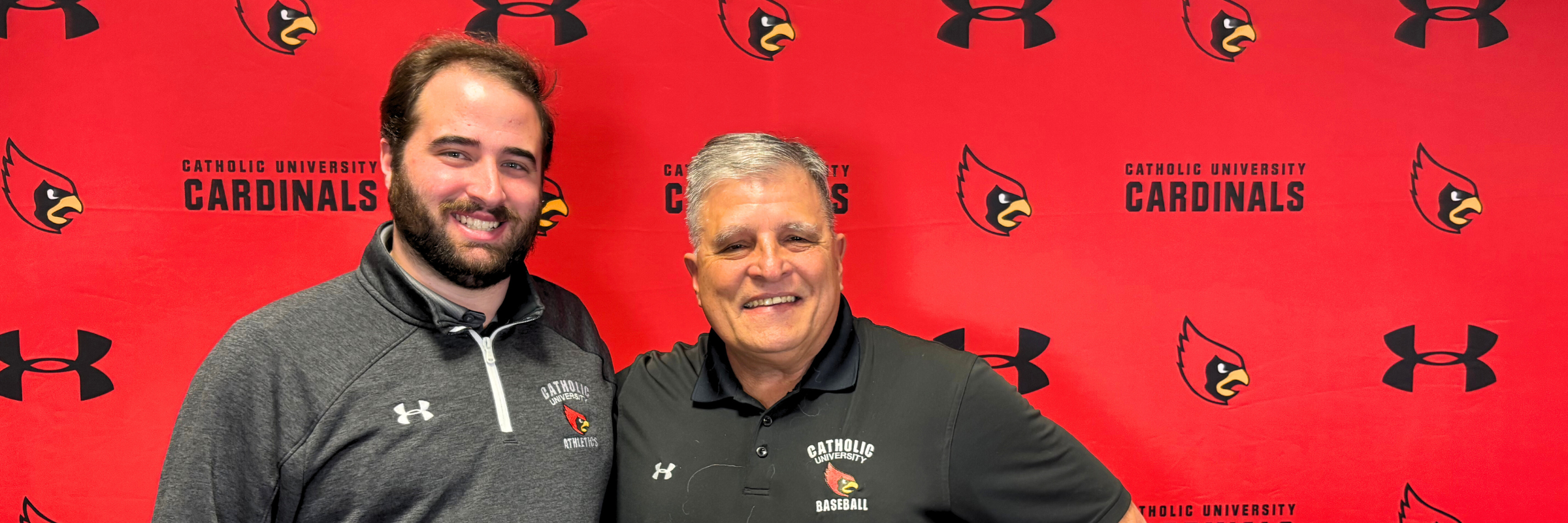
We are pleased to introduce this episode of Cardinal Perspectives featuring Ross Natoli, head baseball coach, and James Higgins, assistant director of leadership annual giving for Athletics. Ross Natoli is entering his 41st season leading Catholic University’s baseball team. A native of Washington, D.C., and a standout outfielder at George Washington University during his undergraduate studies, Ross became the Cardinals' head coach in 1985 and has since guided the team to six Landmark Conference championships and six NCAA Tournament appearances, including a memorable trip to the NCAA Division III World Series.
Under his leadership, Catholic has achieved historic seasons with record win totals and multiple All-America honorees. Coach Natoli himself is in the exclusive club of coaches with more than 800 career victories while remaining at a single institution.
Coach Natoli sits down with us today to discuss highlights from his 40 years at Catholic University, his coaching philosophy, and what’s to come for Catholic University Baseball.
*This transcript is based on an audio recording and has been lightly edited for readability. It reflects the substance of the conversation but may not be a verbatim record.
James
Hello everyone. My name is James Higgins and I'm here with Catholic University Baseball head coach and legend, Ross Natoli. Ross, thank you for joining us today. I appreciate you taking some time.
Ross
Thank you, James. Great to be here with you.
James
You're in your 41st season here at Catholic University, manning the ship for the baseball program. Is there a particular moment that stands out from your time here at the University?
Ross
There are several, but I guess I can't ignore the obvious one, which is that three years ago we made it to the final eight and participated in the Division III Baseball World Series.
It was a special run with a special group of guys. And our goal every year is to try to get as close to that, or get back there.
James
Touching on that a little bit, is there a moment from that run that sticks out? Obviously, winning the Regionals and Super Regionals was awesome, especially after coming back from losing in the Landmark Championship, a great regular season.
Pete Giombetti at the time broke the home run record during the regular season. Is there a moment in particular that stands out to you from that run?
Ross
In our regional, we were at Shenandoah in Winchester, Virginia, and we played our first game to beat Stevens University.
And then the next game, we beat Shenandoah. We had to win one more game, and then of course we lost our next game, and then had to play Shenandoah again for the championship. And in that game, I think we were down four or five runs early on, and I had to go to another pitcher. And Cody Bozak really stepped up and pitched his best game of the year to help us win that game.
We had some great offensive performances too. We had back to back home runs, [Zach] Burton and [Dante] Pozzi and Pete Giombetti swung the bat and Ben Nardi. As always, those guys carried us to the Super Regional at Ithaca.
And again, every time there's postseason play in NCAA Baseball Division I, II, or III; rain is a factor for sure. Every time, whether it’s Conference, Tournaments, Regionals, Super Regionals, or World Series.
We get to Ithaca, and it's basically a two out of three series. The schedule was to play one game Friday, one game Saturday, and the third game if necessary. So we get up there on Wednesday night, and practice on Thursday, and then get ready to tee it up Friday. And then, of course, it's touch and go on the weather. Friday's game was canceled. We get to Saturday. The weather is still not that great.
We were able to get one game in, and the pitcher just pitched a tremendous game against us. I think we ended up losing 4-2 right in that game. Tucker Alch kept us in it. Another All-American player for me that year.
We get to the next game, the next day. We have to play Ithaca for one or two games. If we win, we move on and play a third game. We won the first game and tied the series up 1-1. And in the second game, it was a close game up through the first three or four innings. And then our offense just erupted like never before.
Giombetti, Nardi, Matt Tesoriero, Dante, all those guys. Matt Fisher. Huge hits. We ended up winning that game big. And then Tucker Alch, who just pitched the day before came in to close it as well. So those were some of the special moments during that run.
And then faced some great teams in the World Series for sure, with Marietta and Wisconsin-Stevens Point.
James
I love the attention to detail, too. You have a great recall of everything that went on.
Ross
Some things are easier to forget than others for sure. Some things you can't forget.
James
You mentioned some great names. I was in school at that time. It was my senior year and I was friends with a lot of those guys. That was an unbelievable run that you guys went on. You played your best baseball at the best time, and saved your best for last.
Ross
That's really what it's about. If you can prepare to be successful, to prepare to the best of your ability to play your best baseball when it means the most. And guess what, that's almost every game. So if you don't get in the habit of having that outlook, you can't expect it to just happen.
You've got to make it happen. And it's how you prepare day in and day out that makes that difference.
James
Let’s talk about another thing that's been instrumental for the program, especially over the last few years. The Diamond Project, the upgrade to the turfing and lights on the University's baseball and softball fields, has recently concluded. What impact does this have on the program and the current team overall as a whole?
Ross
The majority of the Diamond Project finally finished June 1, 2025. We didn't play any home games last spring because our facility was under construction. The project was, in essence, completed in June.
As soon as it was completed, our guys flocked to it. Even though it was summertime, everybody wanted to get on it. So this fall has been mine, my coaching staff, and our team's first experience with the new facility and its turf. We also upgraded our bullpens and dugouts to have double bullpens, double batting cages, and we're still finishing some renovations on our dugouts.
Our fall season and practices, they were pretty much like coaching another sport. You could get in so many more reps. The energy was so much higher. Practice efficiency, practice effectiveness, planning for practice, intrasquads, and playing more.
That's how you get better as a team and as a program. We couldn't have done it without tremendous alumni support for that project, both for the lights, which we got three years ago, and for the turf project. We're super grateful and want to try to leverage our new facility to keep our program on an upper trajectory.
James
And one of the hallmarks of a great program is having turf and having lights. You can do a lot of practice. And that is a huge step up for not only the program, but for the athletics department as a whole.
Ross
It gives us so much more flexibility in practice and in player development. As a coaching staff we really only care about two overall things for our team.
One, the overall student athlete experience. Are guys making the adjustment to Catholic University? Are they having a good experience? Are they having a good time? Are they being successful in the classroom? Are they taking advantage of all the opportunities Catholic University has to offer, and by virtue of Catholic being in Washington, D.C.? We want to make sure that all that happens. Guys have a good time doing it. I want them walking out of class and looking forward to coming to practice and playing.
And then our next real emphasis is on player development. It's not just who has the best recruiting class every year that absolutely determines how far that any given team goes; it's player development. How much better can you make players once you recruit them and get them into Catholic University? How much better can you make them as athletes and as student-athletes?
Those two areas have always been our main focus.
James
With that, what strategies do you use to help your current players strive as both athletes and as individuals?
Ross
We try to work very closely with every player. First and foremost, to make sure in their chosen major, or even if they change majors, that we’re providing one-on-one support. Making sure they're succeeding academically. We try to show our players that one of the skills you've just got to learn when you get to college, if you haven't learned it sufficiently before, is communication.
Communication with us, communication with your teammates, communication with your professors, communication with your administrators, communication with your family. We try to make sure guys, first and foremost, are successful academically.
Baseball's a lot more fun when you're doing well in school. That's first and foremost with us. We provide our own study halls and also communicate closely with the professors for every one of our players to make sure they're succeeding.
We get reports on progress during the semesters as well. And we try to just imbue our core values on our team, and hope they buy in as much as possible. We're all about trying to be the best version of ourselves, the best version of our team, day in and day out.
Leave no detail by the wayside, leave no stone unturned, because if you prioritize those little things, eventually you give yourself a chance to be successful. It doesn't necessarily mean it's going to happen as far as wins and losses or in a given game. But if you don't do things the right way every day, whether it's here, when you're at the DeFour Center, on Talbot Field, on campus, or off campus, you're going to give yourself a chance to be as successful as you possibly can be. And we want to make sure we constantly remind guys, that's really the baseline to be successful. And that's great for life as well, not just for playing college.
If you're going to play a sport in college, the idea is the lessons that you learn by virtue of the commitment, the dedication, the time consumption that it takes to be successful and to play a sport at a very high level. And I'd like to think we compete at the highest levels of Division III baseball in the country.
If you're going to do that, you have to have the elements that are going to help you succeed. And that's where we try to support our guys.
James
Going off of that, what values or attitudes are most important to you in shaping the culture of the team?
Ross
First and foremost, trust. We have to trust each other. The coaches have to trust each other, the team has to trust us, we have to trust the players. We have to earn their trust, they have to earn our trust. We have to trust the work that we do. If you're going to make the commitment and to try to participate and be successful at a very high level of competitive college athletics, there's a lot of trust involved.
Then it's really got to be about the “we have to be greater than the me.” It's a team first mindset, you've got to have that. You truly have to find guys who want the team to succeed even more than they succeed individually.
That’s not easy to do, but that's when you really have something special, right? When it is a true team first mindset and then there's attitude and effort. Every day we want you to give your best. Obviously when you're here at practice, when we're developing you, competing games, we want you to compete the fullest.
We want you to do the same in the classroom, and in other aspects of your career development. We want to prepare you for that so that you can be successful long after you graduate from Catholic University, right?
Accountability, respect, communication all have to be in play. Accountability to coaches, accountability to players, accountability to each other. Respect for your teammates, respect for your coaches, respect for your professors, your administrators, all those that you encounter. Are you doing the right thing all the time? Even when nobody's looking, even when you're away from us?
Those are the kind of guys we want in our program. We want high character, lower maintenance guys, not high maintenance, low character. That's who we strive for. That's a core fundamental of our recruiting, as well.
And then again, you want to have a good time doing all this. Have a good experience, or why do it, both for players and coaches? I'm blessed to have a great coaching staff and I care about their development and the experience they're having, as well.
James
That's a great answer. And I think it encompasses everything you've been about in your 41 years here, which is awesome.
Another question I wanted to ask: you've seen a lot during your time here. Could you highlight a way that alumni have really connected and partaken with the program or a way alumni can give back?
Ross
For me, it started during my college days or even back in high school because I knew and played with quite a few guys that attended Catholic University.
I played baseball when I was at George Washington University. Back then our fall seasons were totally different than what they are now. The NCAA allows us, now, to play one date against somebody else in our fall season, our non-traditional season.
When I first started coaching here and when I was in college, we'd play 15 to 20 games in the fall. Go figure, the weather is the best time of the year during the fall in the DMV, in the Washington area. My relationship with alums started when I was playing and coaching at GW.
We were playing Catholic. Bob Talbot was the baseball coach here at Catholic at that time. I was fortunate to be able to coach his sons in high school for a couple years. After I graduated from GW, I coached there for about three years and I helped out at Gonzaga for a couple years.
I came to Catholic University, and knew a lot of guys who were alumni here. And right off the bat, when I started coaching here, starting with Bob Talbot and all the players that played for him and that were so loyal to him, they showed that same loyalty to me. So we were able to get off on a good foot.
Eventually when we came here, we did not have a fence. We did not have dugouts, we had just aluminum benches. We had to replace all that and upgrade to eventually get a fence. That was a huge deal. Eventually we got dugouts in 1995. We got indoor batting cages. And then we kept going, because we know the elements of having a quality facility so guys can have quality experience here, and we can develop them as players. The facility aspect of things is a key element of that.
And 2006, 2007, we did some major renovations to our field. We got our grandstands, we got a netting backstop upgraded, our field leveled it off, things like that.
That was 18 years ago. And then ever since that time, we play baseball in the third week of February through the first week of May in the Washington, D.C. area. We play 40 games in that timespan in our regular season.
Whether you're a high school team or a college team, we all need artificial turf fields to level out the impact that weather can make on playing your season. So getting lights, getting turf has been a big priority even since the early 2000s. And it finally came to fruition here, the last three or four years.
James
That's awesome. Especially through some great alumni help, like you mentioned earlier. From those connections that you made all the way back, even before you were at Catholic University, which speaks to the connection of our community.
Ross
Thank you.
James
Something else I wanted to touch on recent success was last year's Landmark Conference Championship.
You went to the World Series in 2022, but you got an at-large bid to the tournament. And you went through the tournament that way, winning the Regionals and Super Regionals. You guys had, at the beginning of the Landmark, won every few years. And then 2018 was your last Landmark Championship prior to last year, and you came back. You guys got in as a lower seed, and you ended up rattling off multiple wins in the Conference tournament to win it all.
Talk about that run a little bit and what that meant to you in your 40th season to win the Landmark again.
Ross
I used to playfully tease our guys from the 2019 through 2024 classes, “what's the deal?”
The easy way to get the postseason play is to do well, get in your tournament, compete well in the Landmark, find a way to play your best baseball, and win it. We got close in those last six years, but just couldn't pull off the actual Landmark Championships.
This past year, I thought we competed pretty well for not playing any home games at all. We were road warriors the whole year. Had our ups and downs. Honestly, probably a little bit above 500 about the halfway point of our season. And then we really banded together to get into the tournament and then, played our best baseball when it meant the most.
The easiest way to win your tournament is to win your first three games, and that's what we did. We beat Wilkes. We won the regular season, and then we ended up beating Scranton twice. It was a special run with tremendous performances.
Sam Fairhurst has had a tremendous run in our tournament and leading up to our tournament, to get us in there and do well. Our other pitchers really stepped up when it meant the most. And, we had some guys that had really special years. Steve Thomas, Dante Pozzi, Matt Fisher, Zach Burton… It was guys like who really carried us and who were core to our success the last four or five years.
James
You've mentioned a lot of names here. One thing I wanted to touch on, which has been more of a recent development, is sending guys to the Division I ranks, especially after graduation.
You touched on Dante, you touched on Steve Thomas, Pete Giombetti, Matt Tesoriero, Tucker, Ben… What does that mean to you and what does that symbolize to the program that, upon graduation for a fifth year, you guys are sending, not just one or two guys, but have sent multiple guys to the Division I ranks? What does that signify as a program and the development of the plan?
Ross
Another player that's currently playing is Joe Marini at Seton Hall. We currently have four guys who used to be on our team playing at the Division I programs. Honestly, my preference is if there was a way I could have convinced them to come back and run it back with us, that would've been the ideal. But, once you graduate and have given me four years and in today's climate of the transfer portal, I get it.
I think it really speaks to our player development approach and how we make players better, right? As mentioned, we focus on teaching players how to become not only technically better, but how to really compete and succeed.
That's a credit to, first and foremost, Coach [Bobby] Picardo and the rest of my coaching staff, Ethan Risse, Kyle Kingsbury, Will Wikner, my new grad assistant this year has hit the ground running with us. And we have other former players like Ben Nardi and Jesse Lacefield in the coaching realm with us, as well.
So that speaks to the player development aspect of things, and I'm telling you that the highest levels of Division III baseball in this country aren't that much different on the field than a lot of low and even mid-level Division I programs. That's one of our mantras we use in our recruiting.
I probably have eight to nine guys that could have been at a Division I program on any given year, the reason they chose us was all the things that Catholic University offered. Again, the student-athlete experiences, getting a good degree… that really means something.
The professional development opportunities, balling out the best that you can, and being the best baseball player that you can. And then having a darn good time doing it.
James
I've got two more quick ones for you. The first one – what's on the horizon overall for Catholic Athletics and what do you think will make a big impact?
Ross
Facilities are important. To always push the envelope to make your facility better for the sake of the student-athletes that participate in sports here. Our new athletic director, Kevin Robinson, has a lot of experience from many different places: St. Mary's, Mount St. Mary's, etc. He brought just so much energy since he came here.
But we've had a lot of administrators who have been around the block, and have really fought those battles day in and day out. Folks like Megan McDonough and Jaime Walls have been building blocks to the success of this athletic department. They've been the foundation as much as any of the administrators here.
And then our communication with the rest of the University from the department. It's important to get the support from all the way up to the University President, who understands the value of athletics and what it brings to this University.
Facilities are a big part of it, but whatever can contribute to the well-being of our players, our student-athletes, and the student-athlete experience. That's really the trajectory I see a Catholic University moving.
James
And the last one, you've been here for 41 years. What was your long-term vision for Catholic Baseball when you started, and how have you achieved that? What's your vision going forward?
Ross
What really got me into coaching was the experience that I had playing. Being fortunate to play college baseball and being in that arena. The close relationships that you make competing at a very high level, balancing academics and athletics, getting it done, those friendships, those relationships that you formed back then.
I'm still pretty close friends with quite a few guys that I played with in college and guys that I coached in college, both at George Washington and here at Catholic University. My head coach from GW, Mike Toomey, is someone who I'm still very good friends with, and who I still have interactions with on a fairly regular basis a few times a year.
He made it fun and he made me feel important. From a coaching perspective, when you see how other coaches do it, how programs do it, and you look at the technical part of coaching… I just thought I could do it better than a lot of programs, teams, and coaches I observed. So I just wanted to jump into it and give it the world. Bob Talbot convinced me to come over to Catholic University and Fred O'Connor gave me that opportunity, our athletic director back in 1985. I was so excited to get the opportunity.
I really didn't have a predetermined place to be in 5, 10, 15, 20, 40 years. Every year I just have a discussion with my wife, Nancy. We have three kids, and they're all beyond the college age now, but it just comes down to a discussion and a decision made every year asking, “why do I want to come back? What are the elements? What are the things that attract me to coming back?” And there's been enough to keep me going year to year, and that's why I do it.
Coaching is a privilege, it's not a right. Playing college athletics is a privilege. It takes a village to support a young man to be able to participate at the college level in any sport. And you've got to remember every day that it is a privilege to even be in a position to, hopefully, make a positive impact on a young man's life.
I think that's the main element in my coaching philosophy that keeps me coming back. I'm the lucky one that has this opportunity to make an impact. And I'm doing the best I can to make it positive.
James
Definitely. Thank you Ross. This was great. Thank you all for joining us today and go Cards.
Ross
Thank you, James.
Published on: Friday, February 6, 2026