

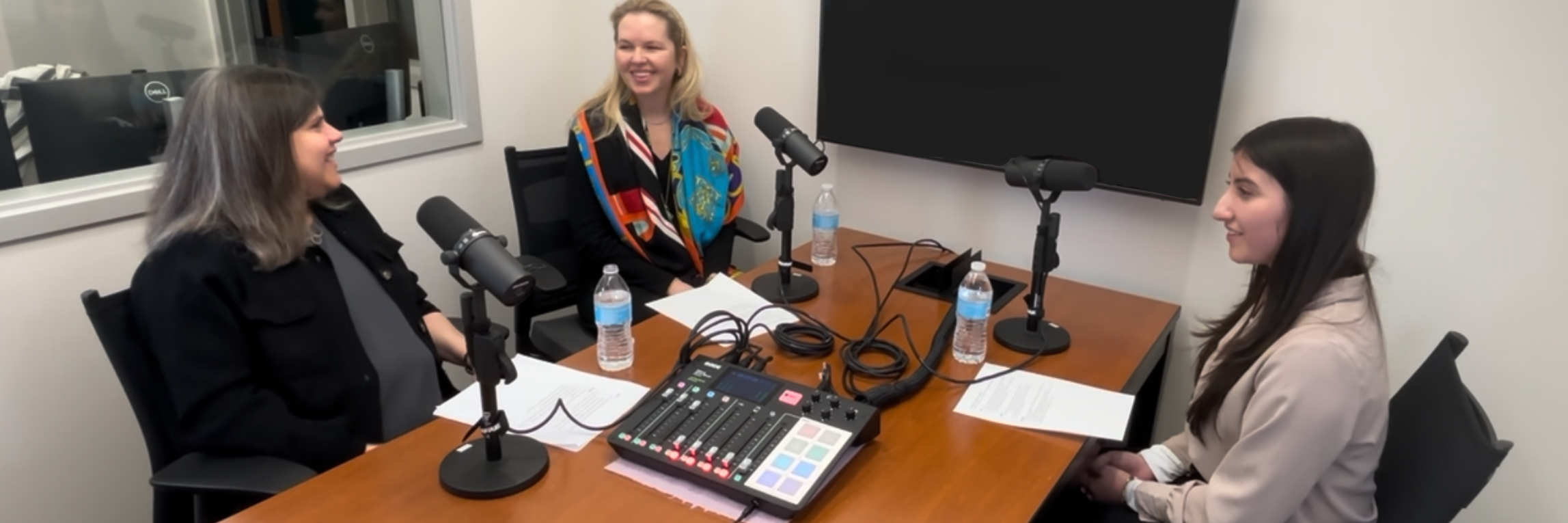
Cardinal Perspectives is a series featuring in-depth conversations with alumni, students, faculty, staff and the extended family and community of The Catholic University of America. We are delighted to introduce this episode featuring Stacy Brustin, Ashley Fealsey, and Stephanie Villalobos.
Stacy Brustin is Director of the Immigration Law and Policy Initiative and Professor of Law Emerita at The Catholic University of America, where she teaches on forced migration law and human rights, leads pro bono service trips to the U.S. southern border, and founded the Immigrant and Refugee Advocacy Clinic. Previously a staff attorney at Ayuda, she created programs supporting immigrant survivors of domestic violence and continues to serve on Ayuda’s Advisory Council. Stacy is also a member of the ABA Commission on Immigration and publishes widely on immigration, family law, and access to justice, bringing decades of experience in advocacy, litigation, and education to her work.
Ashley Feasley is the Legal Expert in Residence at the Immigration Law and Policy Initiative at the Columbus School of Law. She brings extensive experience in immigration and refugee policy, having served in senior roles at the White House National Security Council, U.S. Customs and Border Protection, the U.S. Conference of Catholic Bishops, and several leading nonprofit organizations. Ashley has taught at both Fordham University School of Law and Catholic University's Columbus School of Law.
Stephanie Villalobos is a third-year student at the Catholic University Columbus School of Law. She is the treasurer of the Women’s Law Caucus and has participated in the Spring Break Service Trip, assisting detained individuals with intake forms, translation, and bond request applications. Stephanie has served as a student attorney at Catholic Law’s Immigrant and Refugee Advocacy Clinic for nearly four semesters, held internships at immigration law firms, and volunteers with the Spanish-speaking community in Maryland.
*This transcript is based on an audio recording and has been lightly edited for readability. It reflects the substance of the conversation but may not be a verbatim record.
Stephanie
Hi, Stacy and Ashley.
Stacy
Hi, Stephanie.
Stephanie
How are you doing today?
Stacy
Pretty good. It's fun to have the tables turned right. Usually you're in the classroom with us talking.
Stephanie
I know. It's a new experience. Thank you so much for being here. So Stacy, I would like to begin by asking you some questions. What is the Immigration Law and Policy Initiative at the Columbus School of Law?
Stacy
The initiative is a relatively new project that we're very excited about having here at the law school. It really originated out of our direct services clinic, the Immigrant and Refugee Advocacy Clinic. In the clinic, as you know, since you've worked in the clinic, we represent individual clients in their immigration cases, which is critically important work.
Stephanie
Absolutely.
Stacy
We realize though, that in addition to providing direct services and in part because of the experience we have on the ground in the clinic, it would be really important to complement that with more systemic advocacy work and to use the resources of the University to conduct research on immigration and refugee issues to do more conferences and projects that resulted in community education. And so that formed the incentive to start the Immigration Law and Policy Initiative. The initiative itself advances teaching, research, and advocacy on the issues of immigration, particularly forced migration and ensuring that the right to seek refuge is protected.
Stephanie
Great. That's wonderful to hear. What would you say is the difference between the policy initiative and a law clinic?
Stacy
With our policy initiative, we still involve students. Students are a really important part of what we do, but rather than representing individual clients, they work with us to do bigger research projects.
For example, right now we are undertaking a project to look at the impact of mass and indiscriminate enforcement policies on children, families, and communities. And so we have law students that are working on background research. We're going to be conducting surveys of faith-based organizations around the country, and Ashley can talk more about that. She's really taking the lead on it.
The students are gonna be helping us collect the data, analyze the data, and we're going to be finishing that project up with a fact finding report based on our research. So the students definitely get involved.
And we're very fortunate because this is our first year with a legal expert in residence, Ashley Feasley. She can tell you more about the work she's doing, but that's something else that our project allows us to do that maybe the clinic doesn't have the capacity to do because they're so busy on individual projects – it's to tap experts in the field. In Washington, D.C., we have incredible talent. Ashley is here as our first expert in residence using her policy background, her experience in government and nonprofit organizations to help us do the research and the advocacy work that we want to do.
And I think one of the unique things that's also different from the clinic is that our goal is not to do this work on our own. It's to partner with other organizations, right? So to partner with faith-based organizations, secular organizations, and work in collaboration in order to initiate policy change or court reform, or to engage in community education.
We feel that, as a law school and as a University, we have a lot of resources that we can offer to these organizations. And all the work is really in service of the Church's position on immigration and the way that really dovetails with the due process issues that we work on in the law school.
Stephanie
I think that's incredibly important for students. It's a new experience for sure. Is this a year-long program? Is it a semester?
Stacy
It's not really a course in that sense. What we do is we offer research fellowships for students. We are trying to encourage and start more courses in the area of immigration and refugee law so students are taking courses. I'm teaching a course right now on forced migration law and policy, and Ashley's teaching a course as well that she can describe. And so we have more students involved in this work. And then we also, in collaboration with the clinic, since they are one of our partners, we sponsor and lead a spring break legal services trip. And it's been just about every year.
Students apply to participate. The law school generously sponsors the program so that all students can participate. I know you're familiar with it because you went to Albuquerque and El Paso last year. So that's another way that students get involved in our work.
And, in addition to trying to help the community and to fight for the human dignity and rights of immigrants and refugees, we have a second “agenda,” which is to encourage students to get into immigration law and refugee law, either as full-time careers or on a pro bono basis, because there are so many pro bono opportunities.
Stephanie
Yeah, there are. Why did Catholic Law decide to pursue a program like this?
Stacy
As I mentioned, I can say that students were very interested in this issue. At one point there was a petition to start an immigration clinic years ago, and that's why I took the step of trying to begin the immigration clinic program. There's a lot of interest.
And then if you look at the mission of the University and the mission of the Catholic Church and right now we really see it, on the ground taking such a strong position in terms of protecting the human rights and dignity of immigrants and refugees. And so that mission really aligns with the law school's obligation to pursue justice, ensure access to justice, and ensure that the rule of law is followed and due process is followed. So it was really a perfect match.
Stephanie
That's nice to hear the background on that.
What do you think puts the Columbus School of Law in the unique position to offer a program like this?
Stacy
Again, similar to what I was just saying, this idea of focusing on issues that are at the confluence of law and Catholic social teaching principles, I think makes us uniquely suited to do this work.
There are other organizations working on forced migration issues, but I think this pairing of fighting for due process and the rule of law alongside principles such as protecting the dignity of each human being, protecting the right to liberty and to raise a family, the rights to family unity, the obligation to welcome the stranger and accompany people, that all matches up with our interest on the legal side on these issues. And particularly on issues such as border policy or detention policy, making sure that, while a country has the right to protect its sovereignty, that it's done in the service of the common good, that it's done with compassion. And I think that's really part of the mission of the law school and the University.
Stephanie
I definitely say it gives students an all encompassing view of immigration and immigration law.
Ashley, hello.
Ashley
Hi. Nice to be with you here today.
Stephanie
Thank you for being here. So turning to you now. As the legal expert in residence, what drew you to the initiative?
Ashley
I first just want to say it's been a wonderful experience here, being welcomed into the community at Catholic University and at the law school in particular.
My kind of exposure – I'd had the opportunity to adjunct before, but I think particularly what drove me to the initiative is my work with Stacy, with Professor Brustin. We had an opportunity to collaborate together, in part of what I think Stacy mentioned about collaborating with other Catholic organizations, when I worked at the US Conference of Catholic Bishops. We were able to do some cross-cutting research on unaccompanied children and provide some interesting data, but also some recommendations as it related to their care in government custody.
It was just a really wonderful opportunity for me. And when the opportunity came to think about collaborating again and being able to come and work interdisciplinary here, I jumped at the chance. I think it's truly a great chance to promote interdisciplinary immigration law and its intersection with policy, particularly in today's times.
Stephanie
That's great. I think it's also such an interesting course for students to take in the current time, as you said.
Tell us about what projects you're currently working on with ILPI.
Ashley
Stacy – Professor Brustin, I still call her Professor Brustin.
Stephanie
Me too.
Stacy
It's time to call me Stacy.
Ashley
I think it's a good move. Anyways, we are working on a project that is looking to examine the impacts of mass and indiscriminate deportation on families and children and also service providers. And one of the very exciting cross-cutting elements about this is the ability to work with the National Catholic School of Social Service – the school of social work – and other partners to really leverage and flex the best elements of the University setting to dive into this question.
We are very privileged to be able to focus on faith-based providers, knowing that they are doing so much more across the country than just providing legal services, per se. They are providing access to food. They are providing spiritual support in the form of religious access. And so it’s really a chance to look into that, to see those impacts and highlight them. So that's one initiative.
Another thing I do really want to highlight is we're also going to be working with other partners on a narrative project that talks about engaging Catholics to share their family migration story and what that meant to them in terms of what they know about their story, what they know about how it relates to them being Catholic or living here in the United States as a citizen or a resident. That's also a really important and exciting project that we are looking to do to help share and remind people of their commonalities, but also learn more about our country's very complex and layered history with immigration itself.
Stephanie
It is so important to know the different layers as you've mentioned, because there are and we're still learning about them, as we go. At least as a student, I am.
What background do you have that lends itself to this type of work? You touched on it a little bit.
Ashley
Sure. I'm an immigration attorney. I used to think of myself as a baby immigration attorney, I don't think that label counts anymore. But in the field of immigration law, we're always all learning, which is another reason why I think the law school here is so well-equipped with the clinic.
I worked for the US Conference of Catholic Bishops on their migration policy work and we did a lot of work around some of the programming that Catholic organizations had, like refugee resettlement, working with unaccompanied children, and legalization.
I also had the chance to work in the federal government. I worked for the Biden administration and I worked in various branches including the Department of Homeland Security, Health and Human Services, and then at the White House.
So it's been very much an education in every place I've gone. But it's been helpful, I think, to give some perspectives of that real intersection between immigration law and the policies that kind of inform and sometimes ultimately shape our laws and how they're applied.
Stephanie
That's very interesting to get your perspective because it seems like you've been everywhere, in different places.
Ashley
That's kind of you to say. Thank you.
Stephanie
You're welcome. How does the initiative support the University's overall mission and vision?
Ashley
I'm a Catholic, I'm a cradle Catholic. And I think it's so wonderful to see this exciting level of activity at the Bishop's university.
We recently saw the Bishop's pastoral message on immigration and how united the Catholic Church is about this issue. I feel that this work really aids to the mission, but also, again, leverages on the amazing skills of professors, research staff, and then students like yourself who are here and want to learn more about this and contribute in the future.
Stephanie
That's wonderful. What is in store for the future of ILPI?
Ashley
It is a continuation of some of the work that we've described, but also a continuation of promoting efforts for students and former students to be involved, whether it's in a clinic, an open house with people talking about their kind of work, or sponsoring an externship.
Also, looking for ways for individuals to share things like the narrative project, and promote larger understanding of the U.S. immigration system, the policy implications, and then the teachings that we have, particularly as it relates to the Catholic Church on this issue.
Stephanie
That's great to hear. I think that'll be a wonderful experience for incoming students to really take advantage of. I guess for me, I'll be gone by then, but I'm still excited
Ashley
But we still want you to come and hang out. And do the things we're talking about.
Stacy
Yes. And I’ve heard from several alums. I just heard from one yesterday who said she's not practicing in the area of immigration law, but she is really concerned about some of the inhumane enforcement practices and other things that are going on right now. And she's like, “What can I do? Can I volunteer in some way?” So we're going to come up with some ideas for alumni to participate, as well.
But it would be great to hear more about your experiences. And you've participated in the Immigration Law and Policy Initiative in a couple of different ways, as well as the clinic. Can you tell folks a little more about that?
Stephanie
I will start off with my clinical experience if that's okay, because I began with that experience here. I did [the Immigrant and Refugee Advocacy Clinic] in my fall semester of my second year, and it was really memorable.
It's definitely a one-of-a-kind experience that I'm glad Catholic Law offers, not just what we learn about current immigration policies and the different immigration processes in general – asylum, primarily. But it's also the relationships that I've been able to establish within working on the cases that I've been assigned, and getting to have that one-on-one experience with clients is truly one-of-a-kind.
I think that has reinforced my desire to want to pursue the immigration field, and I'm very grateful for that opportunity. I can definitely go into more specifics about the clinic, but I will say that I've been there for a very long time now – five semesters – because I worked there over the summer too. And it's just been nice to really continue with the clients I’ve worked with – some from the start- – and get to know them as individuals outside of their processes as well.
Stacy
And what skills would you say you developed through that experience since you have had an opportunity to work on a number of cases?
Stephanie
I would say first, being organized and timely. You have deadlines for certain things, for applications and for tasks you need to get done with clients, I would say patience, as well, just because you're going through somebody's story a day at a time. You're taking time, you're really getting to know them, and it's a slow process in the sense of, you're not going to know everything in one day. You continue forming that relationship with them.
I would also say being empathetic, knowing how to communicate with them. We are offered trauma-informed training, so I think that's been critical to my learning. Not just for my professional development, but as a person as well. Those are skills I will definitely carry with me past law school.
Stacy
And any other experiences outside of the clinic?
Stephanie
I was able to participate in the spring break trip that you discussed earlier. That's been, I would say… it's a bittersweet experience in the sense that it's incredibly sad. But for me, wanting to go into this field of work, I felt like it was needed.
Stacy
So where did you go and what kind of work did you do?
Stephanie
We went to Albuquerque for a few days and we visited a detention center there. We were there with a law center. We were able to fill in intakes for clients who were in this detention center, learn about their experiences, not just in their home country, but in the detention center itself and the terrible conditions that they were going through.
And then in some cases, we helped translate. I know a few of my peers and I, we translated in Spanish for some clients or some individuals who were detained. I had one particular case where somebody spoke French and no one else could communicate with that person, so it was nice for me to be able to address his needs and communicate with him.
Stacy
In French?
Stephanie
In French, yes.
And after that we went to El Paso and we did a lot of work with parole requests. That was also a very eye-opening experience. Unfortunately, the requests we had sent were denied. But we still got to learn how to assemble a request and we still were able to meet new people and discuss with them. But like I said, it's a sad experience in general, but you just learn and gain so much from the hands-on part of that trip that you get.
And then also Professor Brustin's course: forced migration. I definitely was interested in taking that course, and I took that before going on the spring break trip.
I think it's such a critical course in general because you're not just taught the processes. It's like an extension of the clinic. It was so nice to have had the clinical experience before and then to have gone on to take Professor Brustin's forced migration course. I had prior knowledge, so I wasn't going into it not knowing much.
She teaches you so much about the current law, about where it all began. I remember the treatises and everything that we learned about human rights law itself. So that was also incredibly crucial to my learning.
And the assignments that we were able to do. We were able to apply what we learned to real world experiences, to new experiences apart from asylum and those processes. We could do activities and there are other types of situations that came up. Professor Brustin always tries to give us new exposure to different things, so I appreciated that for sure.
Ashley
I think that's so key. I remember myself in law school and the professors I was most drawn to were those that made those kinds of real life connections from what was on the books to what was going on in the world or what would be next steps and what I was going to do as a lawyer.
And I will just tell you, I think when it works out like that, it's amazing. And particularly interesting for you to be able to do that in the area of immigration, because it is so front and center now, and likely in the future when we think about future reforms and other things. So it’s a really great opportunity. And it sounds like the two of you clearly have had a lot of time together on these different issues.
Stacy
Do you feel like there's interest among the students on these topics? And what are some of the opportunities that you think students should be aware of in addition to some of the things you've already talked about?
Stephanie
I would say yes, there's definitely interest. I've made friends with people who are also pursuing the same pathway that I would like to go.
The school offers plenty of opportunities. The three we just mentioned, having speakers like Ashley. I was able to see you in my second year and hear you speak. That was wonderful.
Also, the student organizations that we have. The Immigration and Refugee Interest Society, for example. And LALSA [Latin American Law Students Association] has events that highlight immigration law, as well.
There are many different areas and opportunities that the school offers, for sure. And that hopefully helps influence more people to want to pursue immigration law. And I always try to advocate for all of our different programs, especially the ones that I've been a part of.
Stacy
And hopefully you'll be able to do that as an alum as well.
Stephanie
Yes, of course.
Stacy
Shortly. So what are your plans for after law school?
Stephanie
I will say my long-term plans will likely be to hopefully be an immigration attorney and potentially working for a nonprofit.
I don't really know exactly where I would see myself, but just somewhere with immigration law, a place where it's really needed. And that's really what I want to do moving forward.
Stacy
One thing that's so important is for you to stay in touch. One of the things we spend a lot of time on is helping connect students to job opportunities, getting our students out there all over the country doing this kind of work in different ways. Some might be immigration lawyers going to immigration court, others might be specializing in family law, but they have an understanding of immigration so they can see where the implications are for both areas. Others may be doing policy on the border.
And as you're well aware right now, there are more opportunities than ever, unfortunately, to be advocating and pursuing justice in this area. So we're really excited to keep up and hear what you're doing down the road.
And to be in when we're, like I said, we're trying to rope in our alumni and keep them connected.
Stephanie
Of course. And if there's ever a student who would love to get more insight, I'm always happy to speak with anyone about all the programs we've offered and the spring break trip. Anything I can help with when it comes to talking to someone.
Stacy
That's great. Thanks, Stephanie.
Stephanie
Yeah, you're welcome. Thank you both.
Ashley
Thank you. Great opportunity to hear about you and all the things that you've done in this field to prepare.
Published on: Thursday, February 26, 2026